The Week in Review: April 6, 2026
It’s Not Just Oil—Key Commodities That May Soon Be in Short Supply
Oil has captured much of the attention amid the conflict in the Middle East. While a limited number of tankers are transiting the region, the Strait of Hormuz is largely blocked, disrupting nearly one-fifth of the world’s oil supply. But it’s not simply oil. Let’s look at three other key commodities that originate from the region.
About one-third of the world's helium comes from Qatar and flows through the Strait of Hormuz, according to the United States Geological Survey (USGS). It’s not simply party balloons that are affected. Helium is essential in the production of computer chips.
“Currently in our own domestic economy, helium is more valuable than foreign oil because it’s used to cool the processing of semiconductors and there is no substitute for it,” said Todd Schoenberger, CIO at CrossCheck Management.
A prolonged shortage could have a significant impact on semiconductor manufacturing.
Where does the world’s helium come from?
· 44% United States
· 34% Qatar
· 10% Russia
· 6% Algeria
· 6% Other
Source: USGS, Reuters, 2025
The world’s supply of fertilizer is being impacted by the war. Countries exposed to disruptions account for nearly 50% of global exports of urea—a widely used nitrogen fertilizer—and about 30% of global ammonia exports, according to the US Farm Bureau.
Though the US does not directly import large quantities of fertilizer from the Middle East, fertilizer markets, like oil, respond to price movements in the region. Lower global crop yields would likely lift food prices if the Strait remains blocked for an extended period.
Persian Gulf Coast countries produced about 6 million metric tons of aluminum in 2025, representing about 9% of global aluminum output, according to the International Aluminum Institute.
The damage from last week’s attack on Emirates Global Aluminum and Aluminum Bahrain's facilities is still being assessed, according to the companies and S&P Global.
The US relies on imports for about 60% of aluminum, USGS data shows (Reuters). Gulf nations accounted for 22% of US aluminum imports last year. Because aluminum is used early and repeatedly in production chains, price increases can propagate quickly.
Key point: Aluminum is not a niche metal. It is a cost base for large parts of the economy, including autos, packaging, construction, machinery, electronics, and power transmission.
Clearly, the world is interconnected, and what happens in one region can ripple through global supply chains. But we are also mindful that we may not be having this conversation in a few months. Most observers, including the president, believe the war will end shortly.
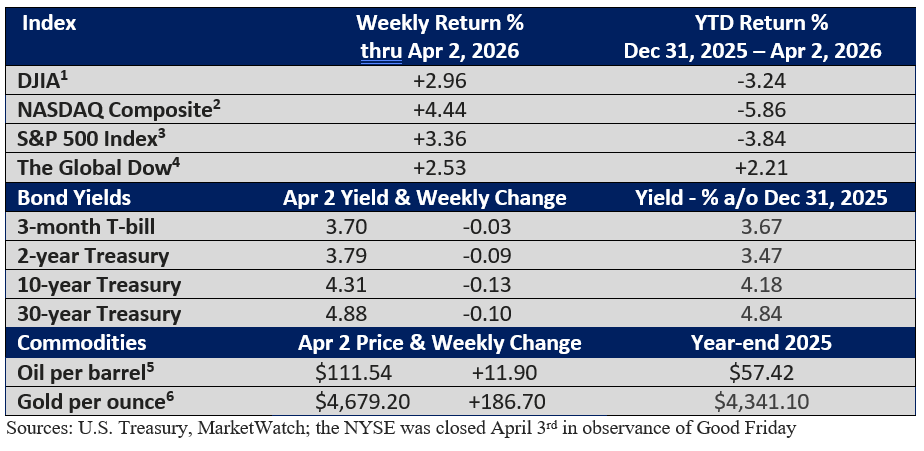
Market Summary
Two FOR THE ROAD
The bull market we’re currently living in is in year four, which, historically speaking, is typically quite strong. Assuming the bull market doesn’t end (by definition, a -20% decline), the average return of the 4th year in a bull market is +14.6% with a 85.7% win rate since 1950. - Ryan Detrick, March 24, 2026
Whenever gold has fallen by more than -10% in one week, it has never been higher 12 months later… and observing the performance of the S&P500 12 months later, after each of these instances, the stock market has been higher 100% of the time. - FundStrat, March 23, 2026
I hope you have a wonderful week!
Warmest Regards,
Bill Stordahl, CFP®
Managing Director
Stordahl Capital Management
A Weekly Perspective on Planning and Markets
Each week, we share The Week in Review — a short collection of articles on
financial planning and wealth management, along with a brief overview for context.
One email per week. No promotions, no sales – just clarity.
Stordahl Capital Management, Inc is a Registered Investment Adviser. This commentary is solely for informational purposes and reflects the personal opinions, viewpoints, and analyses of Stordahl Capital Management, Inc. and should not be regarded as a description of advisory services or performance returns of any SCM Clients. The views reflected in the commentary are subject to change at any time without notice. Nothing in this piece constitutes investment advice, performance data or any recommendation that any particular security, portfolio of securities, transaction or investment strategy is suitable for any specific person. Any mention of a particular security and related performance data is not a recommendation to buy or sell that security. Advisory services are only offered to clients or prospective clients where Stordahl Capital Management and its representatives are properly licensed or exempt from licensure. No advice may be rendered by Stordahl Capital Management unless a client service agreement is in place. Stordahl Capital Management, Inc provides links for your convenience to websites produced by other providers or industry-related material. Accessing websites through links directs you away from our website. Stordahl Capital Management is not responsible for errors or omissions in the material on third-party websites and does not necessarily approve of or endorse the information provided. Users who gain access to third-party websites may be subject to the copyright and other restrictions on use imposed by those providers and assume responsibility and risk from the use of those websites. Please note that trading instructions through email, fax, or voicemail will not be taken. Your identity and timely retrieval of instructions cannot be guaranteed. Stordahl Capital Management, Inc. manages its clients’ accounts using a variety of investment techniques and strategies, which are not necessarily discussed in the commentary. Investments in securities involve the risk of loss. Past performance is no guarantee of future results.
1. The Dow Jones Industrials Average is an unmanaged index of 30 major companies which cannot be invested into directly. Past performance does not guarantee future results.
2. The NASDAQ Composite is an unmanaged index of companies which cannot be invested into directly. Past performance does not guarantee future results.
3. The S&P 500 Index is an unmanaged index of 500 larger companies which cannot be invested into directly. Past performance does not guarantee future results.
4. The Global Dow is an unmanaged index composed of stocks of 150 top companies. It cannot be invested into directly. Past performance does not guarantee future results.
5. CME Group front-month contract; Prices can and do vary; past performance does not guarantee future results.
6. CME Group continuous contract; Prices can and do vary; past performance does not guarantee future results.