Why Portfolio Balance Matters During Market Pullbacks
Global tensions and rising oil prices have been shaking up stock markets lately. Oil prices climbing back above $100 per barrel raise concerns that higher energy costs could slow the economy and push up inflation. On top of this, investors are also watching things like artificial intelligence's impact on businesses, overall market valuations, and what the Federal Reserve (the U.S. central bank) might do with interest rates. It's natural to wonder whether your portfolio is holding up.
When markets move up and down with every news headline, it can feel like you need to constantly adjust your investments. But a key idea in financial planning is that a well-built portfolio is designed to handle different market conditions without needing constant changes. The goal is to hold a good mix of investments that work together and match your long-term financial goals.
Market pullbacks are a normal part of investing
Stock market dips happen regularly and are part of long-term investing
Markets have been uneven this year, with the S&P 500 (a broad measure of U.S. stock performance) sitting about 5% below its all-time high from January, as of mid-March. Drops of this size are actually quite common. In a typical year, the market sees several declines of 5% or more before bouncing back. In 2025, for example, there were six such dips, mostly driven by tariffs, yet the market still finished the year with an 18% total return.
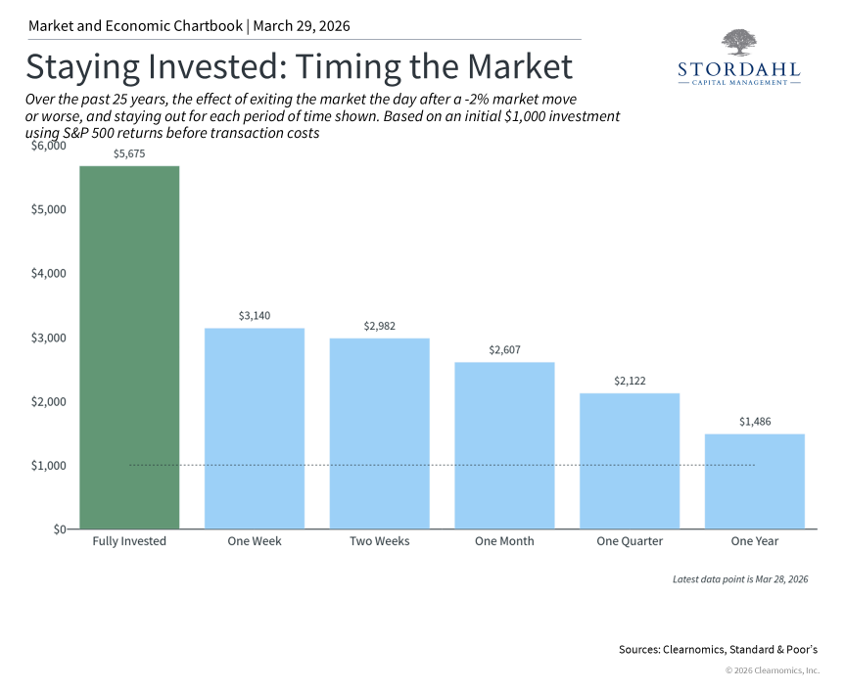
This is why staying invested has historically worked well for long-term investors. Trying to "time the market" — selling before a drop and buying back before a recovery — is very difficult. The chart here shows that even missing just one week of trading after a volatile period can hurt long-term results, because the market's best days often follow its worst days. Investors who stepped aside missed out on the very recoveries they were hoping to capture.
Bond yields offer attractive income compared to the past decade
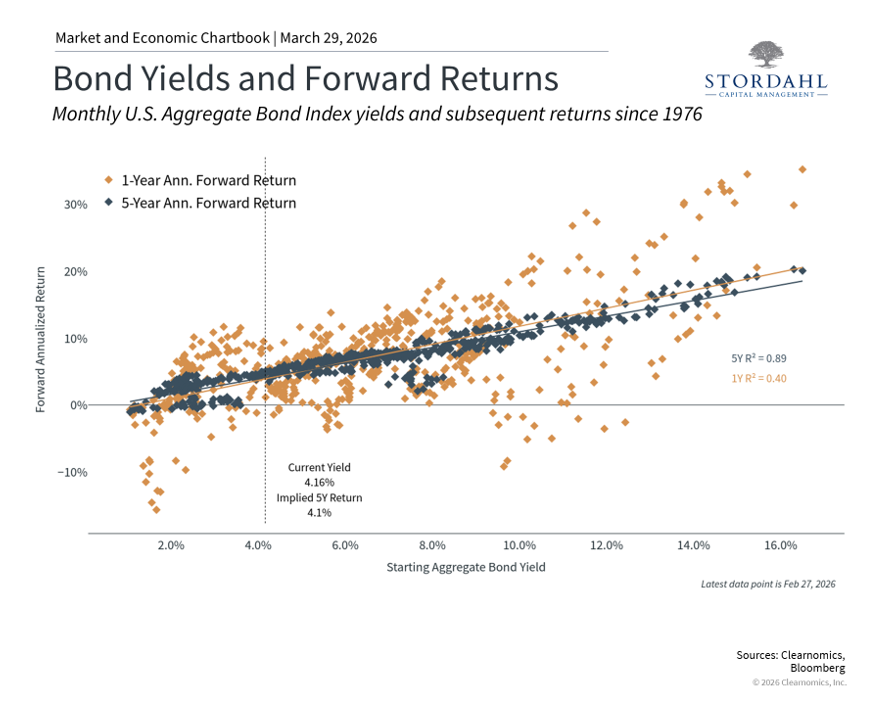
Bonds — which are essentially loans investors make to governments or companies in exchange for regular interest payments — are an important part of a balanced portfolio. They often move differently from stocks, helping to cushion a portfolio during rough patches. The 10-year U.S. Treasury yield recently climbed back above 4.2%, and the broad bond market index currently yields 4.5%, well above the 2.9% average since 2009. Higher yields mean more income potential for investors today than was available for much of the past decade.
Cash may feel safe right now, but after accounting for inflation (currently between 2.5% to 3%), cash savings are actually losing purchasing power. For example, $10,000 in a certificate of deposit earns only about $155 a year, which falls short of inflation. A proper allocation to bonds remains a better way to generate income and support long-term growth.
A diversified portfolio helps smooth out the bumps
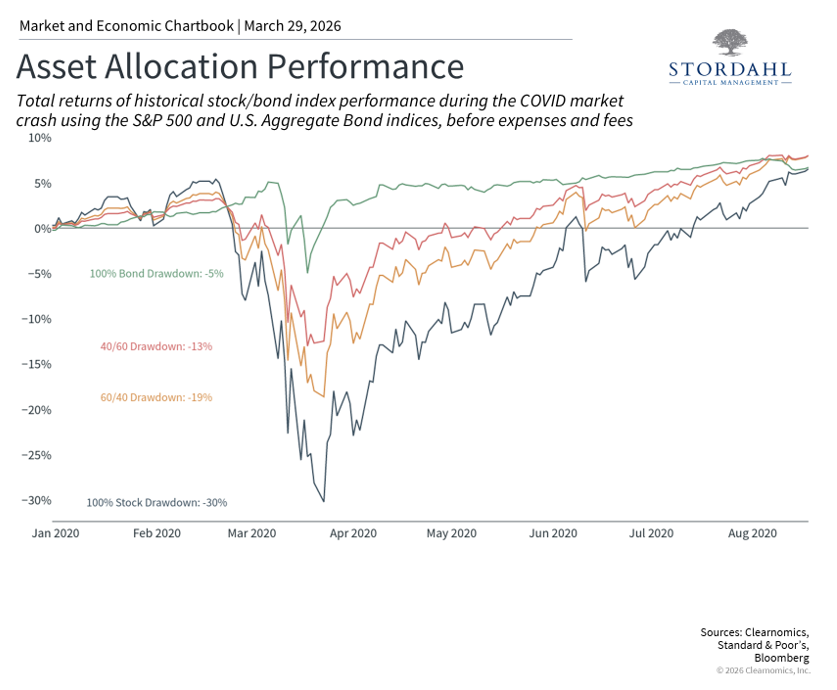
Holding a mix of different investments — such as stocks, bonds, and commodities (physical goods like oil or gold) — helps reduce the impact of any single market moving against you. The chart here looks back at the pandemic-driven volatility in 2020. Portfolios that were more evenly spread across different asset types experienced smaller swings. This matters because smaller drops are easier to stay calm through, reducing the urge to sell at the wrong time.
Today, commodities like energy and precious metals are performing well. But this isn’t about guessing which investment will win next — it’s about holding a broad range of investments so that when one area struggles, another may help balance things out. Over time, this approach supports growth while managing risk.
The bottom line? Market volatility driven by oil prices and geopolitical uncertainty is uncomfortable but not unusual. Staying invested with a diversified portfolio remains the best way to turn short-term swings into long-term progress.
Questions? We offer a complimentary 15-minute call to discuss your concerns and explore how we can assist you.
A Weekly Perspective on Planning and Markets
Each week, we share The Week in Review — a short collection of articles on
financial planning and wealth management, along with a brief overview for context.
One email per week. No promotions, no sales – just clarity.
Stordahl Capital Management, Inc is a Registered Investment Adviser. This commentary is solely for informational purposes and reflects the personal opinions, viewpoints, and analyses of Stordahl Capital Management, Inc. and should not be regarded as a description of advisory services or performance returns of any SCM Clients. The views reflected in the commentary are subject to change at any time without notice. Nothing in this piece constitutes investment advice, performance data or any recommendation that any particular security, portfolio of securities, transaction or investment strategy is suitable for any specific person. Any mention of a particular security and related performance data is not a recommendation to buy or sell that security. Advisory services are only offered to clients or prospective clients where Stordahl Capital Management and its representatives are properly licensed or exempt from licensure. No advice may be rendered by Stordahl Capital Management unless a client service agreement is in place. Stordahl Capital Management, Inc provides links for your convenience to websites produced by other providers or industry-related material. Accessing websites through links directs you away from our website. Stordahl Capital Management is not responsible for errors or omissions in the material on third-party websites and does not necessarily approve of or endorse the information provided. Users who gain access to third-party websites may be subject to the copyright and other restrictions on use imposed by those providers and assume responsibility and risk from the use of those websites. Please note that trading instructions through email, fax, or voicemail will not be taken. Your identity and timely retrieval of instructions cannot be guaranteed. Stordahl Capital Management, Inc. manages its clients’ accounts using a variety of investment techniques and strategies, which are not necessarily discussed in the commentary. Investments in securities involve the risk of loss. Past performance is no guarantee of future results.
Copyright (c) 2024 Clearnomics, Inc. All rights reserved. The information contained herein has been obtained from sources believed to be reliable, but is not necessarily complete and its accuracy cannot be guaranteed. No representation or warranty, express or implied, is made as to the fairness, accuracy, completeness, or correctness of the information and opinions contained herein. The views and the other information provided are subject to change without notice. All reports posted on or via www.clearnomics.com or any affiliated websites, applications, or services are issued without regard to the specific investment objectives, financial situation, or particular needs of any specific recipient and are not to be construed as a solicitation or an offer to buy or sell any securities or related financial instruments. Past performance is not necessarily a guide to future results. Company fundamentals and earnings may be mentioned occasionally, but should not be construed as a recommendation to buy, sell, or hold the company's stock. Predictions, forecasts, and estimates for any and all markets should not be construed as recommendations to buy, sell, or hold any security--including mutual funds, futures contracts, and exchange traded funds, or any similar instruments. The text, images, and other materials contained or displayed in this report are proprietary to Clearnomics, Inc. and constitute valuable intellectual property. All unauthorized reproduction or other use of material from Clearnomics, Inc. shall be deemed willful infringement(s) of this copyright and other proprietary and intellectual property rights, including but not limited to, rights of privacy. Clearnomics, Inc. expressly reserves all rights in connection with its intellectual property, including without limitation the right to block the transfer of its products and services and/or to track usage thereof, through electronic tracking technology, and all other lawful means, now known or hereafter devised. Clearnomics, Inc. reserves the right, without further notice, to pursue to the fullest extent allowed by the law any and all criminal and civil remedies for the violation of its rights.