
2026 Medicare IRMAA Brackets: How to Reduce Your Medicare Surcharges
If you are enrolled in Medicare, your 2026 premiums may be determined partly by how much money you earned in 2024. That can be an unpleasant surprise, especially if you have since retired and your income is considerably lower.
The reason is something called IRMAA, which stands for Income-Related Monthly Adjustment Amount. IRMAA is an additional charge added to Medicare Part B and Part D premiums when your income exceeds certain thresholds.
For retirees with substantial retirement accounts, investment portfolios, or pension income, these surcharges can add thousands of dollars to annual healthcare costs.
What makes IRMAA particularly frustrating is that Medicare generally looks back two years when determining your premiums. Your current income may have little resemblance to the income Medicare is using.
At Stordahl Capital Management, we believe IRMAA deserves a place in every retiree's tax and income planning discussions. Understanding how these surcharges work, when you can request a reduction, and how your financial decisions affect future premiums can help you avoid unnecessary expenses without sacrificing more important financial objectives.
What Are the 2026 Medicare IRMAA Brackets?
Medicare Part B helps cover physician services, outpatient care, and certain other medical expenses. Part D provides prescription drug coverage.
The standard Medicare Part B premium for 2026 is $202.90 per month. However, individuals and married couples whose income exceeds certain thresholds must pay additional monthly surcharges.
For 2026, Medicare generally uses your modified adjusted gross income, or MAGI, from your 2024 federal income tax return.
For IRMAA purposes, MAGI generally consists of your adjusted gross income plus tax-exempt interest income.
If your 2024 MAGI exceeded $109,000 as a single filer or $218,000 as a married couple filing jointly, you will generally pay more for Medicare Part B and Part D in 2026.
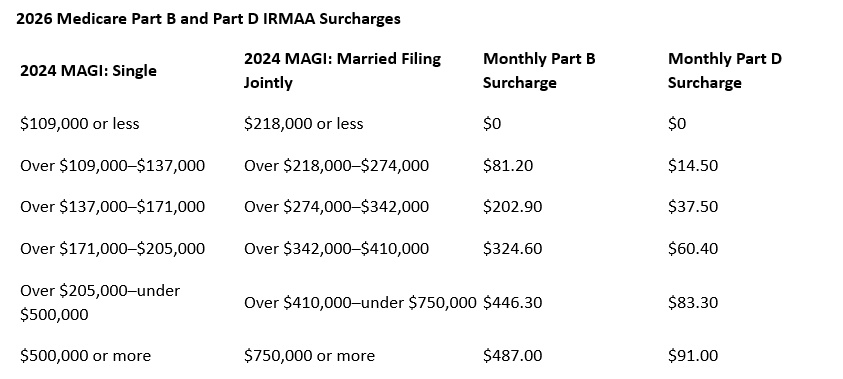
These amounts are additional charges, not your total Medicare premiums. The Part B surcharge is added to the standard $202.90 monthly premium, while the Part D surcharge is added to your prescription drug plan premium.
For married couples who are both enrolled in Medicare, the surcharges apply separately to each spouse.
There are also special IRMAA rules for married individuals who file separate tax returns, which are not reflected in this table.
How Much Could IRMAA Cost a Married Couple?
Consider a married couple whose 2024 modified adjusted gross income was $300,000.
Each spouse would pay an additional $202.90 per month for Medicare Part B and $37.50 per month for Part D.
That amounts to $480.80 per month for the couple, or $5,769.60 annually.
And that is on top of their regular Medicare premiums.
Now consider a couple whose 2024 income exceeded $750,000.
Each spouse would pay an additional $487 per month for Part B and $91 per month for Part D.
For the couple, that amounts to $1,156 in additional monthly Medicare costs, or $13,872 annually.
For retirees who have accumulated substantial savings, these expenses may be manageable. But that does not mean they should be ignored.
We believe the more important question is whether those costs could have been anticipated or reduced through better planning.
Why Does Medicare Use Income From Two Years Ago?
Medicare generally relies on the most recent federal income tax information available from the IRS.
For 2026 premiums, that usually means your 2024 tax return.
This two-year lookback creates an obvious problem for people who have recently retired.
Imagine someone who retired in early 2025 after a successful career. Their 2024 income included a full year of salary, bonuses, and perhaps investment gains.
Today, that person's income may be substantially lower.
Yet Medicare may still calculate 2026 premiums using the income earned during the final years of employment.
This is one reason we encourage clients to think about Medicare well before they reach age 65.
Retirement planning involves more than deciding when to stop working and how to replace a paycheck. It also requires understanding how the timing of income, withdrawals, and investment transactions can affect taxes and healthcare expenses.
Fortunately, Medicare recognizes that certain life changes can make an older tax return a poor reflection of your current financial circumstances.
Can You Appeal Medicare IRMAA After Retirement?
Yes. If you recently retired and your income has declined significantly, you may be able to request a reduction in your Medicare IRMAA surcharges.
The Social Security Administration allows individuals to request a new determination when certain qualifying life-changing events cause a reduction in income.
Retirement is one of those events.
For example, suppose you retired in 2025 after earning $350,000 in 2024.
If your income is now substantially lower, you may be eligible to have your Medicare premiums recalculated using a more recent estimate of your income rather than the higher income reported on your 2024 tax return.
The request is generally made using Form SSA-44, Medicare Income-Related Monthly Adjustment Amount: Life-Changing Event, provided by the Social Security Administration. This form allows eligible individuals to request a new determination of their Medicare premiums following retirement or another qualifying life-changing event.
Other qualifying events can include marriage, divorce, the death of a spouse, loss of pension income, and certain losses of income-producing property.
The form and instructions are available through the Social Security Administration.
We have also prepared a more detailed explanation of the process in our article, How to Appeal IRMAA: A Step-by-Step Guide to Lowering Medicare Premiums.
A Medicare premium notice is not necessarily the final word if your financial circumstances have changed.
However, not every decline in income qualifies for relief. A reduction caused solely by investment losses, for example, generally does not meet the definition of a qualifying life-changing event.
The reason your income changed matters.
How Roth Conversions Affect Medicare IRMAA
Roth conversions are among the most valuable tax planning strategies we evaluate for clients approaching or already in retirement. Our article, Should You Convert Your Traditional IRA to a Roth?, explores the broader considerations when deciding whether a conversion makes sense.
Moving money from a traditional IRA to a Roth IRA can create long-term tax benefits, particularly for retirees who expect future tax rates to be higher or want to reduce future required minimum distributions.
However, the amount converted generally increases your taxable income in the year of the conversion.
That higher income can also increase your Medicare premiums two years later.
A Roth conversion completed in 2026, for example, could affect your Medicare premiums in 2028.
Does that mean you should avoid Roth conversions?
We do not believe so.
A Roth conversion that creates a temporary IRMAA surcharge may still provide substantial long-term benefits. The conversion could reduce future taxable withdrawals, improve the tax treatment of assets left to heirs, or provide more flexibility when managing retirement income.
The mistake would be evaluating the conversion based solely on the income tax owed in the year it occurs.
We prefer to consider the broader financial consequences, including future tax brackets, required minimum distributions, Medicare premiums, and estate planning objectives.
Sometimes spreading conversions over several years produces a better result. Other times, accepting a higher Medicare premium for a year may be a reasonable trade-off.
The right answer depends on the entire financial picture.
Can Capital Gains Increase Medicare Premiums?
Yes. Realized capital gains generally increase your modified adjusted gross income and can push you into a higher IRMAA bracket.
This can become particularly important when retirees sell appreciated investments in taxable brokerage accounts.
Perhaps you are selling a concentrated stock position, rebalancing your portfolio, or raising cash for a major purchase.
A substantial capital gain could increase your Medicare premiums two years later, even if your regular retirement income has not changed.
The effect can be particularly frustrating when a relatively small amount of additional income moves you into the next IRMAA category.
Unlike a graduated income tax bracket, IRMAA applies a specified surcharge once your income exceeds the applicable threshold.
That means exceeding a threshold by a small amount can trigger the higher monthly surcharge.
We believe large investment sales deserve a broader analysis than simply calculating the capital gains tax. The Medicare consequences should be considered as well.
That does not mean avoiding a sensible investment decision solely to remain below an IRMAA threshold. But when there is flexibility in the timing or amount of a transaction, that flexibility can be valuable.
How Required Minimum Distributions Affect IRMAA
Required minimum distributions, or RMDs, are another common reason retirees encounter higher Medicare premiums.
Once you reach the applicable RMD age, you generally must begin taking annual distributions from traditional retirement accounts.
Those withdrawals typically increase your taxable income.
For retirees with substantial IRA balances, the resulting income can be significant.
That can create an ongoing challenge: larger required distributions may push income into higher tax brackets while also increasing Medicare Part B and Part D premiums.
This is one reason we encourage clients to consider the long-term implications of accumulating substantial balances in tax-deferred retirement accounts.
Planning opportunities may include Roth conversions during lower-income years, coordinating withdrawals from taxable and tax-deferred accounts, and using qualified charitable distributions when appropriate.
The objective is to manage taxes and related expenses over the course of retirement, rather than focusing exclusively on minimizing taxes in a single year.
Can Qualified Charitable Distributions Help Reduce IRMAA?
For retirees who are charitably inclined, qualified charitable distributions can be especially valuable.
A qualified charitable distribution, or QCD, allows an eligible IRA owner who is at least age 70½ to transfer funds directly from an IRA to a qualifying charity.
When the requirements are satisfied, the distribution is generally excluded from taxable income.
For retirees who are subject to required minimum distributions, a QCD can also satisfy all or part of the annual RMD.
Because a properly executed QCD generally does not increase adjusted gross income, it may help reduce or avoid future IRMAA surcharges.
Consider someone who already gives $15,000 annually to charitable organizations.
Rather than withdrawing $15,000 from an IRA and then writing a personal check to charity, a direct qualified charitable distribution may produce a better tax result.
For eligible retirees who already support charitable causes, we believe QCDs deserve serious consideration.
They can allow you to support organizations that matter to you while potentially improving the tax efficiency of your retirement income.
Why the IRMAA Income Thresholds Matter
One of the more frustrating features of IRMAA is the way the income brackets work.
If your modified adjusted gross income exceeds a threshold, you generally become subject to the higher surcharge.
Consider a married couple whose income is close to the next IRMAA threshold.
They may be contemplating a Roth conversion, realizing investment gains, or taking an additional retirement account withdrawal.
A relatively modest increase in income could cause both spouses to pay higher Medicare premiums.
That is why we believe IRMAA should be considered before major financial transactions, rather than after the tax return has been filed.
Still, it is important to maintain perspective.
We would not recommend sacrificing a sound investment strategy or a valuable long-term tax planning opportunity merely to avoid a Medicare surcharge.
Sometimes paying additional Medicare premiums is part of a strategy that produces a better overall financial result.
The objective is to understand the trade-offs before making the decision.
Frequently Asked Questions About Medicare IRMAA
What income does Medicare use to calculate IRMAA in 2026?
Medicare generally uses your 2024 modified adjusted gross income to determine your 2026 IRMAA surcharges. For this purpose, MAGI generally includes adjusted gross income plus tax-exempt interest income.
What are the 2026 income limits for avoiding IRMAA?
For 2026, individuals with 2024 MAGI of $109,000 or less and married couples filing jointly with MAGI of $218,000 or less generally avoid IRMAA surcharges.
Can I appeal IRMAA if I recently retired?
Yes. If retirement or another qualifying life-changing event significantly reduced your income, you may be eligible to request a new determination from Social Security using Form SSA-44.
Do Roth conversions count toward Medicare IRMAA?
Yes. Roth conversions generally increase taxable income and can affect Medicare premiums two years later. A conversion completed in 2026 may affect your Medicare premiums in 2028.
Do capital gains count toward IRMAA?
Yes. Realized capital gains generally increase modified adjusted gross income and may move you into a higher IRMAA bracket.
Can qualified charitable distributions help reduce IRMAA?
Potentially. Properly executed qualified charitable distributions are generally excluded from adjusted gross income, which may help eligible retirees manage future Medicare surcharges.
Are IRMAA surcharges permanent?
Not necessarily. IRMAA is generally recalculated annually using updated income information. Your surcharge can increase, decrease, or disappear as your income changes. Certain qualifying life-changing events may also allow you to request a new determination sooner.
Our View: Medicare Premiums Belong in Your Retirement Financial Plan
For many retirees, healthcare is one of the largest recurring expenses in retirement. Yet income-related Medicare surcharges often receive little attention until an unexpected premium notice arrives.
We believe that is too late to begin thinking about them.
The most effective approach is to incorporate IRMAA into your annual tax planning, especially during the years surrounding retirement.
That means understanding how today's income may affect Medicare premiums two years from now, evaluating the consequences of major financial transactions, and knowing when a change in circumstances may qualify you for relief.
It also means keeping IRMAA in perspective.
Avoiding every surcharge is not necessarily the goal. Sometimes a financial strategy that increases Medicare premiums temporarily can still produce a better long-term outcome.
At Stordahl Capital Management, we believe retirement planning should focus on the decisions that help you preserve your financial security while making the most of the wealth you have accumulated.
Managing Medicare premiums is one part of that process.
If you are approaching Medicare eligibility, have recently retired, or received an unexpected IRMAA notice, we welcome the opportunity to discuss how these rules fit into your broader retirement plan. You can schedule a complimentary 15-minute call.
A Weekly Perspective on Planning and Markets
Each week, we share The Week in Review — a short collection of articles on
financial planning and wealth management, along with a brief overview for context.
One email per week. No promotions, no sales – just clarity.
This material was written in collaboration with artificial intelligence (ChatGPT) and derived from sources believed to be correct.
Stordahl Capital Management, Inc is a Registered Investment Adviser. This commentary is solely for informational purposes and reflects the personal opinions, viewpoints, and analyses of Stordahl Capital Management, Inc. and should not be regarded as a description of advisory services or performance returns of any SCM Clients. The views reflected in the commentary are subject to change at any time without notice. Nothing in this piece constitutes investment advice, performance data or any recommendation that any particular security, portfolio of securities, transaction or investment strategy is suitable for any specific person. Any mention of a particular security and related performance data is not a recommendation to buy or sell that security. Advisory services are only offered to clients or prospective clients where Stordahl Capital Management and its representatives are properly licensed or exempt from licensure. No advice may be rendered by Stordahl Capital Management unless a client service agreement is in place. Stordahl Capital Management, Inc provides links for your convenience to websites produced by other providers or industry-related material. Accessing websites through links directs you away from our website. Stordahl Capital Management is not responsible for errors or omissions in the material on third-party websites and does not necessarily approve of or endorse the information provided. Users who gain access to third-party websites may be subject to the copyright and other restrictions on use imposed by those providers and assume responsibility and risk from the use of those websites. Please note that trading instructions through email, fax, or voicemail will not be taken. Your identity and timely retrieval of instructions cannot be guaranteed. Stordahl Capital Management, Inc. manages its clients’ accounts using a variety of investment techniques and strategies, which are not necessarily discussed in the commentary. Investments in securities involve the risk of loss. Past performance is no guarantee of future results.