
The Week in Review: October 12, 2026
Rising Treasury Yields Are Pushing Mortgage Rates Higher
If you have been following mortgage rates, you have probably noticed that borrowing costs have moved sharply higher in recent months. For prospective homebuyers, that means larger monthly payments. For homeowners considering refinancing, it means fewer opportunities to lower their borrowing costs.
The primary driver is the rise in Treasury yields, particularly the yield on the 10-year U.S. Treasury note.
Although mortgage rates and Treasury yields do not move in perfect lockstep, the 10-year Treasury serves as an important benchmark for pricing 30-year fixed-rate mortgages. When investors demand higher yields on Treasury securities, mortgage lenders generally need to offer higher rates as well.
We have seen that relationship play out throughout 2026.
Earlier this year, the average 30-year fixed mortgage rate fell to 5.98%, around the time the 10-year Treasury yield reached its annual low. Last week, the average mortgage rate climbed to 7.40%, its highest level since late 2023.
That is a substantial change in a relatively short period.
To put it in perspective, consider a homebuyer financing $500,000 with a 30-year fixed-rate mortgage. At 5.98%, the monthly principal and interest payment would be approximately $2,991. At 7.40%, that payment increases to approximately $3,462.
That is an additional $471 per month, or roughly $5,650 per year, for the same house and the same loan amount.
For many households, that difference is enough to change what they can comfortably afford.
Homebuyers Are Gaining Negotiating Power
Higher mortgage rates are beginning to affect the housing market in ways that are becoming increasingly visible.
According to Redfin, 21% of U.S. home sellers reduced their asking prices during the four weeks ending September 20. That was the highest percentage for this time of year since Redfin began tracking the data four years ago.
Meanwhile, the Mortgage Bankers Association reported that mortgage refinancing applications fell to their lowest level in almost two years.
Neither development is particularly surprising. When borrowing becomes more expensive, buyers become more selective, and homeowners with existing low-rate mortgages have little incentive to refinance.
What is more interesting is that home prices nationally are still slightly higher than they were a year ago.
That may seem contradictory, but housing markets do not respond to higher interest rates in a uniform way.
Many homeowners who secured mortgages at substantially lower rates are reluctant to sell because moving would mean giving up an attractive loan.
That reluctance limits the number of homes available for sale in some markets, helping support prices even as affordability deteriorates.
The result is a housing market in which buyers may have more negotiating leverage without necessarily seeing a meaningful decline in home prices.
Denver Is Seeing More Price Reductions
Redfin currently describes the national housing market as a strong buyer's market, but the conditions vary considerably by location.
That distinction is particularly relevant here in Colorado.
According to Redfin, Denver has the highest prevalence of seller price reductions among the markets it tracks.
While Denver qualifies as a buyer's market, Redfin notes that it is less heavily tilted toward buyers than some other metropolitan areas.
Nashville, Miami, and Houston are among the strongest buyer's markets, with more than twice as many sellers as buyers. In fact, all ten of the strongest buyer's markets are located in the Sun Belt.
Other markets tell a different story.
San Francisco, for example, remains a seller's market, with relatively few price reductions. Demand associated with the artificial intelligence industry has helped support housing activity there.
These differences reinforce something we have long believed about residential real estate: national headlines provide useful context, but they tell you surprisingly little about the market for a particular home.
A buyer in Denver may have considerably more room to negotiate than someone purchasing a home in San Francisco. Even within the Denver metropolitan area, conditions can vary by neighborhood, price range, and property type.
What Does This Mean for You?
At SCM, we view a home primarily as a place to live and enjoy life, not as an investment that must produce a particular rate of return.
That perspective becomes especially important when mortgage rates are elevated.
If you are considering buying a home, we would focus less on trying to predict where mortgage rates will be six months from now and more on whether the purchase makes sense at today's borrowing costs.
Higher rates may give you an opportunity to negotiate a better purchase price, but that benefit can disappear quickly if the monthly payment stretches your budget.
For homeowners approaching retirement, the calculation is different.
A low-rate mortgage can be a valuable financial asset in its own right.
Selling a home with a mortgage rate near 3% and purchasing another property with a rate above 7% may significantly increase your monthly expenses, even if the new home costs about the same amount.
That does not mean you should remain in a house that no longer fits your needs. Downsizing, relocating, or moving closer to family may be entirely worthwhile. But the financing consequences deserve careful consideration alongside the lifestyle benefits.
We also would not recommend postponing an otherwise sensible housing decision solely because you expect mortgage rates to decline. Interest rates are difficult to forecast, and there is no guarantee that waiting will produce a better combination of home prices and borrowing costs.
Our preference is to make housing decisions that work under current conditions, while treating any future opportunity to refinance as a potential benefit rather than a necessary part of the plan.
For clients approaching or already enjoying retirement, that approach helps keep housing decisions aligned with the larger goal: maintaining financial security while having the freedom to live where and how you want.
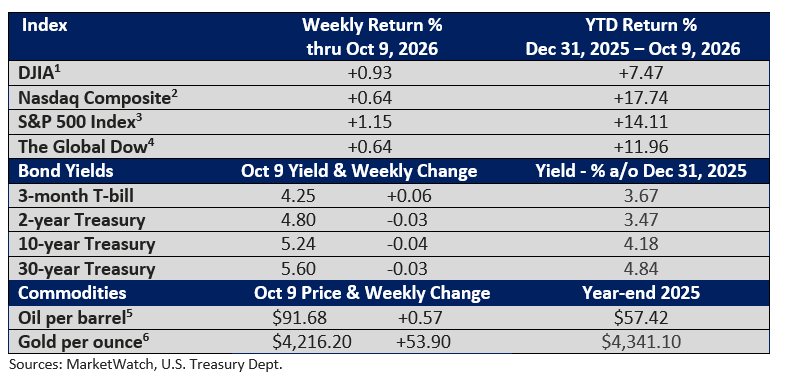
Market summary
TWO FOR THE ROAD
New evidence shows America’s middle class IS shrinking, but it’s because more US households are moving into higher income groups over time. The share of High-Income households earning $100,000 or more (in 2025 dollars) has almost tripled since 1967, from 16.5% to 44.7%. The share of Low-Income households earning $35,000 or less has decreased from 29.8% in 1967 to 19.2% last year. The share of Middle-Income households has decreased since 1967 from 53.7% (more than half) to 36.1% (slightly more than one-third). – Mark J. Perry, October 7, 2026
71% of people with cancer in the United States will live for at least five years after diagnosis, up from 49% in the late 1970s. – Human Progress, October 8,2026
I hope you have a great week!
Warmest Regards,
Bill Stordahl, CFP®
Managing Director
Stordahl Capital Management
A Weekly Perspective on Planning and Markets
Each week, we share The Week in Review — a short collection of articles on
financial planning and wealth management, along with a brief overview for context.
One email per week. No promotions, no sales – just clarity.
Stordahl Capital Management, Inc is a Registered Investment Adviser. This commentary is solely for informational purposes and reflects the personal opinions, viewpoints, and analyses of Stordahl Capital Management, Inc. and should not be regarded as a description of advisory services or performance returns of any SCM Clients. The views reflected in the commentary are subject to change at any time without notice. Nothing in this piece constitutes investment advice, performance data or any recommendation that any particular security, portfolio of securities, transaction or investment strategy is suitable for any specific person. Any mention of a particular security and related performance data is not a recommendation to buy or sell that security. Advisory services are only offered to clients or prospective clients where Stordahl Capital Management and its representatives are properly licensed or exempt from licensure. No advice may be rendered by Stordahl Capital Management unless a client service agreement is in place. Stordahl Capital Management, Inc provides links for your convenience to websites produced by other providers or industry-related material. Accessing websites through links directs you away from our website. Stordahl Capital Management is not responsible for errors or omissions in the material on third-party websites and does not necessarily approve of or endorse the information provided. Users who gain access to third-party websites may be subject to the copyright and other restrictions on use imposed by those providers and assume responsibility and risk from the use of those websites. Please note that trading instructions through email, fax, or voicemail will not be taken. Your identity and timely retrieval of instructions cannot be guaranteed. Stordahl Capital Management, Inc. manages its clients’ accounts using a variety of investment techniques and strategies, which are not necessarily discussed in the commentary. Investments in securities involve the risk of loss. Past performance is no guarantee of future results.
1. The Dow Jones Industrials Average is an unmanaged index of 30 major companies which cannot be invested into directly. Past performance does not guarantee future results.
2. The NASDAQ Composite is an unmanaged index of companies which cannot be invested into directly. Past performance does not guarantee future results.
3. The S&P 500 Index is an unmanaged index of 500 larger companies which cannot be invested into directly. Past performance does not guarantee future results.
4. The Global Dow is an unmanaged index composed of stocks of 150 top companies. It cannot be invested into directly. Past performance does not guarantee future results.
5. CME Group front-month contract; Prices can and do vary; past performance does not guarantee future results.
6. CME Group continuous contract; Prices can and do vary; past performance does not guarantee future results.