
Retiring With $2 Million: What Could Your Retirement Look Like?
There is no single number that defines a successful retirement. Some people enjoy financial independence with considerably less than $2 million, while others accumulate substantially more and still have questions about whether their savings will support the lifestyle they envision.
The difference often comes down to spending, other sources of income, taxes, family circumstances, and personal priorities.
A couple with $1.5 million in savings, a paid-off home, and reliable pension income may have more financial flexibility than a couple with $4 million who maintain several properties and have significantly higher expenses.
That is why we believe retirement planning should begin with the life you want to lead rather than an arbitrary savings target.
Still, if you have accumulated approximately $2 million in investments and retirement accounts, you may be wondering what those resources could make possible.
Could you step away from your career earlier than expected? Travel more frequently? Help your children financially? Spend more time with your grandchildren? Or simply enjoy the confidence that comes from knowing you have options?
Those are the questions worth exploring.
At Stordahl Capital Management, our approach to financial planning focuses on helping clients reach their point of choice, when financial resources provide greater freedom to make decisions about work, family, and how they spend their time.
Understanding what $2 million might support is one part of that process.
What Could $2 Million Provide in Retirement Income?
One of the first questions people ask when considering retirement is how much income their investments can generate.
A common starting point is to estimate an annual withdrawal as a percentage of the portfolio's initial value.
For a $2 million portfolio, different starting withdrawal rates would produce the following amounts:
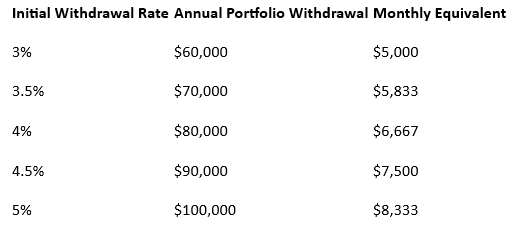
These figures represent initial withdrawals before taxes. They are illustrations, not guaranteed income or recommendations for a particular withdrawal rate.
The familiar 4% rule is often used as a starting point for retirement discussions. Under its traditional framework, someone withdraws 4% of their portfolio in the first year and then adjusts that dollar amount for inflation in subsequent years.
For a $2 million portfolio, that would mean an initial withdrawal of $80,000.
But the appropriate withdrawal strategy depends on several factors, including retirement age, investment allocation, market conditions, spending flexibility, and the length of time the portfolio may need to support withdrawals.
Someone retiring at age 55 may need their investments to support four decades of spending. Someone retiring at 70 with substantial Social Security benefits may face a very different set of circumstances.
We discuss these considerations in greater detail in our article, Retirement Planning Beyond the 4% Rule.
The important point is that a withdrawal percentage provides a useful illustration, but it does not tell you whether your retirement plan is sustainable.
Social Security Can Change the Picture Considerably
Your investment portfolio may be only one source of retirement income.
Social Security benefits, pensions, rental income, and other cash flows can substantially change how much you need to withdraw from your investments.
Consider a hypothetical couple with $2 million in retirement savings.
Suppose their combined Social Security benefits total $60,000 annually, and they initially withdraw $80,000 from their portfolio.
Their total annual income would be approximately $140,000 before taxes.
For some households, that could comfortably support their desired lifestyle. For others, it might not cover their expected expenses.
Now consider a different couple with the same $2 million portfolio who expect to spend $200,000 annually and receive $60,000 in Social Security benefits.
They would need approximately $140,000 from their investments each year, representing a 7% initial withdrawal rate.
That creates a very different planning challenge, particularly if the withdrawals must continue for several decades.
The portfolio balance is identical in both examples. The financial outlook is not.
This is why we spend considerable time understanding what clients actually want their retirement to look like before determining how much income their investments need to provide.
Your Spending Matters More Than Someone Else's Savings
When people compare their retirement savings with those of friends, colleagues, or neighbors, they rarely have enough information to make a meaningful comparison.
They may know approximately how much someone has accumulated, but they probably do not know that person's expenses, debts, tax situation, or other sources of income.
Those details matter.
A household with a paid-off home and relatively modest expenses may have substantial flexibility with a portfolio that is smaller than someone else's.
Another household may have higher expenses because of travel, maintaining multiple homes, supporting family members, or pursuing other interests.
Neither approach is inherently better.
Retirement is an opportunity to make choices that reflect your own priorities.
The planning challenge is to understand what those choices cost and whether your financial resources can support them over time.
We often encourage clients to think about spending in several categories.
There are essential expenses, such as housing, food, insurance, healthcare, and taxes. There are discretionary expenses, including travel, entertainment, hobbies, and dining out. And there may be larger, less frequent commitments, such as purchasing a second home, helping a child buy a house, or making significant charitable gifts.
Understanding these different expenses helps us develop a retirement income strategy that is both practical and flexible.
It also helps distinguish between spending that must continue regardless of market conditions and spending that can be adjusted when circumstances change.
The Timing of Your Retirement Can Be as Important as the Amount You Have Saved
Retiring at 55 is a very different financial proposition from retiring at 67.
An earlier retirement may mean more years of portfolio withdrawals, a longer period before Social Security begins, and the need to obtain health insurance before Medicare eligibility.
It also creates a longer period during which inflation can increase living expenses.
On the other hand, retiring earlier may provide valuable opportunities to travel, pursue interests, or spend time with family while health and energy allow.
These are not purely financial considerations.
One of the most important benefits of financial independence is having greater flexibility to decide when and how you want to work.
For some people, that means leaving a demanding career completely. Others may prefer consulting, serving on boards, starting a business, or continuing to work because they enjoy the challenge and relationships.
Reaching your point of choice does not necessarily mean you stop working. It means work becomes more of a choice.
Accessing Retirement Savings Before Age 59½
If you are considering leaving your career before age 59½, the types of accounts you own can influence your options.
Withdrawals from traditional IRAs and employer-sponsored retirement plans may be subject to a 10% additional tax when taken before age 59½, unless an exception applies.
One potentially valuable exception is commonly called the Rule of 55.
Under certain circumstances, individuals who separate from service during or after the calendar year they turn 55 may be able to access funds from that employer's qualified retirement plan without the 10% early withdrawal penalty.
The rules are specific, and rolling those funds into an IRA can eliminate access to that particular exception.
We explain the considerations in The Rule of 55: What to Know Before Rolling Over Your 401(k).
The broader lesson is that retirement timing should be coordinated with account access, taxes, healthcare coverage, and investment withdrawals rather than treated as an isolated decision.
Taxes Can Make a Significant Difference in What You Actually Have Available
A $2 million portfolio does not necessarily represent $2 million of after-tax spending power.
The types of accounts holding those assets matter.
Money in a traditional IRA or 401(k) generally has not yet been subject to income tax. Withdrawals are typically taxable as ordinary income.
Qualified withdrawals from Roth accounts, by contrast, are generally tax-free.
Taxable investment accounts have their own considerations, including capital gains, dividends, and the cost basis of investments.
Two households with identical portfolio balances can therefore have very different after-tax resources.
Roth Conversions May Create Planning Opportunities
The years between leaving a career and beginning required minimum distributions can present opportunities to manage future taxes.
For example, someone who retires at 60 may have several years before Social Security benefits begin and before required minimum distributions apply.
Depending on their circumstances, those years may provide an opportunity to convert portions of a traditional IRA to a Roth IRA at potentially favorable tax rates.
However, Roth conversions create taxable income in the year they occur. They can also affect Medicare premiums once the relevant income lookback period applies.
The decision requires careful analysis of current and expected future tax rates, available cash to pay the conversion tax, estate planning objectives, and other financial considerations.
We explore this strategy in Should You Convert Your Traditional IRA to a Roth?.
The goal is not necessarily to minimize taxes in any single year. It is to make thoughtful decisions that improve the overall financial picture over time.
Healthcare Costs Deserve Special Attention
Healthcare is one of the most important expenses to consider when planning for retirement.
If you leave your career before becoming eligible for Medicare, you may need to purchase private health insurance or obtain coverage through another source.
Those costs can be substantial, particularly for a couple retiring several years before age 65.
Once Medicare begins, there are still premiums, deductibles, supplemental coverage decisions, prescription drug costs, and expenses that Medicare does not cover.
Higher-income households may also pay additional Medicare premiums through the Income-Related Monthly Adjustment Amount, commonly known as IRMAA.
Because Medicare generally uses income information from two years earlier to determine IRMAA, decisions involving Roth conversions, capital gains, and retirement account withdrawals can affect future premiums.
We discuss Medicare planning in Navigating Medicare: What Retirees Need to Know.
Healthcare planning is particularly important for anyone considering retirement before traditional Medicare eligibility.
Investment Returns Matter, but So Does the Order in Which They Occur
A common mistake in retirement planning is assuming that achieving a reasonable average investment return will automatically produce a successful outcome.
Unfortunately, the timing of investment returns can matter just as much as the average.
Consider two people who begin retirement with identical portfolios and experience the same average investment return over a period of years.
One experiences strong market returns early in retirement, followed by weaker results later.
The other experiences significant market declines during the first few years, followed by stronger returns.
Even if their average returns are similar, their outcomes can be very different if both are withdrawing money throughout the period.
When investments decline early in retirement, withdrawals may require selling assets at depressed prices. That leaves fewer shares available to participate when markets eventually recover.
This is known as sequence-of-returns risk.
It is one reason we believe retirement portfolios should be constructed around more than a long-term return assumption.
An appropriate investment strategy considers the timing of anticipated withdrawals, the need for liquidity, the balance between growth and stability, and the ability to adjust spending when markets are unfavorable.
There is no investment allocation that eliminates risk. But thoughtful planning can help reduce the likelihood that short-term market volatility forces unwanted changes to your lifestyle.
Inflation Can Quietly Change Your Retirement Budget
Inflation deserves attention because retirement may last 25, 30, or even 40 years.
Expenses that seem manageable today may look quite different several decades from now.
For example, if a household spends $120,000 annually and inflation averages 3%, maintaining the same purchasing power would require approximately $217,000 per year after 20 years.
That does not mean every expense will increase at the same rate. Some costs may decline as your lifestyle changes, while others, particularly healthcare-related expenses, may increase more quickly.
The important consideration is that retirement income needs are not static.
A financial plan should account for changing expenses over time rather than assuming that today's spending will remain unchanged indefinitely.
Your Financial Plan Should Reflect More Than Your Own Spending
For many families, retirement planning involves more than determining how much money they can comfortably spend.
You may want to help children or grandchildren with education expenses, contribute toward a first home, provide financial support during a difficult period, or leave a meaningful inheritance.
Charitable giving may also become more important as you gain greater control over your time and financial resources.
These goals can influence how you structure investments, manage taxes, and determine an appropriate withdrawal strategy.
They can also create difficult choices.
For example, helping an adult child purchase a home may be personally rewarding, but a large gift early in retirement could reduce the financial flexibility available later.
The objective is not to discourage generosity. It is to understand how those decisions fit within your broader financial picture.
When financial planning is done well, it helps you make those choices with greater confidence.
What Does a Comfortable Retirement Actually Mean to You?
The word comfortable means different things to different people.
For one couple, it may mean having the freedom to travel internationally several times a year.
For another, it may mean remaining in the family home, spending more time with grandchildren, and never worrying about whether ordinary expenses are covered.
Someone else may want to pursue a second career, become involved in philanthropy, or spend more time volunteering.
Those goals may require very different amounts of money.
This is why we believe a successful retirement cannot be measured solely by portfolio size.
Financial independence creates opportunities, but the value of those opportunities depends on what you do with them.
We explored this idea in The Most Important Retirement Asset Is Not Your Money, It Is Your Time.
The years ahead are not simply a period during which you draw down the assets you accumulated. They are an opportunity to use those resources in ways that reflect what matters most to you.
Frequently Asked Questions About Retiring With $2 Million
Can you retire with $2 million?
Yes, $2 million may support a comfortable retirement, depending on your spending needs, age, Social Security benefits, taxes, investment strategy, and other financial circumstances. Some households can retire comfortably with substantially less, while others may require more to support their desired lifestyle.
How much annual income can $2 million provide in retirement?
A 4% initial withdrawal from a $2 million portfolio would provide $80,000 in the first year before taxes. A 3% withdrawal would provide $60,000, while a 5% withdrawal would provide $100,000. These are illustrations rather than guaranteed or universally sustainable income levels. Social Security, pensions, and other income sources may provide additional cash flow.
Is $2 million enough to retire at age 55?
It may be, but retiring at 55 introduces additional considerations. Your portfolio may need to support withdrawals for 35 to 40 years or longer, and you may need to fund healthcare coverage before Medicare eligibility. Access to retirement accounts, taxes, and the timing of Social Security benefits also require careful planning.
Does it matter whether my $2 million is in an IRA, Roth IRA, or taxable account?
Yes. Traditional retirement account withdrawals are generally taxable as ordinary income, qualified Roth withdrawals are generally tax-free, and taxable accounts have different capital gains and income tax considerations. The account mix can significantly affect how much after-tax income your savings provide.
How do I know whether I have enough money to retire?
Start by estimating your desired spending, identifying reliable income sources, and determining how much you will need from investments. Then consider taxes, inflation, healthcare, market risk, and the length of time your assets may need to last. A comprehensive financial plan can help evaluate different scenarios and identify potential adjustments.
Our Perspective: The Right Retirement Number Is Personal
There is nothing inherently special about having $2 million saved for retirement.
It can represent a meaningful level of financial resources and create substantial flexibility, but it is not a universal benchmark for financial independence.
Some people reach their point of choice with less. Others need more because their goals, spending patterns, or family circumstances are different.
What matters is whether your financial resources can support the life you want to lead.
At Stordahl Capital Management, we believe retirement planning should help answer much more than whether you can afford to stop working.
It should help you understand the choices available to you, how those choices may affect your financial future, and how to use the wealth you have accumulated to support the people and experiences that matter most.
If you are considering retirement and would like to better understand what your financial resources could make possible, we welcome the opportunity to talk. You can schedule a complimentary 15-minute call.
A Weekly Perspective on Planning and Markets
Each week, we share The Week in Review — a short collection of articles on
financial planning and wealth management, along with a brief overview for context.
One email per week. No promotions, no sales – just clarity.
This material was written in collaboration with artificial intelligence (ChatGPT) and derived from sources believed to be correct.
Stordahl Capital Management, Inc is a Registered Investment Adviser. This commentary is solely for informational purposes and reflects the personal opinions, viewpoints, and analyses of Stordahl Capital Management, Inc. and should not be regarded as a description of advisory services or performance returns of any SCM Clients. The views reflected in the commentary are subject to change at any time without notice. Nothing in this piece constitutes investment advice, performance data or any recommendation that any particular security, portfolio of securities, transaction or investment strategy is suitable for any specific person. Any mention of a particular security and related performance data is not a recommendation to buy or sell that security. Advisory services are only offered to clients or prospective clients where Stordahl Capital Management and its representatives are properly licensed or exempt from licensure. No advice may be rendered by Stordahl Capital Management unless a client service agreement is in place. Stordahl Capital Management, Inc provides links for your convenience to websites produced by other providers or industry-related material. Accessing websites through links directs you away from our website. Stordahl Capital Management is not responsible for errors or omissions in the material on third-party websites and does not necessarily approve of or endorse the information provided. Users who gain access to third-party websites may be subject to the copyright and other restrictions on use imposed by those providers and assume responsibility and risk from the use of those websites. Please note that trading instructions through email, fax, or voicemail will not be taken. Your identity and timely retrieval of instructions cannot be guaranteed. Stordahl Capital Management, Inc. manages its clients’ accounts using a variety of investment techniques and strategies, which are not necessarily discussed in the commentary. Investments in securities involve the risk of loss. Past performance is no guarantee of future results.