
What Rising Oil Prices Mean for the Economy and Investors
Oil prices are once again approaching levels that tend to capture headlines and raise concerns about inflation, interest rates, and the broader economy.
Brent crude recently moved back toward $100 per barrel, while West Texas Intermediate approached $90. The immediate cause has been renewed geopolitical instability in the Middle East, including threats to several of the world’s most important energy-shipping routes.
Higher oil prices can create real economic pressure. But before assuming that today’s increase will become a permanent problem, it is worth understanding why prices are rising, how they affect the economy, and what history tells us about previous energy shocks.
Why Oil Prices Are Rising
Global oil markets depend heavily on a small number of strategic waterways.
Roughly 20% of global oil shipments pass through the Strait of Hormuz. Conflict involving Iran has increased concerns about whether oil can continue moving safely through that region. More recently, attacks near the Bab al-Mandeb Strait in the Red Sea have created another potential threat to Saudi Arabian and other regional energy shipments.
Oil markets do not wait for supplies to be physically interrupted. Prices can rise simply because traders believe future shipments may be delayed or reduced.
Failed ceasefire efforts and renewed military activity have added to that uncertainty. As the perceived risk to global supply rises, so does the price buyers are willing to pay for oil available today.
Why Higher Oil Prices Matter
Oil affects much more than what drivers pay at the gas station.
Energy is embedded throughout the economy. It powers transportation, agriculture, manufacturing, aviation, shipping, and the production of countless consumer goods. When crude oil prices rise, businesses often face higher costs to produce and deliver their products.
Some of those costs eventually reach consumers.
Higher oil prices can therefore contribute to:
more expensive gasoline and air travel;
higher shipping and transportation costs;
pressure on household budgets;
increased business expenses; and
renewed inflation concerns.
Recent inflation data had shown improvement, but energy and gasoline prices were still rising significantly from the prior year. A sustained return to higher crude prices could slow that progress.
The Federal Reserve’s Challenge
Higher energy prices can also make the Federal Reserve’s job more difficult.
The Fed has been trying to balance two competing risks: keeping inflation under control without slowing the economy unnecessarily. If oil prices remain elevated, inflation could prove more persistent than policymakers expect.
That could cause the Fed to keep interest rates higher for longer—or potentially consider additional rate increases.
However, the Fed also understands that oil shocks can reduce consumer spending and weaken economic growth. Raising rates too aggressively in response to a temporary energy spike could compound that slowdown.
The important question is therefore not simply whether oil reaches $100 per barrel. It is how long prices remain elevated and how broadly those increases spread through the economy.
History Tells an Important Story
Before reacting to today’s headlines, take a close look at the accompanying chart.
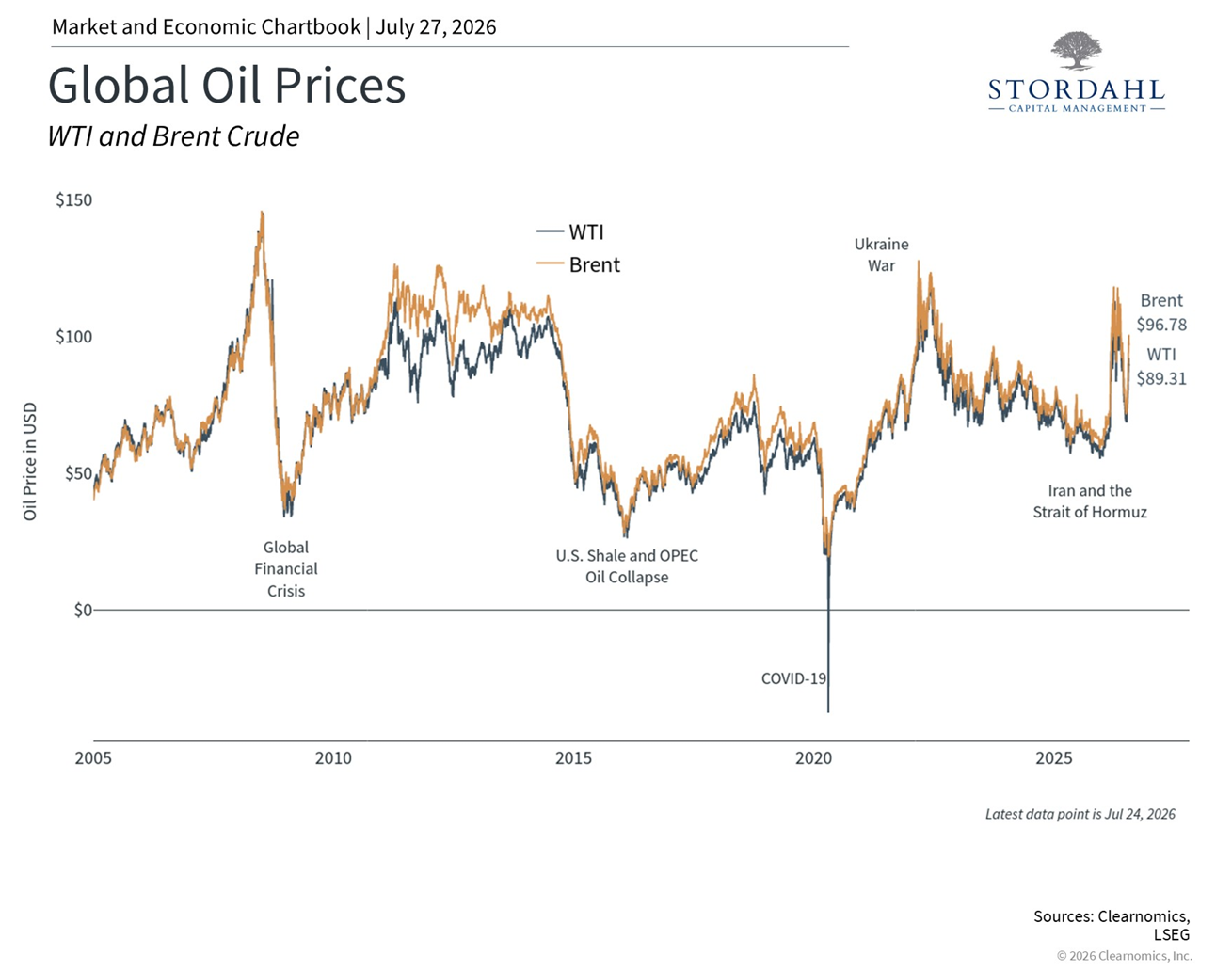
It shows that oil prices have experienced dramatic swings throughout the past two decades. Prices surged before the 2008 financial crisis and then collapsed as the global economy weakened. They fell sharply again during the pandemic when travel and economic activity nearly stopped. Wars, production changes, shifting demand, and geopolitical uncertainty have caused additional spikes and declines along the way.
The lesson is not merely that oil prices are unpredictable.
The more important lesson is that oil prices are cyclical.
Periods of high prices encourage producers to increase supply, businesses to improve efficiency, and consumers to adjust their behavior. Slower economic growth can also reduce demand. Over time, those responses often help bring the market back into balance.
The history of oil prices is not a story of permanently rising costs. It is a story of markets adapting.
Markets and Businesses Adjust
The global economy does not remain frozen when energy prices rise.
Airlines adjust routes and fuel policies. Manufacturers look for efficiencies. Consumers drive less or choose more fuel-efficient vehicles. Oil producers increase drilling where additional production is economical. Alternative energy sources also become more competitive.
These changes do not happen overnight, and they cannot eliminate the near-term effects of an energy shock. But they help explain why previous oil spikes have not continued indefinitely.
If you study the chart again, one feature stands out: every major increase felt alarming while it was happening.
None of them lasted forever.
What This Means for Investors
Higher oil prices may benefit energy producers while creating challenges for transportation companies, manufacturers, and businesses that cannot easily pass higher costs to customers.
The effect on the overall stock market is less straightforward.
Markets must weigh several factors at once: the benefits to energy companies, the pressure on consumers, the inflation outlook, possible Federal Reserve action, and the risk that higher costs slow economic growth.
Because those expectations are incorporated into prices rapidly, attempting to reposition a portfolio around every movement in oil can be difficult and counterproductive.
At Stordahl Capital Management, we believe oil prices deserve attention—but not an emotional response.
A diversified portfolio is designed with the expectation that different industries will face different conditions at different times. Long-term financial plans should be built to withstand commodity cycles, geopolitical uncertainty, and periods of market volatility.
The Bottom Line
Rising oil prices can affect inflation, consumer spending, business costs, and Federal Reserve policy. Those pressures are real, particularly if high prices persist.
But history also provides useful perspective.
Oil prices have repeatedly surged during periods of crisis, and markets and economies have repeatedly adjusted. Production changes, shifting demand, technological innovation, and changing geopolitical conditions eventually influence prices in the other direction.
Rather than trying to predict every movement in the energy market, investors are generally better served by maintaining a diversified portfolio, following a thoughtful financial plan, and keeping short-term events in their proper long-term context.
The history of oil prices is not a story of permanently higher prices. It is a story of markets adapting.
If current market events have you questioning your investment strategy, we offer a complimentary 15-minute call to discuss your concerns and explore how a thoughtful financial plan can help you remain focused on your long-term goals.
A Weekly Perspective on Planning and Markets
Each week, we share The Week in Review — a short collection of articles on
financial planning and wealth management, along with a brief overview for context.
One email per week. No promotions, no sales – just clarity.
This material was written in collaboration with artificial intelligence (ChatGPT) and derived from sources believed to be correct.
Stordahl Capital Management, Inc is a Registered Investment Adviser. This commentary is solely for informational purposes and reflects the personal opinions, viewpoints, and analyses of Stordahl Capital Management, Inc. and should not be regarded as a description of advisory services or performance returns of any SCM Clients. The views reflected in the commentary are subject to change at any time without notice. Nothing in this piece constitutes investment advice, performance data or any recommendation that any particular security, portfolio of securities, transaction or investment strategy is suitable for any specific person. Any mention of a particular security and related performance data is not a recommendation to buy or sell that security. Advisory services are only offered to clients or prospective clients where Stordahl Capital Management and its representatives are properly licensed or exempt from licensure. No advice may be rendered by Stordahl Capital Management unless a client service agreement is in place. Stordahl Capital Management, Inc provides links for your convenience to websites produced by other providers or industry-related material. Accessing websites through links directs you away from our website. Stordahl Capital Management is not responsible for errors or omissions in the material on third-party websites and does not necessarily approve of or endorse the information provided. Users who gain access to third-party websites may be subject to the copyright and other restrictions on use imposed by those providers and assume responsibility and risk from the use of those websites. Please note that trading instructions through email, fax, or voicemail will not be taken. Your identity and timely retrieval of instructions cannot be guaranteed. Stordahl Capital Management, Inc. manages its clients’ accounts using a variety of investment techniques and strategies, which are not necessarily discussed in the commentary. Investments in securities involve the risk of loss. Past performance is no guarantee of future results.
Copyright (c) 2024 Clearnomics, Inc. All rights reserved. The information contained herein has been obtained from sources believed to be reliable, but is not necessarily complete and its accuracy cannot be guaranteed. No representation or warranty, express or implied, is made as to the fairness, accuracy, completeness, or correctness of the information and opinions contained herein. The views and the other information provided are subject to change without notice. All reports posted on or via www.clearnomics.com or any affiliated websites, applications, or services are issued without regard to the specific investment objectives, financial situation, or particular needs of any specific recipient and are not to be construed as a solicitation or an offer to buy or sell any securities or related financial instruments. Past performance is not necessarily a guide to future results. Company fundamentals and earnings may be mentioned occasionally, but should not be construed as a recommendation to buy, sell, or hold the company's stock. Predictions, forecasts, and estimates for any and all markets should not be construed as recommendations to buy, sell, or hold any security--including mutual funds, futures contracts, and exchange traded funds, or any similar instruments. The text, images, and other materials contained or displayed in this report are proprietary to Clearnomics, Inc. and constitute valuable intellectual property. All unauthorized reproduction or other use of material from Clearnomics, Inc. shall be deemed willful infringement(s) of this copyright and other proprietary and intellectual property rights, including but not limited to, rights of privacy. Clearnomics, Inc. expressly reserves all rights in connection with its intellectual property, including without limitation the right to block the transfer of its products and services and/or to track usage thereof, through electronic tracking technology, and all other lawful means, now known or hereafter devised. Clearnomics, Inc. reserves the right, without further notice, to pursue to the fullest extent allowed by the law any and all criminal and civil remedies for the violation of its rights.