The Week in Review: August 3, 2026
A Murky Fed Message
"All hat and no cattle" is a traditional cowboy phrase—especially popular in Texas—describing someone who is basically a poser: plenty of talk, lots of sparkle, but little to back it up.
It’s all talk and no action, and that’s the takeaway from Federal Reserve Chair Kevin Warsh’s second Fed meeting and subsequent press conference.
In a 9-3 split decision, the Federal Reserve left its key rate, the fed funds rate, unchanged at 3.50–3.75%. While it wasn't entirely unexpected, Warsh's tough talk in June raised the possibility that the Fed might raise its key rate last week.
The three dissenters favored a quarter-point hike.
Once again, Warsh came out swinging against inflation, insisting that the Fed will deliver on its goal to bring down inflation. He pointed out that inflation has been above the Fed’s target of 2% for over five years. His rhetoric and posture were unwavering and resolute.
But achieving the Fed’s goal of price stability hasn’t been easy. The Fed’s tools aren’t perfect. It’s not like a recipe. You know, mix several pre-measured ingredients and bake at a set temperature for a set amount of time.
Historically, the preferred tool in its toolkit has been interest rates.
But the lack of a rate hike on Wednesday, no hint of a rate hike in September, and a vague explanation as to why the Fed isn’t backing up its tough talk with action left investors, especially bond investors, with a feeling that the Fed’s bark is louder than its bite.
Warsh’s comments seemed to suggest the bond market was doing the heavy lifting for the Fed. He pointed out that the intra-meeting rise in bond yields was "among the most significant in the last two decades.”
The graphic below illustrates the rise in longer-term bond yields between the two meetings. And yields have edged higher since the Wednesday meeting.
Notably, the 30-year Treasury yield, a bond primarily purchased by institutional investors such as pension funds, is at its highest level since 2007, per Bloomberg.
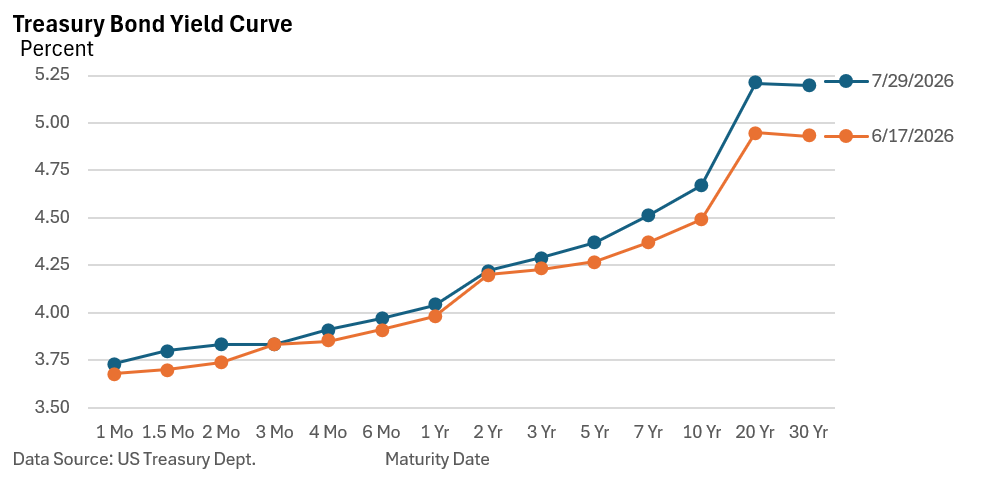
In other words, bond investors have gradually backed away from bonds (bond prices and bond yields move in opposite directions) amid worries about inflation and the Fed’s credibility in its fight against inflation.
Additionally, the large federal deficit and enormous need for capital for the AI buildout may also be playing a role.
Perhaps investors simply need to adjust to his style. Over the last two decades, investors have grown accustomed to guidance, signaling, and plain talk about the Fed's intentions.
That’s not Warsh's style.
Maybe the Fed chairman simply didn’t have the votes to raise rates. But I can’t stress enough how unusual it would be for a Fed chairman to side with the minority. It's never happened.
There are those who believe inflation has peaked, and rate hikes aren’t needed. And Fed policy can’t produce one drop of oil.
Even so, the lack of congruence between tough talk and inaction left investors questioning the Fed’s commitment to its message.
Market summary
TWO FOR THE ROAD
An analysis by The Economist finds that, for the first time in its 25-year dataset, over half of global billionaire wealth is now held by self-made billionaires who made their fortunes through “competitive activities,” meaning by providing goods and services in competitive markets, as opposed to inheriting their wealth or accumulating it in politically connected industries. – The Economist, July 23, 2026
Science Corporation, a startup developing novel brain-computer interfaces (BCI), won approval from Europe’s medical device regulator to begin selling a device that restores vision lost from age-related macular degeneration. – TechCrunch – July 22, 2026
I hope you have a great week!
Warmest Regards,
Bill Stordahl, CFP®
Managing Director
Stordahl Capital Management
A Weekly Perspective on Planning and Markets
Each week, we share The Week in Review — a short collection of articles on
financial planning and wealth management, along with a brief overview for context.
One email per week. No promotions, no sales – just clarity.
Stordahl Capital Management, Inc is a Registered Investment Adviser. This commentary is solely for informational purposes and reflects the personal opinions, viewpoints, and analyses of Stordahl Capital Management, Inc. and should not be regarded as a description of advisory services or performance returns of any SCM Clients. The views reflected in the commentary are subject to change at any time without notice. Nothing in this piece constitutes investment advice, performance data or any recommendation that any particular security, portfolio of securities, transaction or investment strategy is suitable for any specific person. Any mention of a particular security and related performance data is not a recommendation to buy or sell that security. Advisory services are only offered to clients or prospective clients where Stordahl Capital Management and its representatives are properly licensed or exempt from licensure. No advice may be rendered by Stordahl Capital Management unless a client service agreement is in place. Stordahl Capital Management, Inc provides links for your convenience to websites produced by other providers or industry-related material. Accessing websites through links directs you away from our website. Stordahl Capital Management is not responsible for errors or omissions in the material on third-party websites and does not necessarily approve of or endorse the information provided. Users who gain access to third-party websites may be subject to the copyright and other restrictions on use imposed by those providers and assume responsibility and risk from the use of those websites. Please note that trading instructions through email, fax, or voicemail will not be taken. Your identity and timely retrieval of instructions cannot be guaranteed. Stordahl Capital Management, Inc. manages its clients’ accounts using a variety of investment techniques and strategies, which are not necessarily discussed in the commentary. Investments in securities involve the risk of loss. Past performance is no guarantee of future results.
1. The Dow Jones Industrials Average is an unmanaged index of 30 major companies which cannot be invested into directly. Past performance does not guarantee future results.
2. The NASDAQ Composite is an unmanaged index of companies which cannot be invested into directly. Past performance does not guarantee future results.
3. The S&P 500 Index is an unmanaged index of 500 larger companies which cannot be invested into directly. Past performance does not guarantee future results.
4. The Global Dow is an unmanaged index composed of stocks of 150 top companies. It cannot be invested into directly. Past performance does not guarantee future results.
5. CME Group front-month contract; Prices can and do vary; past performance does not guarantee future results.
6. CME Group continuous contract; Prices can and do vary; past performance does not guarantee future results.