The Week in Review: September 28, 2026
Rising Bond Yields: What Does 5% Mean for Investors?
The bond market has been getting a lot of attention lately.
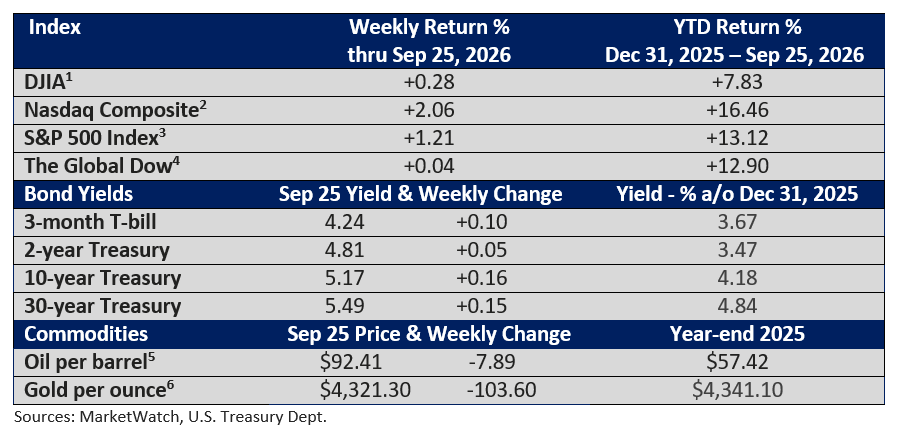
Last week, the 10-year Treasury yield climbed to 5.17%, its highest level in years, while the 30-year Treasury reached 5.49%. At the same time, stocks continued to move higher, with the S&P 500 gaining 1.21% for the week and sitting just below their August high.
So, what's going on?
And perhaps more importantly, should investors be concerned about Treasury yields above 5%?
Why Are Treasury Yields Rising?
There isn't one single cause.
Inflation is still a concern, economic data have generally pointed to a stronger-than-expected economy, and the federal government continues to issue significant amounts of Treasury debt to finance its deficits. A gradual shift in foreign demand for Treasury securities may also be contributing to higher yields.
All of that can put upward pressure on yields.
And the move has been significant.
The 10-year Treasury yield hit its 2026 low in late February. Since then, yields have risen across nearly the entire Treasury curve.
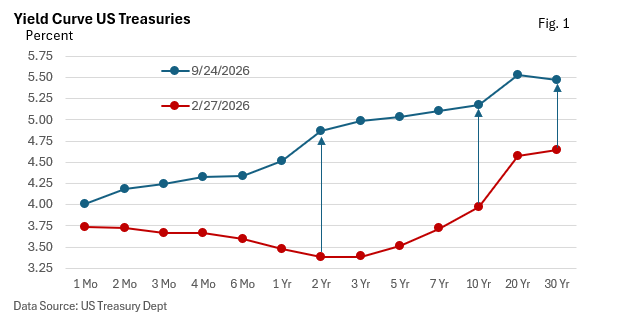
Last week, the Federal Reserve voted to raise its key interest rate, the fed funds rate, by a quarter percentage point to 3.75–4.0%. It’s the first increase in three years.
For much of the year, the stock market has taken the increase in stride. Strong corporate earnings have helped stocks move higher even as borrowing costs have increased.
But once longer-term Treasury yields cross 5%, people understandably start paying more attention.
Why Does 5% Matter?
Think about it from an investor's perspective.
When Treasury yields were 1% or 2%, an investor looking for meaningful long-term returns had relatively few alternatives to stocks.
At 5%, the calculation changes.
Higher Treasury yields provide more competition for investment dollars. They also raise borrowing costs for businesses and consumers and can put pressure on stock valuations.
That doesn't mean stocks suddenly become unattractive.
It means the hurdle is higher.
And history tells us that the relationship between interest rates and stocks isn't nearly as simple as rates up, stocks down.
Why?
Because why rates are rising matters.
If yields are moving higher because the economy is growing and corporate profits are improving, stocks may be able to absorb higher rates.
If yields are rising rapidly because inflation is accelerating or investors are demanding more compensation to own long-term debt, markets may have a harder time.
How Much Is Too Much?
More recent history gives us another useful perspective.
Since 2021, months with the largest increases in the 10-year Treasury yield have been difficult for stocks on average. The S&P 500 declined an average of 1.56% during those months.
But during months when yields increased more moderately, the S&P 500 actually gained an average of 1.29%.
That's an important distinction.
Rising rates aren't necessarily the problem. Rapidly rising rates can be.
Sharp increases can put pressure on stock valuations, raise borrowing costs quickly, and expose weaknesses that weren't obvious when money was cheaper. The collapse of Silicon Valley Bank in 2023 was one example of how rapidly changing rates can create stress in the financial system.
That doesn't mean something is about to "break" today.
It means we're paying attention.
There's a Good Side to Higher Yields, Too
For retirees and conservative investors, there’s another side of this story that tends to get lost in the headlines.
Bonds are paying investors again.
For years, investors had to accept very low yields from high-quality fixed-income investments. That's no longer the case.
Higher yields can make bonds more useful for generating income and providing diversification within a retirement portfolio.
So, while 5% Treasury yields may create some headwinds for stocks, they can also create opportunities elsewhere in a diversified portfolio.
That's one reason we don't look at interest rates in isolation.
What Should Investors Do About It?
This is where we want to keep some perspective.
The 10-year Treasury crossing 5% is important. We're watching it.
But we're not going to make wholesale changes to a long-term financial plan because a particular interest rate crossed a particular number.
The S&P 500 finished Friday only 0.7% below its August high despite the significant increase in Treasury yields this year. That's a good reminder that markets can absorb a lot when economic growth and corporate earnings remain supportive.
Eventually, that could change.
Rates could continue higher. Inflation could prove stubborn. Economic growth could slow. Or yields could retreat.
We don't know.
And that's really the point.
We don't build financial plans that require us to correctly predict interest rates.
We build diversified portfolios knowing that rates will rise and fall, stocks will go through good and bad periods, and occasionally markets will surprise everyone.
The goal isn't to predict every surprise.
It's to be prepared for them.
Market summary
TWO FOR THE ROAD
The share of Americans who say they drink alcohol remains at a record-low 54% for the second consecutive year, the lowest reading in Gallup’s trend dating back to 1939. – Gallup, August 20, 2026
According to new data from the Census Bureau, US inflation-adjusted median household income reached a record high of $87,460 in 2025, surpassing the previous record of $85,320, set in 2019. – U.S. Census Bureau, September, 2026
I hope you have a great week!
Warmest Regards,
Bill Stordahl, CFP®
Managing Director
Stordahl Capital Management
A Weekly Perspective on Planning and Markets
Each week, we share The Week in Review — a short collection of articles on
financial planning and wealth management, along with a brief overview for context.
One email per week. No promotions, no sales – just clarity.
Stordahl Capital Management, Inc is a Registered Investment Adviser. This commentary is solely for informational purposes and reflects the personal opinions, viewpoints, and analyses of Stordahl Capital Management, Inc. and should not be regarded as a description of advisory services or performance returns of any SCM Clients. The views reflected in the commentary are subject to change at any time without notice. Nothing in this piece constitutes investment advice, performance data or any recommendation that any particular security, portfolio of securities, transaction or investment strategy is suitable for any specific person. Any mention of a particular security and related performance data is not a recommendation to buy or sell that security. Advisory services are only offered to clients or prospective clients where Stordahl Capital Management and its representatives are properly licensed or exempt from licensure. No advice may be rendered by Stordahl Capital Management unless a client service agreement is in place. Stordahl Capital Management, Inc provides links for your convenience to websites produced by other providers or industry-related material. Accessing websites through links directs you away from our website. Stordahl Capital Management is not responsible for errors or omissions in the material on third-party websites and does not necessarily approve of or endorse the information provided. Users who gain access to third-party websites may be subject to the copyright and other restrictions on use imposed by those providers and assume responsibility and risk from the use of those websites. Please note that trading instructions through email, fax, or voicemail will not be taken. Your identity and timely retrieval of instructions cannot be guaranteed. Stordahl Capital Management, Inc. manages its clients’ accounts using a variety of investment techniques and strategies, which are not necessarily discussed in the commentary. Investments in securities involve the risk of loss. Past performance is no guarantee of future results.
1. The Dow Jones Industrials Average is an unmanaged index of 30 major companies which cannot be invested into directly. Past performance does not guarantee future results.
2. The NASDAQ Composite is an unmanaged index of companies which cannot be invested into directly. Past performance does not guarantee future results.
3. The S&P 500 Index is an unmanaged index of 500 larger companies which cannot be invested into directly. Past performance does not guarantee future results.
4. The Global Dow is an unmanaged index composed of stocks of 150 top companies. It cannot be invested into directly. Past performance does not guarantee future results.
5. CME Group front-month contract; Prices can and do vary; past performance does not guarantee future results.
6. CME Group continuous contract; Prices can and do vary; past performance does not guarantee future results.