The Week in Review: September 21, 2026
The Fed Hikes Rates: What Investors Should Know
In his opening remarks in a speech last month at the Federal Reserve Bank of Kansas City’s Economic Symposium, Fed Chief Kevin Warsh said, “Jeff and the other planners have some recreation options lined up for later today. And I'd advise you to be very careful with your choices. As I learned years ago, you can take two different kinds of hikes on the trails around Jackson Hole (Wyoming).
“I can sum up my hikes with former Vice Chairman Don Kohn in two words: I survived. These steely marathon death marches revealed a side of Don I wasn't ready for.
“There's another kind of hike—one I associate with Chairman Ben Bernanke, my old colleague. With Ben, it's a much more leisurely pace, an easy stroll along the wandering trails at the Rockefeller Preserve.”
Warsh isn’t fond of offering interest rate forecasts (often called guidance). Moreover, he chooses his words carefully. While his comments about various ‘hikes’ elicited laughter, his use of that specific word 'hike' (as in a rate hike) wasn’t lost on analysts.
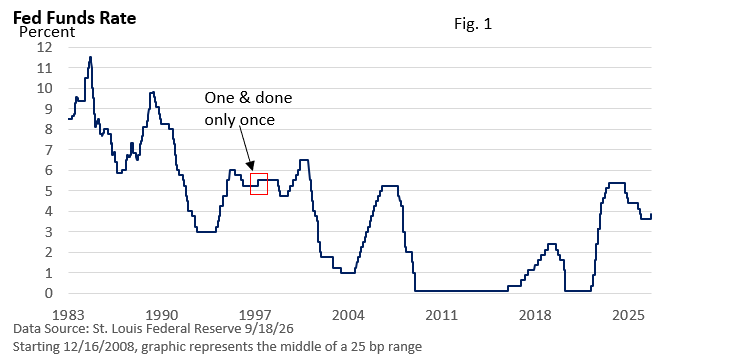
Last week, the Federal Reserve voted to raise its key interest rate, the fed funds rate, by a quarter percentage point to 3.75–4.0%. It’s the first increase in three years.
So, in keeping with his Jackson Hole remarks, was Warsh hinting at a more aggressive series of rate hikes—steely marathon death marches—that might bring inflation under control more quickly? Or was he suggesting that a gentler pace is on the horizon, i.e., the Rockefeller Preserve?
He didn’t offer an outlook last week, but the Fed is clearly taking a more hawkish tone, with Warsh noting, “The plain fact is that inflation is too high and has been for too long.”
As illustrated in Figure 1, the Fed has been "one and done" only once in the last 40 years. The Fed’s economic projections, released quarterly, suggest one more hike by December.
Beyond that, the press conference offered little additional clarity. Lasting just 29 minutes, he painted an upbeat picture of the economy, but otherwise, his remarks were sometimes less than transparent, and he declined to take any follow-up questions from reporters.
That stood in contrast to his June press conference and the practice commonly followed by former Fed Chair Powell, who routinely allowed reporters to seek clarification with follow-up questions.
Investor reaction to rate hikes—historical review
What has happened to stocks when the Fed begins hiking rates? The table below illustrates the return of the S&P 500 Index during a rate-hike cycle and one year after the rate-hike cycle ends.
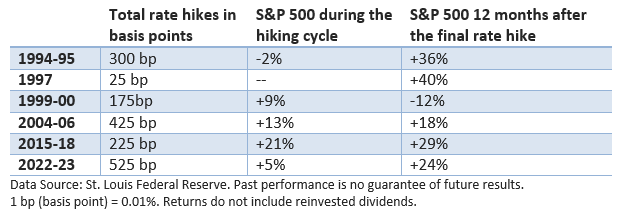
The aggressive hiking cycle of 1994-95 hampered equities. While stocks rose during the 2022-23 rate-hike cycle, the S&P 500 briefly entered a bear market in 2022—down 25% at one point—amid the sharpest series of rate hikes since 1980. Otherwise, rate hikes aren’t necessarily negative.
LPL Research noted that since 1994, stocks have generally struggled in the first several months after the first rate hike.
But LPL was quick to add that early headwinds typically did not lead to lasting losses.
Every cycle has its own peculiarities (and 2026 is no exception), but in most tightening cycles, stocks ultimately generated gains over the following 12 months as investors adjusted to higher borrowing costs and refocused on the underlying strength of economic growth and corporate earnings.
Much may ultimately depend on how economic growth plays out.
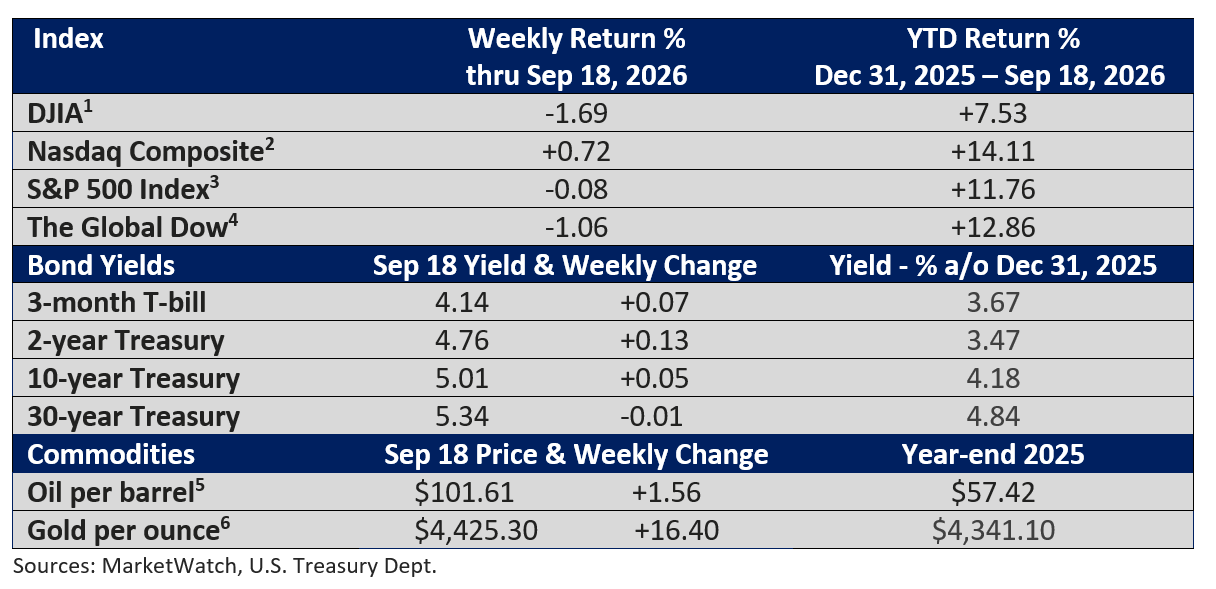
Market summary
I hope you have a great week!
Warmest Regards,
Bill Stordahl, CFP®
Managing Director
Stordahl Capital Management
A Weekly Perspective on Planning and Markets
Each week, we share The Week in Review — a short collection of articles on
financial planning and wealth management, along with a brief overview for context.
One email per week. No promotions, no sales – just clarity.
Stordahl Capital Management, Inc is a Registered Investment Adviser. This commentary is solely for informational purposes and reflects the personal opinions, viewpoints, and analyses of Stordahl Capital Management, Inc. and should not be regarded as a description of advisory services or performance returns of any SCM Clients. The views reflected in the commentary are subject to change at any time without notice. Nothing in this piece constitutes investment advice, performance data or any recommendation that any particular security, portfolio of securities, transaction or investment strategy is suitable for any specific person. Any mention of a particular security and related performance data is not a recommendation to buy or sell that security. Advisory services are only offered to clients or prospective clients where Stordahl Capital Management and its representatives are properly licensed or exempt from licensure. No advice may be rendered by Stordahl Capital Management unless a client service agreement is in place. Stordahl Capital Management, Inc provides links for your convenience to websites produced by other providers or industry-related material. Accessing websites through links directs you away from our website. Stordahl Capital Management is not responsible for errors or omissions in the material on third-party websites and does not necessarily approve of or endorse the information provided. Users who gain access to third-party websites may be subject to the copyright and other restrictions on use imposed by those providers and assume responsibility and risk from the use of those websites. Please note that trading instructions through email, fax, or voicemail will not be taken. Your identity and timely retrieval of instructions cannot be guaranteed. Stordahl Capital Management, Inc. manages its clients’ accounts using a variety of investment techniques and strategies, which are not necessarily discussed in the commentary. Investments in securities involve the risk of loss. Past performance is no guarantee of future results.
1. The Dow Jones Industrials Average is an unmanaged index of 30 major companies which cannot be invested into directly. Past performance does not guarantee future results.
2. The NASDAQ Composite is an unmanaged index of companies which cannot be invested into directly. Past performance does not guarantee future results.
3. The S&P 500 Index is an unmanaged index of 500 larger companies which cannot be invested into directly. Past performance does not guarantee future results.
4. The Global Dow is an unmanaged index composed of stocks of 150 top companies. It cannot be invested into directly. Past performance does not guarantee future results.
5. CME Group front-month contract; Prices can and do vary; past performance does not guarantee future results.
6. CME Group continuous contract; Prices can and do vary; past performance does not guarantee future results.