
The National Debt Has Crossed $40 Trillion. What Does It Mean for Investors?
The United States national debt has now crossed $40 trillion.
That's a staggering number. It's also large enough to raise a reasonable question for investors:
At what point does all this government borrowing begin to matter?
The answer is that it already matters. But perhaps not in the way many investors assume.
A growing national debt doesn't automatically mean a stock market crash, a financial crisis, or that investors should abandon U.S. markets. The United States has operated with federal budget deficits for most of modern history while the economy and financial markets have continued to grow.
But that doesn't mean debt is irrelevant.
The connection investors should be paying attention to interest rates.
As the federal government borrows more money and pays more interest on the debt it has already accumulated, financing the government becomes increasingly expensive. And when the government has to compete for enormous amounts of capital in the bond market, that can put upward pressure on longer-term interest rates.
That has consequences for almost every investor.
How Did We Get to $40 Trillion?
The national debt is simply the accumulation of years of federal borrowing.
When the government spends more than it collects in taxes and other revenue, it runs a budget deficit. The Treasury finances that shortfall by borrowing money. Each year's borrowing adds to the outstanding national debt.
That has been happening for decades.
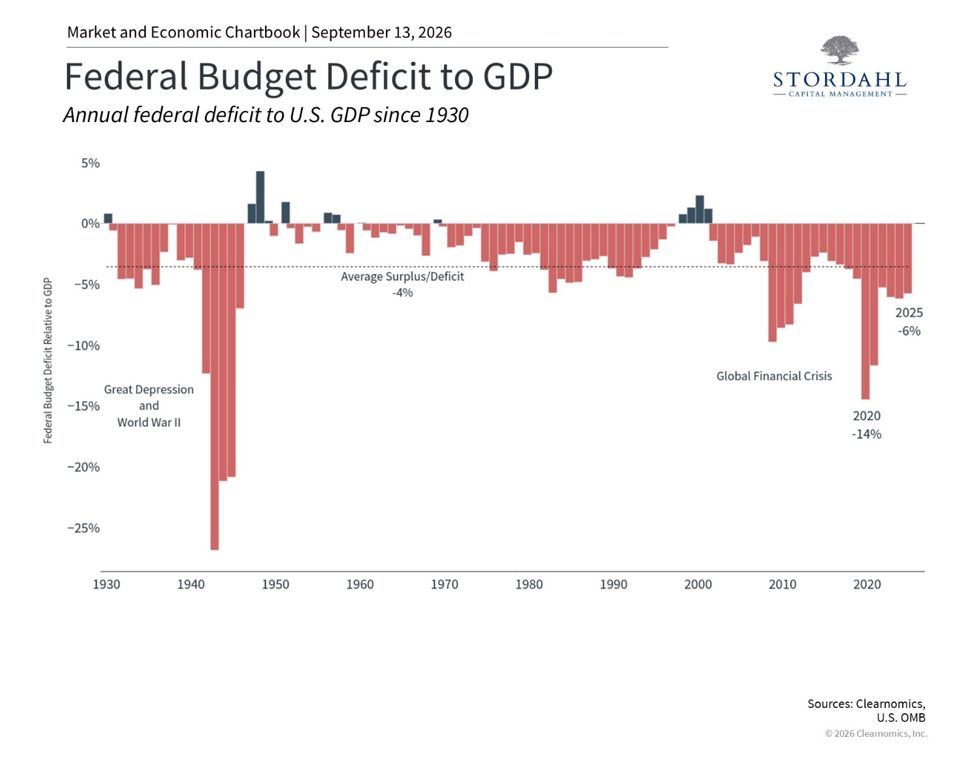
The chart above puts the issue in perspective.
Since 1970, the federal government has run a deficit in all but a handful of years. More recently, deficits have remained unusually large even outside of recessions and other economic emergencies. The source material reports that the current annual deficit is approximately $1.8 trillion with the fiscal year still underway, while the Congressional Budget Office projects a full-year deficit of approximately $2.1 trillion.
Those annual deficits accumulate.
That's how we arrived at more than $40 trillion of federal debt.
The $40 trillion number gets the headlines. But for investors, the more important issue may be what it costs the government to finance that debt.
The Interest Bill Is Becoming More Important
For years, the federal government benefited from extraordinarily low interest rates.
That made carrying a large debt load easier.
If you owe a tremendous amount of money but can finance it at 1%, 2%, or 3%, the interest expense is relatively manageable.
The equation changes when interest rates rise.
As older Treasury securities mature, the government must issue new securities to refinance them. If those new securities carry higher interest rates, the government's interest expense rises.
At the same time, continuing budget deficits require the Treasury to issue still more debt.
So the government isn't simply paying interest on $40 trillion of static debt. It is continually refinancing existing obligations while borrowing additional money.
That's where the debt problem and the interest-rate problem begin to intersect.
More Government Borrowing Can Put Pressure on Interest Rates
Interest rates are determined by many forces, including inflation, economic growth, Federal Reserve policy, investor demand, and expectations about the future.
Government borrowing is another part of that equation.
The Treasury has to find buyers for the enormous amount of debt the federal government issues.
Investors will buy Treasury securities if the return is attractive relative to the alternatives. If the supply of government debt grows faster than demand, yields may need to rise to attract additional buyers.
That doesn't mean a $2 trillion deficit automatically produces a specific interest rate.
Markets don't work that neatly.
But persistent government borrowing can contribute to upward pressure on longer-term rates, particularly when investors become more concerned about inflation, fiscal policy, or the sheer volume of Treasury securities entering the market.
The source notes that long-term Treasury yields have climbed to levels not seen for many years and identifies government borrowing costs as one of the important ways fiscal policy can affect the broader economy.
Why Long-Term Interest Rates Mater to Everyone
Treasury yields don't exist in isolation.
They form the foundation for interest rates throughout the economy.
When yields on 10-year and 30-year Treasury securities rise, borrowing generally becomes more expensive for businesses and households.
Mortgage rates can remain higher.
Businesses may pay more to borrow money for expansion.
Commercial real estate financing becomes more expensive.
Corporate bonds may need to offer higher yields.
The cost of financing acquisitions and new projects increases.
And higher borrowing costs can eventually affect economic growth and corporate profitability.
This is why the national debt isn't simply a political or accounting issue.
It can work its way into the financial markets through the cost of money.
Higher Rates Aren't Necessarily Bad for Investors
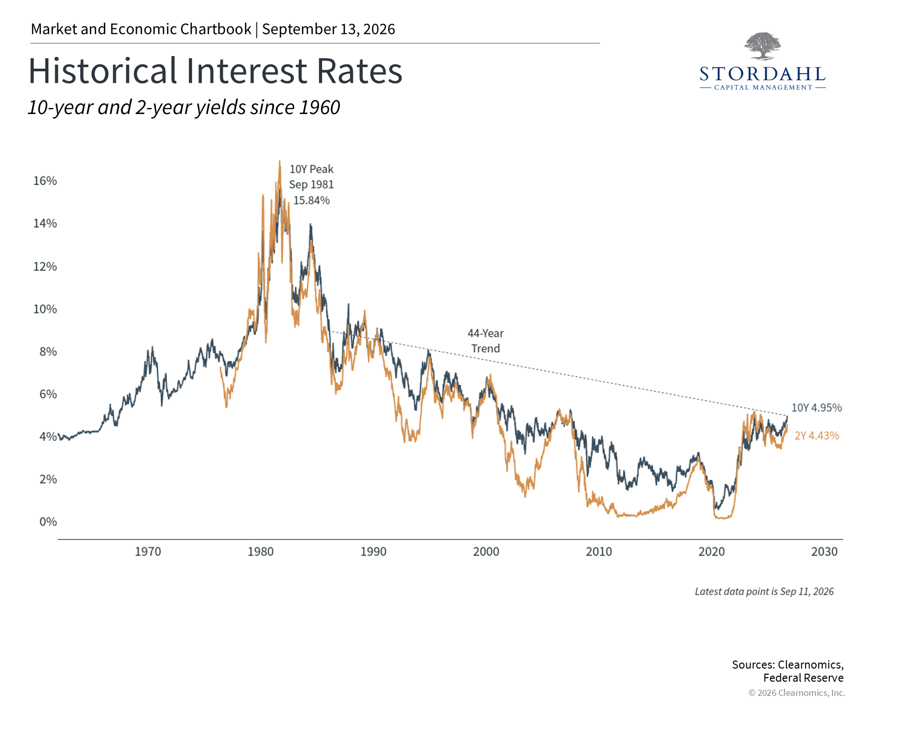
The chart above is important because our perception of "normal" interest rates has been heavily influenced by the period following the financial crisis.
For years, investors became accustomed to extraordinarily low rates. The Federal Reserve held short-term rates near zero for extended periods, and yields throughout the bond market fell with them.
Today's rates look high compared with much of the past 15 years.
But the historical chart shows that they aren't particularly extreme when viewed across several decades.
And for savers and retirees, higher interest rates can actually be good news.
Bonds can once again generate meaningful income.
Treasury securities can offer attractive yields.
Cash and other short-term investments can provide returns that were almost nonexistent during the zero-rate years.
For someone entering retirement, that can fundamentally change how we build the income portion of a portfolio.
The same higher interest rates that create challenges for borrowers can create opportunities for lenders and savers.
What About Stocks?
This is where investors need to be careful about drawing a straight line from the national debt to the stock market.
It's easy to construct a frightening narrative:
The debt is too high. The government will have to borrow more. Interest rates will rise. Therefore, stocks will fall.
Markets are considerably more complicated than that.
Companies continue to innovate, earn profits, invest, hire employees, and increase productivity regardless of whether the federal budget is balanced.
And history gives us an important perspective.
The federal government has run deficits during the overwhelming majority of the past several decades, yet investors who owned diversified portfolios participated in tremendous economic and market growth during that period.
That doesn't prove the next 50 years will look like the last 50.
It does tell us that the existence of government debt, by itself, has not historically been a useful reason to abandon a long-term investment strategy.
The Debt Can Matter Without Becoming an Investment Strategy
This distinction is important.
We can believe that $40 trillion of federal debt is a serious long-term fiscal problem while also believing that selling investments because of the national debt is probably not a sound financial plan.
Those aren't contradictory positions.
The debt can affect interest rates.
Interest rates can affect bond prices, borrowing costs, corporate profits, real estate values, and economic growth.
Those factors should influence how portfolios are constructed.
But that's very different from trying to predict exactly when financial markets will decide the national debt has become "too large."
No one knows where that threshold is.
And building a retirement strategy around predicting it creates a different kind of risk.
What Should Investors Do?
For most investors, the national debt shouldn't cause a wholesale change in strategy. But today's interest-rate environment does deserve attention.
If rates remain higher for longer, bonds may play a more productive role in portfolios than they did during the years when yields were near zero.
Retirees may have more opportunities to generate income without taking as much investment risk.
At the same time, investors should make sure they understand the interest-rate sensitivity of their bond holdings and avoid assuming that an investment is safe simply because it produces income.
Stocks remain important because they provide ownership in businesses that can grow earnings over time.
And diversification becomes particularly valuable when the economic outlook is uncertain.
The objective isn't to build a portfolio that depends on one prediction about interest rates, inflation, the national debt, or Washington.
It's to build one that can work reasonably well across many different outcomes.
$40 Trillion Is a Serious Number. It Isn't a Financial Plan.
The national debt deserves attention.
Running trillion-dollar deficits indefinitely creates real economic challenges, particularly as the government must finance a growing debt load at higher interest rates.
But investors should resist turning a legitimate concern into a prediction about what markets must do next.
The more useful question is:
How does a world with higher government debt and potentially higher long-term interest rates affect the financial plan we've already built?
For retirees, that might mean better income opportunities in bonds.
For borrowers, it might mean higher financing costs.
For stock investors, it reinforces the importance of owning profitable businesses across industries rather than trying to make a single macroeconomic bet.
And for all investors, it is another reminder that our financial plans need to be built for a range of possible futures.
The national debt may continue to rise. Interest rates will continue to change. Markets will continue to react.
Our job isn't to predict each turn.
It's to make sure your financial life doesn't depend on getting those predictions right.
If you'd like to talk about how today's interest-rate environment affects your investment strategy and retirement plan, we'd be happy to help. Schedule a complimentary 15-minute call.
A Weekly Perspective on Planning and Markets
Each week, we share The Week in Review — a short collection of articles on
financial planning and wealth management, along with a brief overview for context.
One email per week. No promotions, no sales – just clarity.
This material was written in collaboration with artificial intelligence (ChatGPT) and derived from sources believed to be correct.
Stordahl Capital Management, Inc is a Registered Investment Adviser. This commentary is solely for informational purposes and reflects the personal opinions, viewpoints, and analyses of Stordahl Capital Management, Inc. and should not be regarded as a description of advisory services or performance returns of any SCM Clients. The views reflected in the commentary are subject to change at any time without notice. Nothing in this piece constitutes investment advice, performance data or any recommendation that any particular security, portfolio of securities, transaction or investment strategy is suitable for any specific person. Any mention of a particular security and related performance data is not a recommendation to buy or sell that security. Advisory services are only offered to clients or prospective clients where Stordahl Capital Management and its representatives are properly licensed or exempt from licensure. No advice may be rendered by Stordahl Capital Management unless a client service agreement is in place. Stordahl Capital Management, Inc provides links for your convenience to websites produced by other providers or industry-related material. Accessing websites through links directs you away from our website. Stordahl Capital Management is not responsible for errors or omissions in the material on third-party websites and does not necessarily approve of or endorse the information provided. Users who gain access to third-party websites may be subject to the copyright and other restrictions on use imposed by those providers and assume responsibility and risk from the use of those websites. Please note that trading instructions through email, fax, or voicemail will not be taken. Your identity and timely retrieval of instructions cannot be guaranteed. Stordahl Capital Management, Inc. manages its clients’ accounts using a variety of investment techniques and strategies, which are not necessarily discussed in the commentary. Investments in securities involve the risk of loss. Past performance is no guarantee of future results.
Copyright (c) 2024 Clearnomics, Inc. All rights reserved. The information contained herein has been obtained from sources believed to be reliable, but is not necessarily complete and its accuracy cannot be guaranteed. No representation or warranty, express or implied, is made as to the fairness, accuracy, completeness, or correctness of the information and opinions contained herein. The views and the other information provided are subject to change without notice. All reports posted on or via www.clearnomics.com or any affiliated websites, applications, or services are issued without regard to the specific investment objectives, financial situation, or particular needs of any specific recipient and are not to be construed as a solicitation or an offer to buy or sell any securities or related financial instruments. Past performance is not necessarily a guide to future results. Company fundamentals and earnings may be mentioned occasionally, but should not be construed as a recommendation to buy, sell, or hold the company's stock. Predictions, forecasts, and estimates for any and all markets should not be construed as recommendations to buy, sell, or hold any security--including mutual funds, futures contracts, and exchange traded funds, or any similar instruments. The text, images, and other materials contained or displayed in this report are proprietary to Clearnomics, Inc. and constitute valuable intellectual property. All unauthorized reproduction or other use of material from Clearnomics, Inc. shall be deemed willful infringement(s) of this copyright and other proprietary and intellectual property rights, including but not limited to, rights of privacy. Clearnomics, Inc. expressly reserves all rights in connection with its intellectual property, including without limitation the right to block the transfer of its products and services and/or to track usage thereof, through electronic tracking technology, and all other lawful means, now known or hereafter devised. Clearnomics, Inc. reserves the right, without further notice, to pursue to the fullest extent allowed by the law any and all criminal and civil remedies for the violation of its rights.