The Week in Review: November 9, 2026
Stocks rallied broadly on Wednesday following the midterm elections, but sentiment shifted on Thursday as investors reconsidered the results and their potential implications for technology companies and the artificial intelligence trade.
The reversal illustrated how quickly markets can respond to political developments. Yet for long-term investors, the more important question is whether these short-term reactions meaningfully change the outlook for the businesses they own.
History suggests that election outcomes and market performance do not always move together.
Investing in Businesses, Not Just Stock Prices
Warren Buffett has long emphasized that buying a stock means owning a share of a business. While stock prices can fluctuate significantly over days, weeks, or months, the long-term value of an investment is ultimately influenced by the ability of that business to grow earnings and generate profits.
This distinction is especially important during periods of political uncertainty.
The U.S. economy has expanded considerably over the past several decades, through Republican and Democratic administrations, periods of divided government, recessions, and significant changes in economic policy.
Over time, American businesses have developed new products, improved productivity, entered new markets, and increased earnings. The stock market has generally reflected that growth, although not in a straight line.
Economic expansion does not guarantee positive stock market returns. Valuations, inflation, interest rates, and investor expectations can influence performance, and stocks can experience substantial declines that take years to recover.
Nevertheless, the historical growth of businesses provides an important reason for maintaining a long-term investment perspective.
Reacting to every election result or market decline can be counterproductive. Selling investments during periods of uncertainty also creates the challenge of deciding when to reinvest, and missing periods of market recovery can have lasting consequences.
For those approaching or living in retirement, the objective is not to ignore market risk. It is to maintain an investment strategy that balances long-term growth with near-term income needs and the ability to withstand periods of volatility.
What the Midterm Elections Tell Us About the Economy
Last week's elections resulted in Democrats winning control of both the House and Senate, setting the stage for divided government during the remaining two years of President Trump's term.
Economic concerns played a significant role in the outcome, particularly the rising cost of living.
One of the more interesting aspects of the current economy is the difference between how consumers feel and how the economy is performing.
Consumer sentiment has remained historically weak as households contend with higher prices for necessities such as food, housing, and energy. Yet consumer spending has continued to support economic growth.
This disconnect reflects an important reality: economic conditions do not affect every household in the same way.
Families with substantial investments may have benefited from rising financial markets, while households that spend a larger share of their income on everyday necessities may be experiencing greater financial pressure.
Both experiences can exist within the same economy.
These differences help explain why voters may be dissatisfied with economic conditions even when broader economic indicators remain relatively healthy.
For investors, the distinction matters because consumer sentiment, election outcomes, and stock market performance are related, but they are not interchangeable.
What History Tells Us About Midterm Elections
Elections often create uncertainty as investors evaluate potential changes in taxes, government spending, regulation, and economic policy.
However, historical market performance following midterm elections has generally been positive.
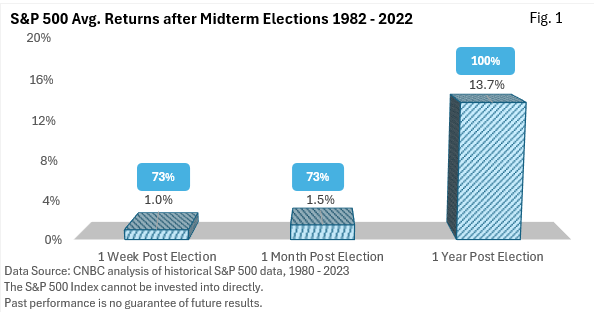
As Figure 1 illustrates, the S&P 500 has generated average returns of 1.0% one week after midterm elections and 1.5% one month afterward, based on data going back to 1982. The index posted gains approximately 73% of the time over those periods.
One year after midterm elections, the S&P 500 delivered an average return of 13.7%, finishing higher following every midterm election included in the analysis.
Stocks and Elections
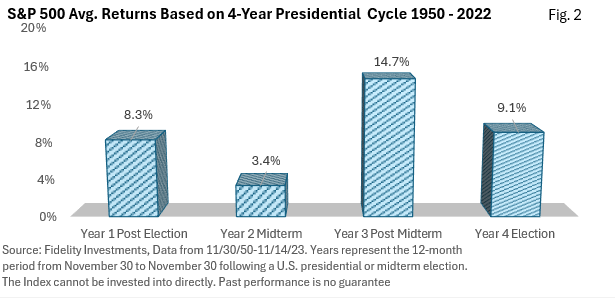
Using data going back to 1950, Figure 2 examines average annual returns for year one, year two, year three, and year four based on the presidential election cycle.
Does the Presidential Election Cycle Matter?
Another way to examine the relationship between elections and markets is to look at returns during each year of the four-year presidential election cycle.
Figure 2 compares average annual S&P 500 returns for the first, second, third, and fourth years of the cycle using historical data beginning in 1950.
While historical returns have varied across the four years, the election calendar alone is not a reliable basis for investment decisions.
Markets are influenced by economic conditions, corporate earnings, inflation, interest rates, and Federal Reserve policy. These factors do not necessarily follow a predictable political timetable.
An election may influence expectations about the economy, but those expectations can change quickly as new information becomes available.
What Matters More Than Election Results?
Over longer periods, stock market returns have been supported by the ability of businesses to grow, innovate, generate earnings, and create value for shareholders.
That does not mean stocks rise every year. Recessions, bear markets, and extended periods of disappointing returns are part of investing.
It does mean that making major investment changes in response to an election can introduce risks of its own.
Investors who move out of the market because they are concerned about a political outcome must eventually decide when to reinvest. Both decisions require correctly anticipating market movements, something that is difficult to do consistently.
For those approaching or living in retirement, a more useful approach is to evaluate whether their investment allocation remains appropriate for their income needs, time horizon, and tolerance for market fluctuations.
A well-considered financial plan should account for the possibility of market volatility regardless of which political party controls Washington.
Keeping the Long-Term Perspective
Last week's market swings illustrated how quickly investor expectations can change. A strong rally one day can give way to selling the next, even when the underlying financial circumstances of individual investors have not changed.
Election results may influence markets, but they do not replace the fundamentals that drive long-term investment performance.
At Stordahl Capital Management, we believe investment decisions should be guided by your financial plan rather than short-term political developments. The goal is not to predict every market movement, but to maintain an investment strategy that supports your retirement income needs and the life you want to live.
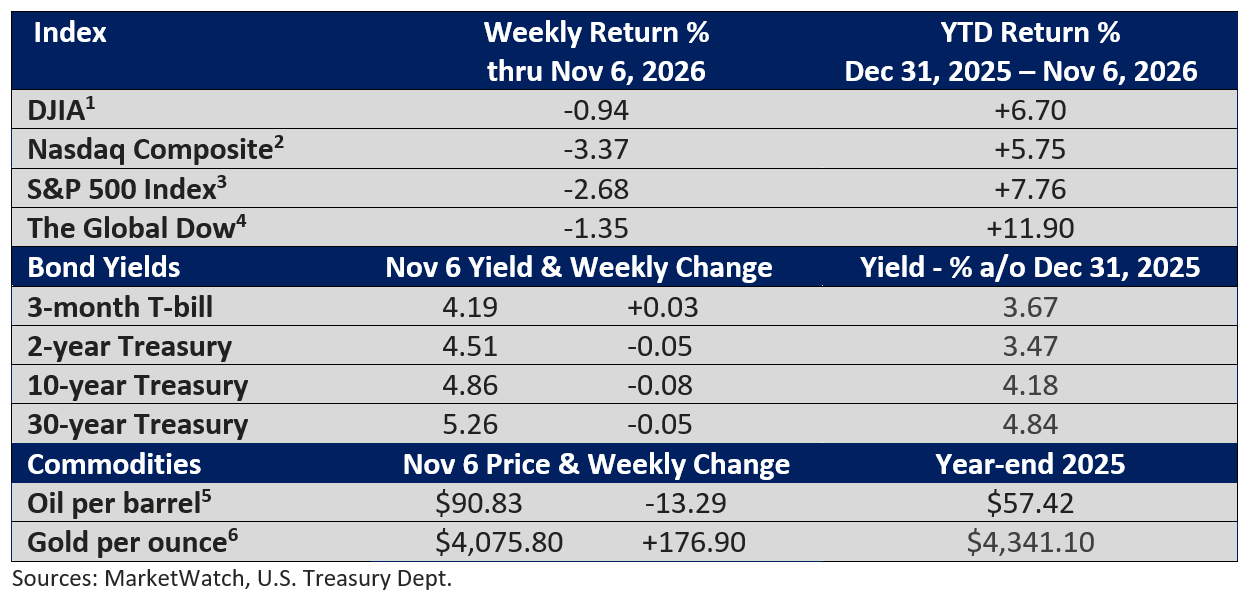
Market summary
TWO FOR THE ROAD
About one-third of US states passed deregulatory housing reforms in 2026, according to a new analysis by The Pew Charitable Trusts. The measures vary by state but include loosening zoning restrictions, eliminating parking requirements, streamlining permitting processes, relaxing staircase and elevator requirements, and legalizing accessory dwelling units, all of which could reduce construction costs and help expand the housing supply. The Pew Trusts, November, 5, 2026
The World Bank’s International Poverty Line is an extremely low poverty line. Set at $3 per day, it draws attention to the living conditions of the poorest people on the planet…In the year 2000, 36% of the world’s population lived on less than $3 per day. In 2024, it was 10%…Progress against higher poverty lines has been large, too. The share living on less than $5 a day has declined from 57% to 25%, and the share living on less than $10 a day has declined from 74% to 53%. – Our World in Data, October 22,2026
I hope you have a great week!
Warmest Regards,
Bill Stordahl, CFP®
Managing Director
Stordahl Capital Management
A Weekly Perspective on Planning and Markets
Each week, we share The Week in Review — a short collection of articles on
financial planning and wealth management, along with a brief overview for context.
One email per week. No promotions, no sales – just clarity.
Stordahl Capital Management, Inc is a Registered Investment Adviser. This commentary is solely for informational purposes and reflects the personal opinions, viewpoints, and analyses of Stordahl Capital Management, Inc. and should not be regarded as a description of advisory services or performance returns of any SCM Clients. The views reflected in the commentary are subject to change at any time without notice. Nothing in this piece constitutes investment advice, performance data or any recommendation that any particular security, portfolio of securities, transaction or investment strategy is suitable for any specific person. Any mention of a particular security and related performance data is not a recommendation to buy or sell that security. Advisory services are only offered to clients or prospective clients where Stordahl Capital Management and its representatives are properly licensed or exempt from licensure. No advice may be rendered by Stordahl Capital Management unless a client service agreement is in place. Stordahl Capital Management, Inc provides links for your convenience to websites produced by other providers or industry-related material. Accessing websites through links directs you away from our website. Stordahl Capital Management is not responsible for errors or omissions in the material on third-party websites and does not necessarily approve of or endorse the information provided. Users who gain access to third-party websites may be subject to the copyright and other restrictions on use imposed by those providers and assume responsibility and risk from the use of those websites. Please note that trading instructions through email, fax, or voicemail will not be taken. Your identity and timely retrieval of instructions cannot be guaranteed. Stordahl Capital Management, Inc. manages its clients’ accounts using a variety of investment techniques and strategies, which are not necessarily discussed in the commentary. Investments in securities involve the risk of loss. Past performance is no guarantee of future results.
1. The Dow Jones Industrials Average is an unmanaged index of 30 major companies which cannot be invested into directly. Past performance does not guarantee future results.
2. The NASDAQ Composite is an unmanaged index of companies which cannot be invested into directly. Past performance does not guarantee future results.
3. The S&P 500 Index is an unmanaged index of 500 larger companies which cannot be invested into directly. Past performance does not guarantee future results.
4. The Global Dow is an unmanaged index composed of stocks of 150 top companies. It cannot be invested into directly. Past performance does not guarantee future results.
5. CME Group front-month contract; Prices can and do vary; past performance does not guarantee future results.
6. CME Group continuous contract; Prices can and do vary; past performance does not guarantee future results.