
Original Medicare vs. Medicare Advantage: Understanding the Pros and Cons
Choosing between Original Medicare and Medicare Advantage is one of the most important healthcare decisions you will make as you approach retirement. Both provide Medicare coverage, but they differ significantly in cost, provider flexibility, and how you receive care.
Original Medicare generally offers greater freedom to choose doctors and hospitals, while Medicare Advantage may provide lower monthly premiums and additional benefits. Neither is automatically the better choice. The right option depends on your healthcare needs, financial circumstances, and what matters most to you.
Understanding these differences before enrolling can help you avoid unexpected costs and limitations later.
Understanding Your Two Medicare Options
When you become eligible for Medicare, generally at age 65, you have two primary ways to receive your healthcare coverage.
Original Medicare, sometimes called Traditional Medicare, is administered by the federal government. It consists of:
Part A, which covers hospital care and certain other inpatient services.
Part B, which covers physician services, outpatient care, and other medically necessary services.
Optional Part D prescription drug coverage through a separate private insurance plan.
Optional Medicare Supplement Insurance, commonly called Medigap, which can help cover deductibles, coinsurance, and other out-of-pocket expenses.
Medicare Advantage, also known as Part C, is an alternative offered by private insurance companies approved by Medicare. These plans provide your Part A and Part B benefits, usually include prescription drug coverage, and may offer additional benefits such as dental, vision, and hearing services.
Medicare Advantage is not supplemental coverage. It is a different way to receive your Medicare benefits.
The official Medicare comparison provides a helpful overview of the differences.
Original Medicare: The Pros and Cons
For many people, the primary appeal of Original Medicare is flexibility. However, that flexibility can come with higher premiums and additional decisions about supplemental coverage.
Advantages of Original Medicare
Greater freedom to choose healthcare providers
With Original Medicare, you can generally visit any doctor or hospital in the United States that accepts Medicare.
You are not restricted to a particular insurance company's provider network, and you generally do not need a referral to see a specialist.
This flexibility may be particularly valuable if you spend part of the year in another state, travel frequently, or want access to specialists at medical centers outside your local area.
Fewer prior authorization requirements
Original Medicare generally does not require prior authorization for most covered medical services.
That can simplify access to care, particularly when multiple physicians or specialists are involved in your treatment.
The option to purchase supplemental coverage
Original Medicare allows you to purchase a Medigap policy to help cover certain out-of-pocket expenses.
For example, after meeting the Part B deductible, Original Medicare generally pays 80% of the Medicare-approved amount for covered Part B services, leaving you responsible for the remaining 20%.
Depending on the Medigap plan you select, supplemental insurance may cover much of that remaining expense.
For someone who values predictable healthcare costs, the combination of Original Medicare and a Medigap policy may be attractive.
Disadvantages of Original Medicare
Potentially higher monthly premiums
Original Medicare combined with Medigap and a separate Part D prescription drug plan can involve several monthly premiums.
You will generally pay your Medicare Part B premium, a Medigap premium, and potentially a Part D premium.
Although supplemental coverage may reduce your expenses when you receive medical care, the recurring premium costs can be higher than those of some Medicare Advantage plans.
No annual out-of-pocket maximum without supplemental coverage
Original Medicare by itself does not have an annual limit on your out-of-pocket costs for covered Part A and Part B services.
Without Medigap or other supplemental coverage, a significant medical event could result in substantial expenses.
Limited coverage for certain services
Original Medicare generally does not cover routine dental care, routine eye exams, hearing aids, or most long-term custodial care.
You may need separate coverage or additional savings to pay for these services.
More coverage decisions to coordinate
You may need to evaluate and maintain separate policies for prescription drugs and supplemental coverage. Each can have its own premiums and enrollment considerations.
Medicare Advantage: The Pros and Cons
Medicare Advantage plans can be appealing because they combine multiple types of coverage into one plan, often with lower monthly premiums.
However, the tradeoff may involve restrictions on healthcare providers and additional requirements for receiving certain services.
Advantages of Medicare Advantage
Potentially lower monthly premiums
Some Medicare Advantage plans have a $0 additional monthly plan premium.
You generally must still pay your Medicare Part B premium, but the absence of an additional plan premium may make Medicare Advantage less expensive on a monthly basis than Original Medicare combined with Medigap and Part D.
Keep in mind that a lower premium does not necessarily mean lower total healthcare costs.
Prescription drug coverage is often included
Most Medicare Advantage plans include Part D prescription drug coverage, eliminating the need to purchase a separate drug plan.
This can simplify how you manage your healthcare coverage.
Additional benefits
Many Medicare Advantage plans offer benefits that Original Medicare generally does not cover, such as certain dental, vision, and hearing services.
Some plans may also include fitness programs or other supplemental benefits.
The scope of these benefits varies considerably. Dental coverage, for example, may be subject to annual limits, restricted provider networks, or exclusions for certain procedures.
An annual out-of-pocket maximum
Medicare Advantage plans have an annual limit on what you pay out of pocket for covered Medicare Part A and Part B services.
Once you reach the applicable limit, the plan generally pays the full cost of covered services for the remainder of the year.
This provides a measure of financial protection that Original Medicare does not offer without supplemental coverage.
However, the maximum can still be substantial, and premiums, prescription drug costs, and noncovered services generally do not count toward that limit.
Disadvantages of Medicare Advantage
Provider network restrictions
Many Medicare Advantage plans operate through Health Maintenance Organization (HMO) or Preferred Provider Organization (PPO) networks.
An HMO generally requires you to receive nonemergency care from providers within its network, subject to certain exceptions. A PPO may allow out-of-network care, but usually at a higher cost.
This can become particularly important if you travel frequently, maintain residences in different states, or want access to a specialist outside your plan's network.
Prior authorization requirements
Medicare Advantage plans may require approval before covering certain medical services, procedures, or supplies.
These requirements can create additional administrative steps and, in some circumstances, delays or disputes over coverage.
Although Medicare Advantage plans must cover medically necessary services that Original Medicare covers, the process for accessing those services can differ.
Costs can vary with healthcare usage
Lower monthly premiums may be offset by copayments, coinsurance, and other expenses when you receive care.
If you require frequent specialist visits, outpatient treatments, or hospital services, your total annual costs may be considerably higher than the monthly premium initially suggests.
Benefits and networks can change
Medicare Advantage plans can change their premiums, provider networks, prescription drug formularies, and supplemental benefits from year to year.
A plan that works well today may be less attractive in the future.
This makes it important to review your coverage annually rather than assuming your current plan will remain appropriate indefinitely.
Original Medicare vs. Medicare Advantage: A Side-by-Side Comparison
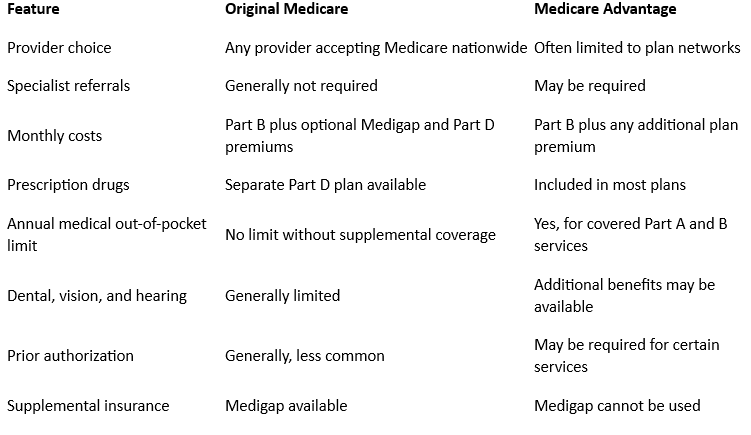
The Medicare.gov coverage comparison offers additional details.
One Important Consideration: Switching Plans Later May Not Be Easy
One of the most overlooked aspects of this decision is the potential difficulty of moving from Medicare Advantage to Original Medicare with supplemental coverage later.
You can generally switch between Original Medicare and Medicare Advantage during Medicare's annual Open Enrollment Period, October 15 through December 7.
However, switching back to Original Medicare does not necessarily mean you will be able to purchase a Medigap policy on the same terms available when you first became eligible.
Under federal rules, your initial Medigap Open Enrollment Period generally lasts six months, beginning the first month you are both age 65 or older and enrolled in Medicare Part B.
During this period, insurance companies generally cannot deny you a Medigap policy because of preexisting health conditions.
After that window closes, insurers may be permitted to evaluate your medical history, charge higher premiums, or deny coverage altogether.
Certain guaranteed-issue protections and state-specific rules provide exceptions, but they do not apply in every situation.
For example, someone might choose Medicare Advantage at age 65 because of its lower premiums and later decide that Original Medicare would provide greater access to specialists. While returning to Original Medicare may be possible, obtaining affordable Medigap coverage could be more difficult.
This is why the initial decision deserves careful consideration.
You can learn more about these protections through Medicare's explanation of Medigap enrollment rights.
How Medicare Choices Affect Your Retirement Financial Plan
Healthcare costs are an important part of retirement planning, and the decision between Original Medicare and Medicare Advantage extends beyond comparing insurance premiums.
Consider two people with different circumstances.
One person is generally healthy, receives most medical care locally, and prefers lower monthly premiums. A Medicare Advantage plan with a suitable provider network may meet that person's needs.
Another person travels extensively, receives care from specialists in multiple states, and prefers broader provider access with more predictable medical expenses. Original Medicare combined with Medigap may be more appealing, despite potentially higher monthly premiums.
Neither approach is inherently better.
What matters is understanding how each option fits your healthcare needs, lifestyle, and financial resources.
There is also an important tax planning consideration.
Medicare Part B and Part D premiums can increase when your income exceeds certain thresholds. These adjustments, known as Income-Related Monthly Adjustment Amounts (IRMAA), can apply whether you choose Original Medicare or Medicare Advantage.
Retirement income decisions, Roth conversions, and investment withdrawals may affect these premiums.
We discuss this further in our article, How to Appeal IRMAA: A Step-by-Step Guide to Lowering Medicare Premiums.
The broader point is that Medicare should be evaluated alongside your retirement income strategy, tax planning, and other financial decisions.
Which Medicare Option Is Right for You?
When comparing Original Medicare and Medicare Advantage, it helps to consider a few practical questions:
How important is it to see doctors and specialists without network restrictions?
Do you travel frequently or spend extended periods away from your primary residence?
Would you prefer higher, more predictable monthly premiums or potentially lower premiums with variable healthcare expenses?
What prescription medications do you take, and how are they covered under the available plans?
How important are additional dental, vision, and hearing benefits?
How might your healthcare needs change over the next 10 or 20 years?
If you choose Medicare Advantage now, would you be comfortable with the possibility that Medigap coverage could be more difficult to obtain later?
It is also important to compare the actual plans available where you live, rather than relying solely on general descriptions of the two Medicare options.
You can use the Medicare Plan Finder to review coverage choices, estimated costs, and available benefits.
Making Medicare Part of Your Retirement Plan
Choosing Medicare coverage is about more than finding the lowest premium. It is about understanding the tradeoffs between cost, flexibility, access to care, and financial predictability.
Original Medicare may appeal to people who value broad provider access and the option to purchase supplemental coverage. Medicare Advantage may appeal to those who prefer an integrated plan with potentially lower monthly premiums and additional benefits.
The right decision depends on your circumstances, and it deserves careful consideration before you enroll.
At Stordahl Capital Management, we believe healthcare decisions should be part of a comprehensive retirement plan. Understanding how Medicare costs fit alongside retirement income, taxes, and long-term financial goals can help you make more informed choices.
If you are approaching Medicare eligibility or preparing for retirement and would like to discuss how healthcare costs fit into your broader financial plan, we invite you to schedule a complimentary 15-minute call.
Frequently Asked Questions
Is Original Medicare better than Medicare Advantage?
Neither option is universally better. Original Medicare generally provides greater flexibility in choosing healthcare providers, while Medicare Advantage may offer lower monthly premiums, integrated prescription drug coverage, and additional benefits. The right choice depends on your healthcare needs, financial circumstances, and preferences.
Can I have Medicare Advantage and a Medigap policy at the same time?
No. Medigap policies are designed to supplement Original Medicare and cannot be used to pay Medicare Advantage out-of-pocket expenses. If you enroll in Medicare Advantage, you generally cannot purchase a Medigap policy for that coverage.
Does Medicare Advantage cover everything Original Medicare covers?
Medicare Advantage plans must cover medically necessary services that Original Medicare covers, subject to applicable rules and exceptions. However, plans may use provider networks, prior authorization, and different cost-sharing arrangements. They may also offer supplemental benefits not included in Original Medicare.
Can I switch from Medicare Advantage to Original Medicare?
Yes, during applicable enrollment periods. However, obtaining a Medigap policy after switching may be more difficult if you are outside your initial Medigap Open Enrollment Period and do not qualify for guaranteed-issue protections. State rules may provide additional rights.
Is Medicare Advantage really free if a plan advertises a $0 premium?
No. A $0 plan premium generally means there is no additional monthly premium for that Medicare Advantage plan. You typically must still pay your Medicare Part B premium, along with applicable deductibles, copayments, coinsurance, and other expenses.
A Weekly Perspective on Planning and Markets
Each week, we share The Week in Review — a short collection of articles on
financial planning and wealth management, along with a brief overview for context.
One email per week. No promotions, no sales – just clarity.
This material was written in collaboration with artificial intelligence (ChatGPT) and derived from sources believed to be correct.
Stordahl Capital Management, Inc is a Registered Investment Adviser. This commentary is solely for informational purposes and reflects the personal opinions, viewpoints, and analyses of Stordahl Capital Management, Inc. and should not be regarded as a description of advisory services or performance returns of any SCM Clients. The views reflected in the commentary are subject to change at any time without notice. Nothing in this piece constitutes investment advice, performance data or any recommendation that any particular security, portfolio of securities, transaction or investment strategy is suitable for any specific person. Any mention of a particular security and related performance data is not a recommendation to buy or sell that security. Advisory services are only offered to clients or prospective clients where Stordahl Capital Management and its representatives are properly licensed or exempt from licensure. No advice may be rendered by Stordahl Capital Management unless a client service agreement is in place. Stordahl Capital Management, Inc provides links for your convenience to websites produced by other providers or industry-related material. Accessing websites through links directs you away from our website. Stordahl Capital Management is not responsible for errors or omissions in the material on third-party websites and does not necessarily approve of or endorse the information provided. Users who gain access to third-party websites may be subject to the copyright and other restrictions on use imposed by those providers and assume responsibility and risk from the use of those websites. Please note that trading instructions through email, fax, or voicemail will not be taken. Your identity and timely retrieval of instructions cannot be guaranteed. Stordahl Capital Management, Inc. manages its clients’ accounts using a variety of investment techniques and strategies, which are not necessarily discussed in the commentary. Investments in securities involve the risk of loss. Past performance is no guarantee of future results.