
The Week in Review: August 17, 2026
Rising Yields Fail to Derail Stocks
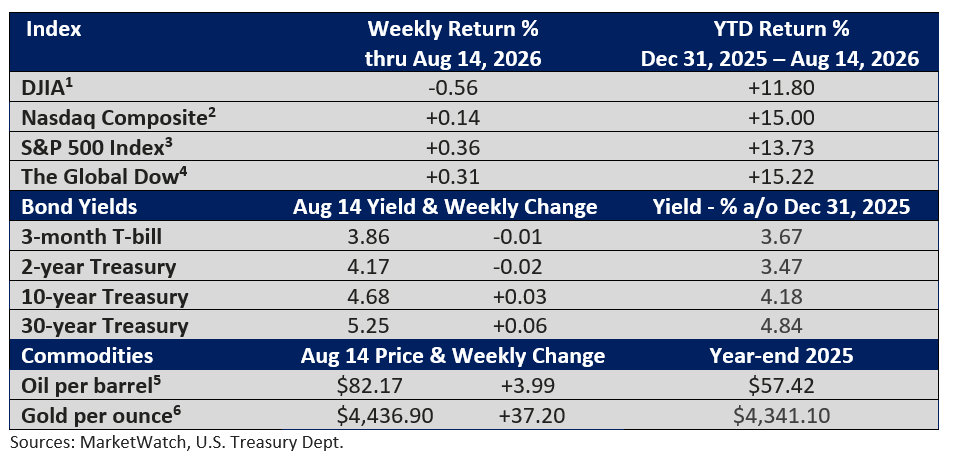
This year, the stock market has risen significantly. Lingering worries about oil prices, inflation, the war with Iran, and the possibility of an AI bubble haven’t subsided.
But the economy is expanding, corporate profits have been strong, and the S&P 500 Index set a new high last week.
Nonetheless, while stocks are up this year, we’ve also watched Treasury bond yields rise, as evidenced by the graphic and weekly table of returns below.
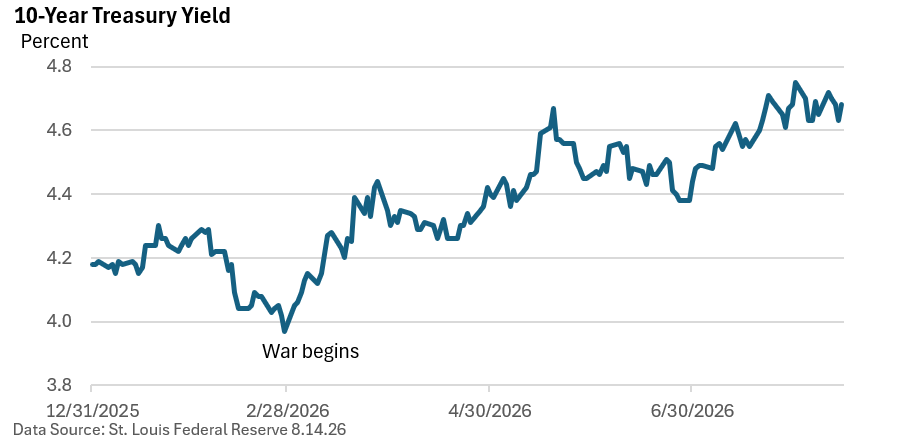
Note that yields briefly snuck under 4% just before the war started. In part, blame rising oil prices and fears that higher oil and other commodities might boost overall inflation at home.
For bondholders, rising yields translate into lower prices, since yields and prices move in opposite directions.
For those looking to buy a home and lock in a mortgage rate, the 30-year mortgage tracks the 10-year yield closely.
Just before the war began, Freddie Mac’s weekly survey recorded an average rate of 5.98%. As of last Thursday, the 30-year mortgage averaged 6.67%, according to the survey.
Yet, despite higher long-term Treasury yields, stocks have had a good run this year, though the market has experienced bouts of volatility, which is normal.
You see, rising bond yields would be expected to create stiffer headwinds for equities.
If an investor can earn a higher return from a Treasury bond, they may choose Treasuries over stocks, as attractive yields could encourage some to reallocate funds within their portfolios.
Higher yields could also slow economic growth, which in turn would likely slow corporate profits.
But the stock market has defied the rise in yields, as booming corporate profits have provided a strong tailwind.
From another perspective, rising bond yields have yet to put downward pressure on stocks and may have simply slowed the market’s rise.
Market summary
TWO FOR THE ROAD
US residents took 24 million trips to Europe in 2025, up from 13.4 million in 2000, while the share of consumer spending devoted to foreign travel has reached a record high. – Wall Street Journal, August 9, 2026
Despite fertilizer and fuel shortages and dry El Niño weather, global production of major staple crops remains at or near all-time highs, thanks in part to the development of drought- and heat-resistant crop varieties. And while El Niño is expected to intensify as the year goes on, new major exporters have broadened the global grain supply, and grain stockpiles are near record levels, giving humanity a substantial buffer against poor harvests. – By the Numbers, August 14, 2026
I hope you have a great week!
Warmest Regards,
Bill Stordahl, CFP®
Managing Director
Stordahl Capital Management
A Weekly Perspective on Planning and Markets
Each week, we share The Week in Review — a short collection of articles on
financial planning and wealth management, along with a brief overview for context.
One email per week. No promotions, no sales – just clarity.
Stordahl Capital Management, Inc is a Registered Investment Adviser. This commentary is solely for informational purposes and reflects the personal opinions, viewpoints, and analyses of Stordahl Capital Management, Inc. and should not be regarded as a description of advisory services or performance returns of any SCM Clients. The views reflected in the commentary are subject to change at any time without notice. Nothing in this piece constitutes investment advice, performance data or any recommendation that any particular security, portfolio of securities, transaction or investment strategy is suitable for any specific person. Any mention of a particular security and related performance data is not a recommendation to buy or sell that security. Advisory services are only offered to clients or prospective clients where Stordahl Capital Management and its representatives are properly licensed or exempt from licensure. No advice may be rendered by Stordahl Capital Management unless a client service agreement is in place. Stordahl Capital Management, Inc provides links for your convenience to websites produced by other providers or industry-related material. Accessing websites through links directs you away from our website. Stordahl Capital Management is not responsible for errors or omissions in the material on third-party websites and does not necessarily approve of or endorse the information provided. Users who gain access to third-party websites may be subject to the copyright and other restrictions on use imposed by those providers and assume responsibility and risk from the use of those websites. Please note that trading instructions through email, fax, or voicemail will not be taken. Your identity and timely retrieval of instructions cannot be guaranteed. Stordahl Capital Management, Inc. manages its clients’ accounts using a variety of investment techniques and strategies, which are not necessarily discussed in the commentary. Investments in securities involve the risk of loss. Past performance is no guarantee of future results.
1. The Dow Jones Industrials Average is an unmanaged index of 30 major companies which cannot be invested into directly. Past performance does not guarantee future results.
2. The NASDAQ Composite is an unmanaged index of companies which cannot be invested into directly. Past performance does not guarantee future results.
3. The S&P 500 Index is an unmanaged index of 500 larger companies which cannot be invested into directly. Past performance does not guarantee future results.
4. The Global Dow is an unmanaged index composed of stocks of 150 top companies. It cannot be invested into directly. Past performance does not guarantee future results.
5. CME Group front-month contract; Prices can and do vary; past performance does not guarantee future results.
6. CME Group continuous contract; Prices can and do vary; past performance does not guarantee future results.