Don't Let Politics Drive Your Investment Decisions
As the November midterm elections approach, political coverage will become increasingly difficult to avoid.
Every election feels important. Every campaign tells us the stakes have never been higher. And depending on the outcome, investors may worry that a change in Congress could be good—or disastrous—for their portfolios.
As citizens, elections matter enormously. Tax policy, government spending, entitlement programs, tariffs, regulation, and the national debt can all be affected by who controls Washington.
But as investors, we should be careful about allowing our political beliefs to influence our investment decisions.
History provides a compelling reason why.
The Market Doesn't Vote
It's tempting to believe that the political party we prefer will also produce better investment returns.
The historical evidence tells a very different story.
Take a look at the first chart below, which compares average S&P 500 returns during presidential election years, midterm election years, and years without a federal election.
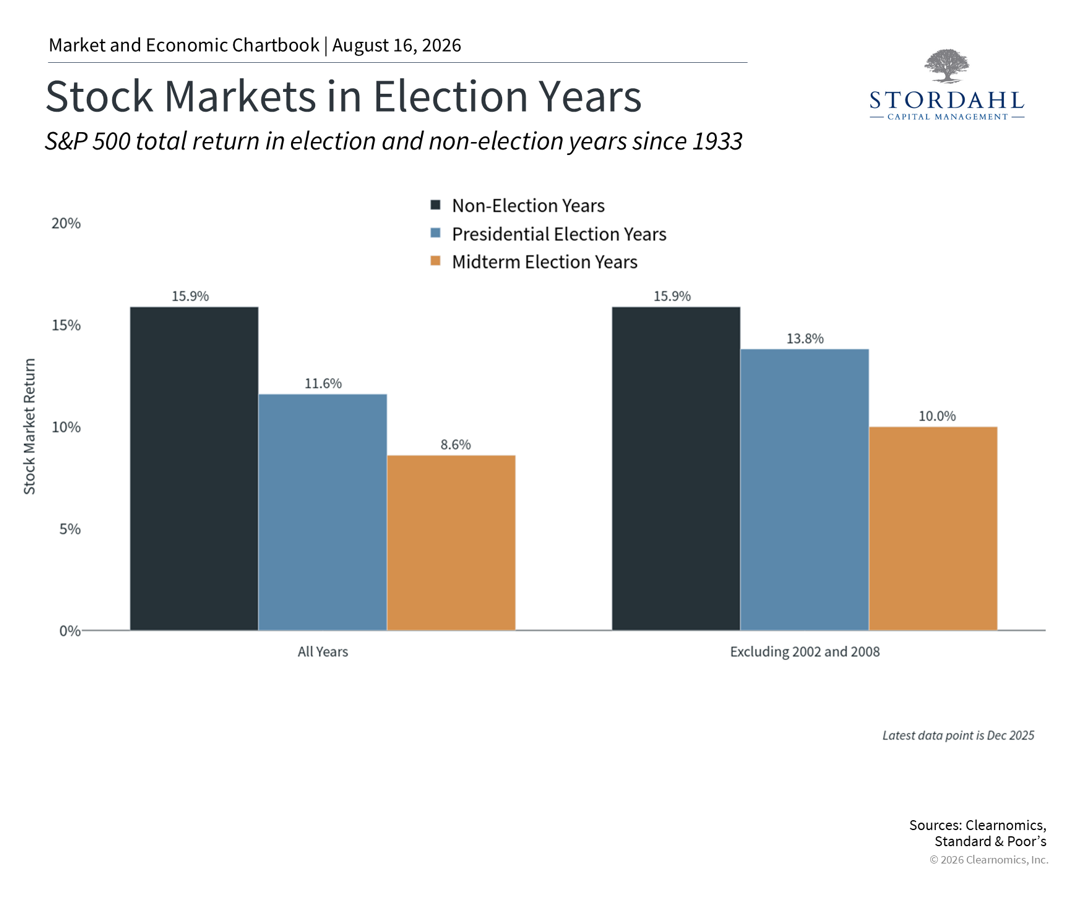
The market has historically produced positive average returns across all three categories. Markets have also performed well during Republican administrations, Democratic administrations, and periods of divided government.
That doesn't mean every election year produces a positive return. It means elections themselves have historically been a poor explanation for why markets rise or fall.
Consider two recent midterm years.
In 2018, markets struggled amid concerns about global economic growth and Federal Reserve policy. In 2022, markets fell as the economy dealt with significant post-pandemic inflation and rapidly rising interest rates.
Both happened to be midterm election years.
But the elections weren't what drove the markets. The underlying economic conditions were.
The Economy Usually Matters More Than Washington
Investors understandably pay close attention to Washington. But over longer periods, the business cycle, corporate earnings, inflation, interest rates, innovation, and economic growth have generally been much more important to investment returns.
The second chart helps put this into perspective.
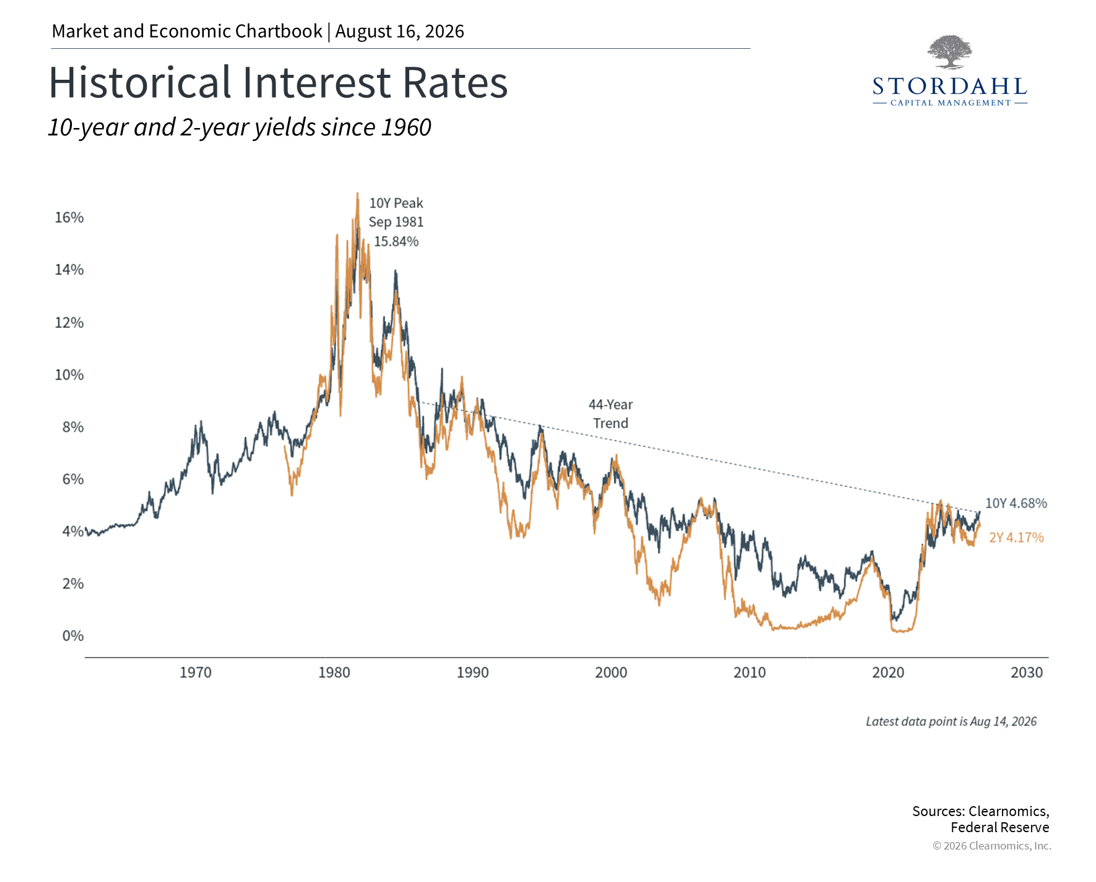
Interest rates have moved through enormous cycles over the past several decades. Those movements have affected the cost of mortgages, business borrowing, bonds, stock valuations, consumer spending, and ultimately the economy itself.
For investors, forces like these tend to matter much more than which party controls Congress.
Think about some of the biggest forces that have shaped markets over the past several decades: the technology revolution of the 1990s, the housing boom and financial crisis, the pandemic, the inflation that followed, and today's artificial intelligence boom.
None fit neatly into a Republican or Democratic investment narrative.
Policy Matters—But Markets Are More Complicated
None of this means elections or public policy are irrelevant.
Changes to taxes, tariffs, government spending, regulation, and other policies can absolutely affect businesses, consumers, and markets.
But there is an important difference between saying policy matters and believing we can reliably translate an election result into an investment decision.
The economy is simply too complicated.
Economic growth, corporate profits, employment, inflation, interest rates, consumer behavior, technological innovation, and global events are all interacting at the same time. Even significant policy changes can take years to work their way through the economy.
And markets don't wait.
Stock prices continuously adjust as millions of investors evaluate what new information might mean for the future.
By the time an election result is known, expectations surrounding that outcome may already be reflected in market prices.
A Century of Perspective
Perhaps the most important chart is the last one.
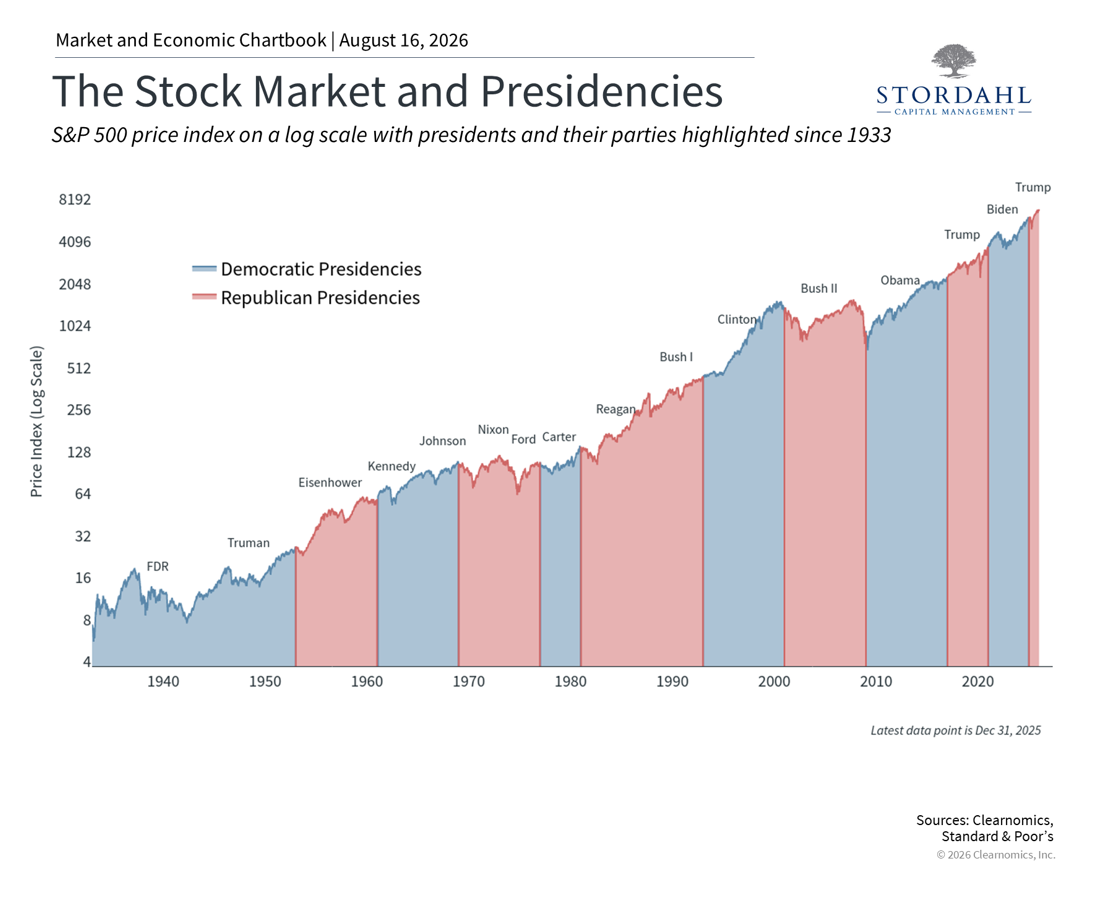
It shows the growth of the U.S. stock market across nearly a century of Democratic and Republican administrations.
Look at all that happened during that period.
Wars.
Recessions.
Inflation.
Financial crises.
Political scandals.
Tax increases and tax cuts.
Democratic presidents.
Republican presidents.
Unified governments and divided governments.
And yet the long-term direction of the American stock market has remained remarkably clear.
That's not because politics don't matter.
It's because the American economy is much bigger than any one president, Congress, political party, or election.
Thousands of businesses continue trying to innovate, compete, earn profits, and create value regardless of who occupies the White House or controls Congress.
Don't Turn Your Portfolio Into a Political Statement
This may be the most important lesson as we approach November.
Vote according to your beliefs.
Care deeply about the issues.
Support the candidates you believe will make the country better.
But don't assume your political convictions give you an investment advantage.
Investors from both sides of the political spectrum can fall into this trap.
When their preferred party wins, they become overly optimistic. When the other party wins, they become convinced that markets or the economy are headed for disaster.
That can lead to one of the most damaging investment decisions of all: moving money out of the market because you dislike an election result.
Your portfolio isn't a ballot.
It's there to fund your retirement, support your family, provide financial independence, and help you achieve the goals you've spent a lifetime working toward.
Those objectives shouldn't change every two or four years.
The Bottom Line
The November midterms will matter.
They may change the balance of power in Washington and influence important debates about taxes, spending, tariffs, entitlement programs, foreign policy, and the federal debt.
But history suggests investors should resist the temptation to restructure their portfolios based on who wins.
The stock market has grown through Democratic administrations and Republican administrations, unified governments and divided governments, and countless periods when Americans were convinced the political stakes had never been higher.
The better approach is to maintain a portfolio designed for a wide range of political and economic environments and remain focused on the goals your money is ultimately intended to achieve.
Make your political views heard at the ballot box—not through your investment portfolio.
If election-year headlines have you questioning your investment strategy, we invite you to schedule a complimentary 15-minute call to discuss your concerns and how your financial plan is positioned for the years ahead.
References
1. https://www.usa.gov/midterm-elections
2. https://www.realclearpolling.com/latest-polls/2026
3. https://polymarket.com/event/balance-of-power-2026-midterms
4. Clearnomics research and Standard & Poor's data, as of August 7, 2026
5. Clearnomics research and Standard & Poor's data, as of August 7, 2026
Index Descriptions
S&P 500
The Standard & Poor's 500 Index is a capitalization-weighted index of 500 stocks designed to measure performance of the broad domestic economy through changes in the aggregate market value of 500 stocks representing all major industries. The modern design of the S&P 500 stock index was first launched in 1957. Performance prior to 1957 incorporates the performance of the predecessor index, the S&P 90.
A Weekly Perspective on Planning and Markets
Each week, we share The Week in Review — a short collection of articles on
financial planning and wealth management, along with a brief overview for context.
One email per week. No promotions, no sales – just clarity.
This material was written in collaboration with artificial intelligence (ChatGPT) and derived from sources believed to be correct.
Stordahl Capital Management, Inc is a Registered Investment Adviser. This commentary is solely for informational purposes and reflects the personal opinions, viewpoints, and analyses of Stordahl Capital Management, Inc. and should not be regarded as a description of advisory services or performance returns of any SCM Clients. The views reflected in the commentary are subject to change at any time without notice. Nothing in this piece constitutes investment advice, performance data or any recommendation that any particular security, portfolio of securities, transaction or investment strategy is suitable for any specific person. Any mention of a particular security and related performance data is not a recommendation to buy or sell that security. Advisory services are only offered to clients or prospective clients where Stordahl Capital Management and its representatives are properly licensed or exempt from licensure. No advice may be rendered by Stordahl Capital Management unless a client service agreement is in place. Stordahl Capital Management, Inc provides links for your convenience to websites produced by other providers or industry-related material. Accessing websites through links directs you away from our website. Stordahl Capital Management is not responsible for errors or omissions in the material on third-party websites and does not necessarily approve of or endorse the information provided. Users who gain access to third-party websites may be subject to the copyright and other restrictions on use imposed by those providers and assume responsibility and risk from the use of those websites. Please note that trading instructions through email, fax, or voicemail will not be taken. Your identity and timely retrieval of instructions cannot be guaranteed. Stordahl Capital Management, Inc. manages its clients’ accounts using a variety of investment techniques and strategies, which are not necessarily discussed in the commentary. Investments in securities involve the risk of loss. Past performance is no guarantee of future results.
Copyright (c) 2024 Clearnomics, Inc. All rights reserved. The information contained herein has been obtained from sources believed to be reliable, but is not necessarily complete and its accuracy cannot be guaranteed. No representation or warranty, express or implied, is made as to the fairness, accuracy, completeness, or correctness of the information and opinions contained herein. The views and the other information provided are subject to change without notice. All reports posted on or via www.clearnomics.com or any affiliated websites, applications, or services are issued without regard to the specific investment objectives, financial situation, or particular needs of any specific recipient and are not to be construed as a solicitation or an offer to buy or sell any securities or related financial instruments. Past performance is not necessarily a guide to future results. Company fundamentals and earnings may be mentioned occasionally, but should not be construed as a recommendation to buy, sell, or hold the company's stock. Predictions, forecasts, and estimates for any and all markets should not be construed as recommendations to buy, sell, or hold any security--including mutual funds, futures contracts, and exchange traded funds, or any similar instruments. The text, images, and other materials contained or displayed in this report are proprietary to Clearnomics, Inc. and constitute valuable intellectual property. All unauthorized reproduction or other use of material from Clearnomics, Inc. shall be deemed willful infringement(s) of this copyright and other proprietary and intellectual property rights, including but not limited to, rights of privacy. Clearnomics, Inc. expressly reserves all rights in connection with its intellectual property, including without limitation the right to block the transfer of its products and services and/or to track usage thereof, through electronic tracking technology, and all other lawful means, now known or hereafter devised. Clearnomics, Inc. reserves the right, without further notice, to pursue to the fullest extent allowed by the law any and all criminal and civil remedies for the violation of its rights.