
The Week in Review: October 5, 2026
When Bad Economic News Is Good News for Investors
Wall Street has a funny way of looking at things. Last week, we learned that the U.S. economy added far fewer jobs than expected in September. Normally, you would think disappointing employment numbers would be bad news for stocks.
Instead, investors seemed relieved.
Why? Because weaker hiring makes it less likely that the Federal Reserve will raise interest rates at its meeting later this month.
Of course, nobody wants to see people struggling to find work. But investors have spent much of the year worrying about interest rates, and a cooler labor market may give the Fed a reason to leave them alone.
The interesting part of this report is that, despite the weak headline number, the underlying economic picture isn't nearly as troubling as it might first appear.
Hiring Has Slowed. Is That a Problem?
The economy added just 29,000 jobs in September. August's originally reported gain of 162,000 was also revised down to 133,000.
Those aren't particularly impressive numbers, especially compared with the hiring we saw earlier in the economic expansion. But monthly employment reports can be surprisingly noisy. One month looks strong, the next looks weak, and earlier figures are often revised.
That's why we prefer to look at the three-month average rather than getting too excited or concerned about any single report.
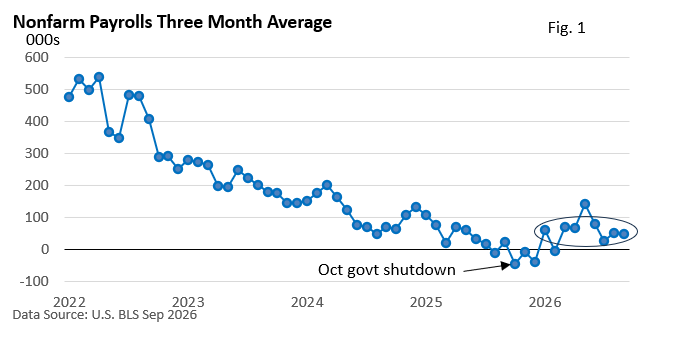
The chart tells an interesting story. Hiring has slowed considerably from the exceptionally strong pace of a few years ago, but it has also been relatively steady over seven of the past nine periods.
Employers are still adding workers. They're simply doing so at a much slower pace.
What's particularly interesting is that this is happening while the broader economy appears to be picking up speed.
Last week, the Bureau of Economic Analysis revised economic growth higher for both the first and second quarters. The Atlanta Fed's GDPNow model is also pointing toward strong growth in the third quarter.
So we have an economy that appears to be growing at a healthy pace while businesses are hiring relatively few additional workers.
That may seem contradictory, but businesses can increase production without expanding their workforces at the same rate. Improvements in productivity, technology, and how companies use their existing employees can all play a role.
For now, the employment numbers suggest that companies are being more selective about hiring, rather than indicating that the economy has suddenly hit a wall.
What About the Increase in Unemployment?
You may have seen headlines reporting that the unemployment rate rose from 4.1% in August to 4.2% in September.
That sounds like a meaningful increase, but the actual change was quite small. Before rounding, unemployment moved from 4.14% to 4.175%.
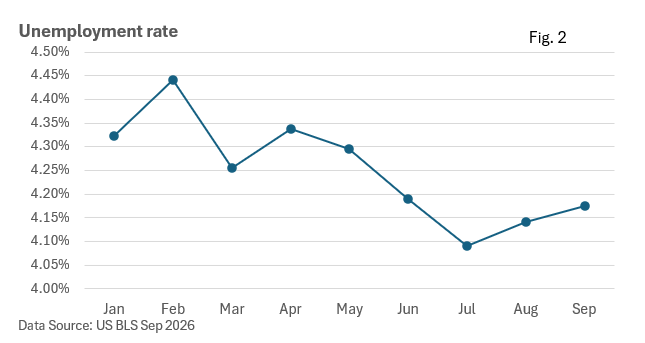
There's another detail worth understanding. Unemployment didn't rise because the economy lost jobs. It rose because more people entered the labor force.
Employment increased in September, but the number of people looking for work increased even faster. As a result, the number of unemployed Americans edged higher.
That's a very different situation from one in which companies are laying off large numbers of workers.
We don't want to dismiss signs of a cooling labor market. If hiring remains weak for an extended period, it could eventually become a concern. But the latest unemployment figures don't suggest that the job market is deteriorating as quickly as the headlines might lead you to believe.
Why Did Investors Like the News?
The Federal Reserve is the key to understanding last week's market reaction.
The Fed has been trying to keep inflation under control without unnecessarily slowing the economy. Strong hiring can make that job more difficult because a tight labor market may contribute to wage pressures and inflation.
A weaker employment report gives policymakers a little more room to be patient.
Following September's report, investors became less concerned about the possibility of another interest rate increase at the Fed's late-October meeting.
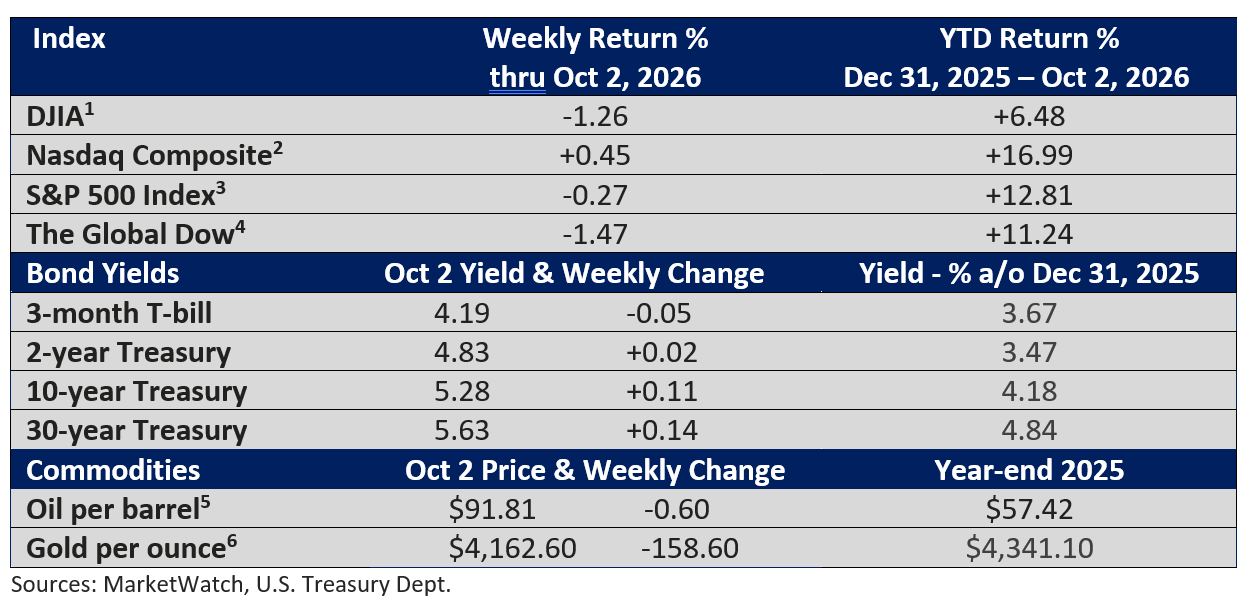
That helped explain why the Nasdaq Composite managed to gain 0.45% last week, even though the Dow fell 1.26% and the S&P 500 slipped 0.27%.
But the bond market offered an important reminder that interest rates aren't controlled entirely by the Fed.
The 10-year Treasury yield rose to 5.28%, while the 30-year yield climbed to 5.63%. Longer-term interest rates reflect a much broader set of expectations, including economic growth, inflation, and the amount of government borrowing.
So even as investors became less concerned about an immediate Fed rate increase, longer-term borrowing costs continued to rise.
That's one of the reasons predicting interest rates is so difficult. Even when you correctly anticipate what the Fed might do, the bond market doesn't necessarily cooperate.
What Does This Mean for Your Investments?
We spend a lot of time looking at economic data, but we try not to let any single report dictate our investment decisions.
September's employment numbers are a good example of why.
A disappointing jobs report helped ease concerns about another Fed rate increase. At the same time, stronger economic growth and higher long-term Treasury yields complicated the picture. And despite all the attention paid to the report, the major stock indexes finished the week moving in different directions.
It's tempting to look at the latest economic news and try to figure out what the market will do next. The trouble is that even when we know the numbers, we don't know exactly how investors will react to them.
For SCM clients, our focus remains on building portfolios that can support your financial plan through a variety of economic environments.
If you're retired or approaching retirement, that means having an appropriate amount of money available for near-term spending so that a temporary market decline does not force you to sell long-term investments at an inconvenient time. It also means keeping enough invested for growth to help your portfolio support you over what could be a very long retirement.
We'll continue watching employment, inflation, economic growth, and interest rates. They are all important pieces of the puzzle. But we're not going to make major changes to a well-constructed portfolio every time a new economic report surprises Wall Street.
Your financial plan shouldn't depend on correctly predicting the next jobs report or the Fed's next decision.
Market summary
TWO FOR THE ROAD
Despite the war with Iran and its associated oil-supply shock, consensus forecasts compiled by the World Bank predict that the global economy will grow by around 2.6 percent in 2026, roughly equal to forecasts at the start of the year. – World Bank, September 28, 2026
According to data from the National Insurance Crime Bureau, vehicle thefts in the US fell 21 percent in the first half of 2026 compared with the same period last year. The bureau previously reported that vehicle thefts fell more than 20 percent between 2024 and 2025, reaching their lowest level in decades. – National Insurance Crime Bureau, September 30, 2026
I hope you have a great week!
Warmest Regards,
Bill Stordahl, CFP®
Managing Director
Stordahl Capital Management
A Weekly Perspective on Planning and Markets
Each week, we share The Week in Review — a short collection of articles on
financial planning and wealth management, along with a brief overview for context.
One email per week. No promotions, no sales – just clarity.
Stordahl Capital Management, Inc is a Registered Investment Adviser. This commentary is solely for informational purposes and reflects the personal opinions, viewpoints, and analyses of Stordahl Capital Management, Inc. and should not be regarded as a description of advisory services or performance returns of any SCM Clients. The views reflected in the commentary are subject to change at any time without notice. Nothing in this piece constitutes investment advice, performance data or any recommendation that any particular security, portfolio of securities, transaction or investment strategy is suitable for any specific person. Any mention of a particular security and related performance data is not a recommendation to buy or sell that security. Advisory services are only offered to clients or prospective clients where Stordahl Capital Management and its representatives are properly licensed or exempt from licensure. No advice may be rendered by Stordahl Capital Management unless a client service agreement is in place. Stordahl Capital Management, Inc provides links for your convenience to websites produced by other providers or industry-related material. Accessing websites through links directs you away from our website. Stordahl Capital Management is not responsible for errors or omissions in the material on third-party websites and does not necessarily approve of or endorse the information provided. Users who gain access to third-party websites may be subject to the copyright and other restrictions on use imposed by those providers and assume responsibility and risk from the use of those websites. Please note that trading instructions through email, fax, or voicemail will not be taken. Your identity and timely retrieval of instructions cannot be guaranteed. Stordahl Capital Management, Inc. manages its clients’ accounts using a variety of investment techniques and strategies, which are not necessarily discussed in the commentary. Investments in securities involve the risk of loss. Past performance is no guarantee of future results.
1. The Dow Jones Industrials Average is an unmanaged index of 30 major companies which cannot be invested into directly. Past performance does not guarantee future results.
2. The NASDAQ Composite is an unmanaged index of companies which cannot be invested into directly. Past performance does not guarantee future results.
3. The S&P 500 Index is an unmanaged index of 500 larger companies which cannot be invested into directly. Past performance does not guarantee future results.
4. The Global Dow is an unmanaged index composed of stocks of 150 top companies. It cannot be invested into directly. Past performance does not guarantee future results.
5. CME Group front-month contract; Prices can and do vary; past performance does not guarantee future results.
6. CME Group continuous contract; Prices can and do vary; past performance does not guarantee future results.