The Week in Review: October 19, 2026
Is Inflation Becoming Entrenched in the Economy?
Inflation has come down significantly from its recent highs, but returning to the Federal Reserve's 2% target has proven difficult. The longer inflation remains elevated, the greater the concern that higher prices become an accepted part of everyday economic decisions.
The Federal Reserve has two primary responsibilities, maintaining price stability and supporting maximum employment.
Its 2% inflation target, formally adopted in 2012, is intended to provide a modest cushion against deflation while keeping price increases predictable for consumers and businesses.
Even small differences in inflation can have a meaningful impact over time. Using the Rule of 72, prices would approximately double in:
· 36 years at 2% inflation
· 24 years at 3% inflation
· 18 years at 4% inflation
· 14 years at 5% inflation
· 10 years at 7% inflation
For someone planning for a retirement that could span 25 or 30 years, maintaining purchasing power is the most important issue.
Why Persistent Inflation Matters
According to the Bureau of Labor Statistics, consumer prices increased 3.7% over the 12 months ending in September. Using the Consumer Price Index as a measure, inflation has remained above 2% for 67 consecutive months, one of the longest stretches since 1965
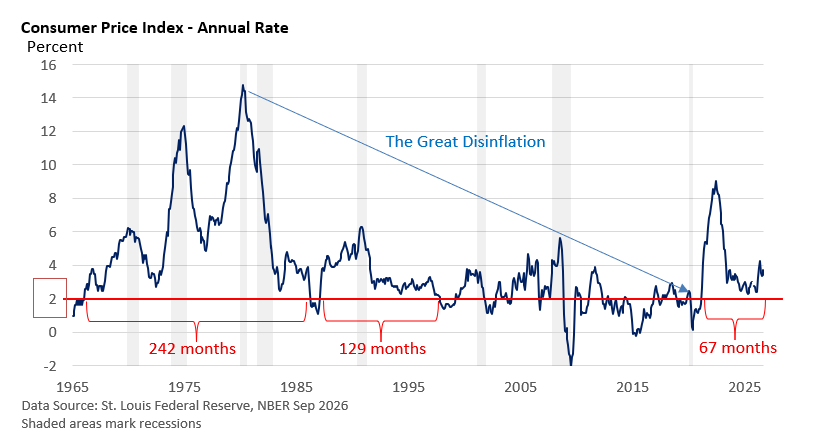
The concern is that inflation can become self-reinforcing. Businesses anticipating higher costs may raise prices, workers may seek larger wage increases, and consumers may accelerate purchases to avoid future price increases. These behaviors can make inflation more difficult to control.
We saw the consequences of entrenched inflation in the early 1980s, when exceptionally high interest rates helped bring prices under control but also contributed to a severe recession. Today's environment is very different, but the historical lesson remains relevant.
What It Means for You
Higher interest rates can benefit savers through improved yields on cash and newly issued bonds. However, rising rates generally put downward pressure on existing bond prices and can create challenges for stock valuations.
For those approaching or living in retirement, inflation also affects how much income a portfolio needs to provide over time. A financial plan should account for rising living expenses, changing market conditions, and the flexibility to make adjustments along the way.
While inflation may not return to the Fed's target as quickly as hoped, the objective is not to predict every economic development. It is to maintain a thoughtful, diversified portfolio that supports your goals and maintains your purchasing power through different economic environments.
Market summary
TWO FOR THE ROAD
In the long run, corporate earnings and dividend yield drive stock prices. - The Economic Times, October 24, 2018
Despite significant changes in federal tax rates over the decades, federal tax collections have remained remarkably consistent as a percentage of the economy. This observation, sometimes called Hauser's Law, is supported by Congressional Budget Office data showing that federal revenues have averaged approximately 17.3% of GDP over the past 50 years. It is a reminder that higher tax rates do not necessarily translate into proportionately higher revenues. Economic growth, taxpayer behavior, and the structure of the tax system all influence how much the government ultimately collects.
I hope you have a great week!
Warmest Regards,
Bill Stordahl, CFP®
Managing Director
Stordahl Capital Management
A Weekly Perspective on Planning and Markets
Each week, we share The Week in Review — a short collection of articles on
financial planning and wealth management, along with a brief overview for context.
One email per week. No promotions, no sales – just clarity.
Stordahl Capital Management, Inc is a Registered Investment Adviser. This commentary is solely for informational purposes and reflects the personal opinions, viewpoints, and analyses of Stordahl Capital Management, Inc. and should not be regarded as a description of advisory services or performance returns of any SCM Clients. The views reflected in the commentary are subject to change at any time without notice. Nothing in this piece constitutes investment advice, performance data or any recommendation that any particular security, portfolio of securities, transaction or investment strategy is suitable for any specific person. Any mention of a particular security and related performance data is not a recommendation to buy or sell that security. Advisory services are only offered to clients or prospective clients where Stordahl Capital Management and its representatives are properly licensed or exempt from licensure. No advice may be rendered by Stordahl Capital Management unless a client service agreement is in place. Stordahl Capital Management, Inc provides links for your convenience to websites produced by other providers or industry-related material. Accessing websites through links directs you away from our website. Stordahl Capital Management is not responsible for errors or omissions in the material on third-party websites and does not necessarily approve of or endorse the information provided. Users who gain access to third-party websites may be subject to the copyright and other restrictions on use imposed by those providers and assume responsibility and risk from the use of those websites. Please note that trading instructions through email, fax, or voicemail will not be taken. Your identity and timely retrieval of instructions cannot be guaranteed. Stordahl Capital Management, Inc. manages its clients’ accounts using a variety of investment techniques and strategies, which are not necessarily discussed in the commentary. Investments in securities involve the risk of loss. Past performance is no guarantee of future results.
1. The Dow Jones Industrials Average is an unmanaged index of 30 major companies which cannot be invested into directly. Past performance does not guarantee future results.
2. The NASDAQ Composite is an unmanaged index of companies which cannot be invested into directly. Past performance does not guarantee future results.
3. The S&P 500 Index is an unmanaged index of 500 larger companies which cannot be invested into directly. Past performance does not guarantee future results.
4. The Global Dow is an unmanaged index composed of stocks of 150 top companies. It cannot be invested into directly. Past performance does not guarantee future results.
5. CME Group front-month contract; Prices can and do vary; past performance does not guarantee future results.
6. CME Group continuous contract; Prices can and do vary; past performance does not guarantee future results.