The Week in Review: November 23, 2026
Consumers Stay Strong, Investors Lose Their Footing
It was a difficult week for investors, even as the latest consumer spending data offered reasons for optimism about the economy.
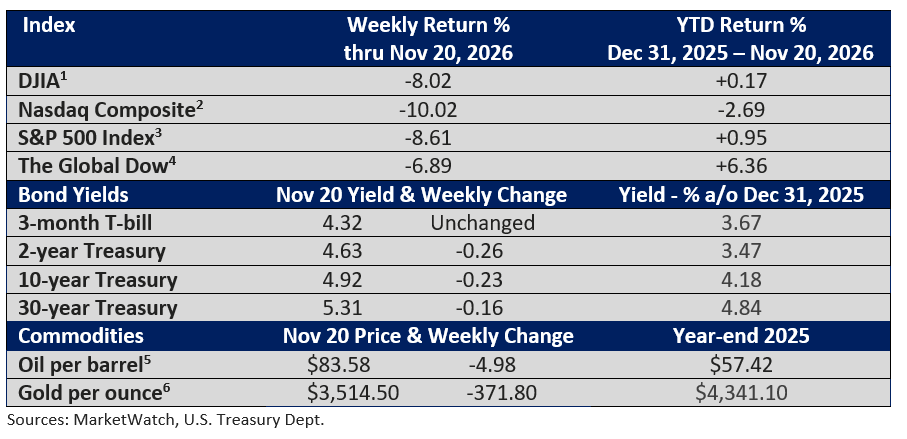
The S&P 500 declined 8.6% for the week ending November 20, bringing the index more than 10% below its October record high and officially into correction territory. The Nasdaq Composite fell 10%, while the
Dow Jones Industrial Average lost 8%.
Much of the selling reflected growing concerns about artificial intelligence investments, technology company valuations, and whether the enormous amounts being spent on AI infrastructure will ultimately generate the profits investors expect.
Yet beneath the market volatility, consumer spending continues to show resilience.
And for long-term investors, the decline in stock prices has brought valuations back to more reasonable levels.
Consumer Spending Remains Resilient
Higher gasoline prices have frustrated households throughout the year. More money spent at the pump can leave less available for restaurants, entertainment, travel, and other discretionary purchases.
Yet October's retail sales report suggests consumers are continuing to spend.
According to the U.S. Census Bureau, retail sales increased 0.2% in October. A 1.6% decline in auto sales weighed on the overall figure. Excluding autos, sales increased 0.6%, while sales excluding both autos and gasoline stations rose 0.5%.
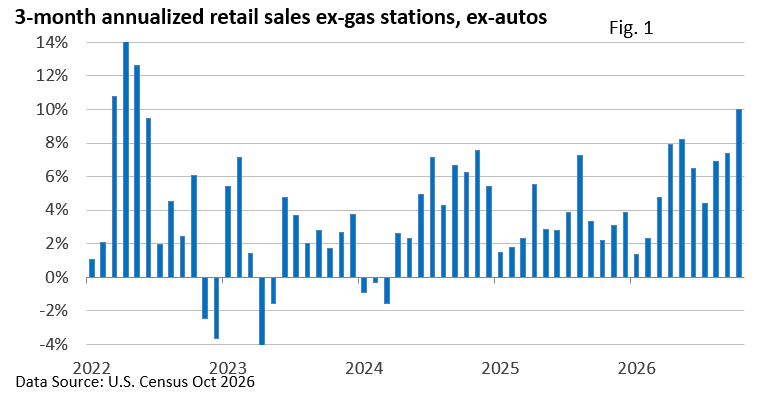
Figure 1 shows that underlying retail sales growth accelerated in recent months, reaching approximately 10% on a three-month annualized basis in October.
Although retail sales can fluctuate from month to month, the recent trend suggests that consumer demand remains an important source of support for the economy.
These figures measure dollars spent rather than inflation-adjusted purchases, so some of the growth reflects higher prices. Even so, the persistence of consumer spending is noteworthy given the financial pressures many households continue to experience.
Restaurant Spending Offers Another Sign of Strength
Restaurants and bars provide a useful perspective on consumer behavior because dining out is generally a discretionary expense.
Despite higher prices, Americans continue to spend on dining experiences.
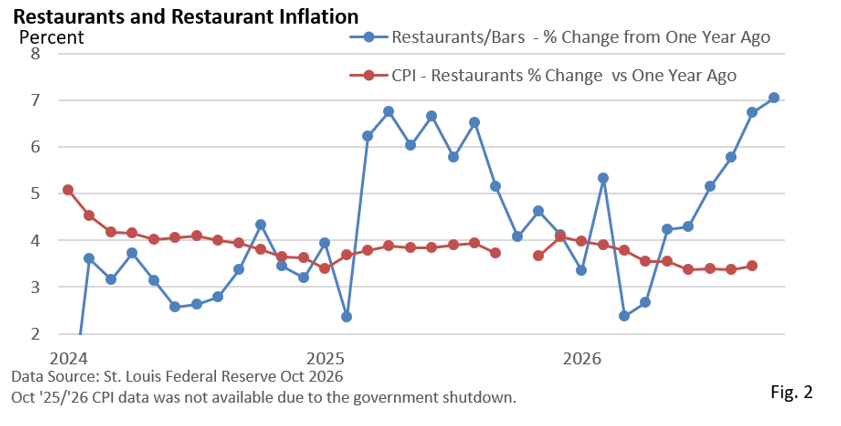
Figure 2 shows that restaurant and bar sales growth has recently accelerated to approximately 7% from a year earlier. Meanwhile, the latest available restaurant inflation readings have been closer to 3.5%.
This suggests that higher restaurant receipts aren't simply the result of rising menu prices. Consumer spending on dining out appears to be growing faster than restaurant prices.
Of course, this doesn't mean every household is financially comfortable. Higher living costs continue to affect families differently.
But the data reinforces an important point: consumer activity is still relatively resilient, even as concerns about the economy persist.
Investors Reconsider the AI Investment Boom
While consumer spending has remained positive, investors have become increasingly cautious about the outlook for artificial intelligence.
AI-related companies have been among the market's strongest performers, benefiting from enthusiasm surrounding advanced semiconductors, data centers, and the potential for new technologies to transform businesses.
That enthusiasm has also created substantial expectations.
Investors are now asking whether the enormous sums being committed to AI infrastructure will produce sufficient returns, how quickly those investments will become profitable, and whether current stock valuations adequately reflect the risks.
Concerns about competition, semiconductor export restrictions, and the pace of data center development have added to uncertainty.
These questions contributed to a sharp sell-off in technology shares during the week. The weakness also spread beyond technology, pulling the broader market lower.
The S&P 500 finished the week more than 10% below its October peak, meeting the commonly used definition of a market correction.
A correction can be unsettling, particularly after a prolonged period of strong market performance. But it doesn't necessarily mean the economy is headed toward recession.
Sometimes it reflects investors reconsidering how much they're willing to pay for future growth.
Lower Stock Prices Are Bringing Valuations Back into Focus
One encouraging aspect of the recent market pullback is that stock valuations have become more attractive.
The S&P 500's forward price-to-earnings ratio, which compares stock prices with expected earnings over the next 12 months, has fallen considerably.
According to StreetStats, the index traded at approximately 16.6 times forward earnings as of November 20, compared with substantially higher valuations earlier in the year.
For perspective, FactSet reported that the S&P 500's 25-year average forward P/E was approximately 16.4.
That places current valuations much closer to their longer-term historical average.
This matters because the price investors pay for future earnings influences their potential long-term returns.
When stock prices decline without a comparable reduction in expected earnings, valuations become more attractive.
However, lower valuations don't guarantee that stocks will immediately recover. Earnings forecasts can change, economic conditions can deteriorate, and markets may experience additional volatility.
Still, for investors with a long-term perspective, more reasonable valuations can create opportunities that weren't available when prices were considerably higher.
Why Stocks Can Pull Back While the Economy Remains Healthy
The contrast between resilient consumer spending and falling stock prices is worth understanding.
Economic reports largely describe what has happened or is happening. Stock prices, on the other hand, reflect expectations about future corporate earnings, interest rates, and economic growth.
When investors become particularly optimistic, stock valuations can rise substantially.
If those expectations begin to change, prices can decline even when current economic conditions remain relatively healthy.
That's an important part of the current environment.
Consumer spending continues to support economic activity, while investors are reassessing the future profitability of AI-related investments and the valuations of companies associated with that growth.
The two developments aren't necessarily contradictory.
A healthy economy doesn't prevent stock market corrections, just as a strong stock market doesn't guarantee that every part of the economy is performing well.
SCM's Perspective: Keeping Market Volatility in Context
At Stordahl Capital Management, we understand that a week like this can be unsettling, particularly for individuals approaching or enjoying retirement.
An 8.6% weekly decline in the S&P 500 is significant, and we don't believe investors should simply dismiss it.
At the same time, market corrections are a normal, if uncomfortable, part of long-term investing.
Artificial intelligence may continue to transform businesses and industries for years to come. But recognizing the potential of a new technology is different from knowing which companies will benefit most or what investors should pay for their shares.
That's one reason our investment philosophy emphasizes broad diversification, disciplined portfolio management, and a long-term perspective rather than concentrating investments around a particular company or market trend.
We also believe it's important to recognize that market declines can improve future investment opportunities.
When prices fall while corporate earnings expectations remain relatively healthy, valuations become more appealing. Although no one can consistently predict when a market will reach its bottom, lower valuations can provide a more favorable starting point for long-term investors.
For those approaching or enjoying retirement, the more important question is whether their investment allocation remains appropriate for their circumstances.
A thoughtfully constructed retirement portfolio should balance the need for long-term growth with sufficient liquidity and high-quality fixed-income investments to help meet near-term spending needs.
That balance can reduce the pressure to sell stocks during market downturns while maintaining the opportunity to participate in future market growth.
Successful investing doesn't require predicting every market decline or identifying the next winning technology company.
It requires a disciplined approach that reflects your goals, income needs, and willingness to accept risk.
You can learn more about our philosophy in Evidence-Based Investing in Brief.
Market summary
Wishing You a Wonderful Thanksgiving
As Thanksgiving approaches, we hope you'll have the opportunity to slow down, enjoy the holiday, and spend meaningful time with family and friends.
All of us at Stordahl Capital Management are grateful for the trust you place in us and wish you and your loved ones a wonderful Thanksgiving filled with happiness, gratitude, and cherished memories.
Warmest Regards,
Bill Stordahl, CFP®
Managing Director
Stordahl Capital Management
A Weekly Perspective on Planning and Markets
Each week, we share The Week in Review — a short collection of articles on
financial planning and wealth management, along with a brief overview for context.
One email per week. No promotions, no sales – just clarity.
Stordahl Capital Management, Inc is a Registered Investment Adviser. This commentary is solely for informational purposes and reflects the personal opinions, viewpoints, and analyses of Stordahl Capital Management, Inc. and should not be regarded as a description of advisory services or performance returns of any SCM Clients. The views reflected in the commentary are subject to change at any time without notice. Nothing in this piece constitutes investment advice, performance data or any recommendation that any particular security, portfolio of securities, transaction or investment strategy is suitable for any specific person. Any mention of a particular security and related performance data is not a recommendation to buy or sell that security. Advisory services are only offered to clients or prospective clients where Stordahl Capital Management and its representatives are properly licensed or exempt from licensure. No advice may be rendered by Stordahl Capital Management unless a client service agreement is in place. Stordahl Capital Management, Inc provides links for your convenience to websites produced by other providers or industry-related material. Accessing websites through links directs you away from our website. Stordahl Capital Management is not responsible for errors or omissions in the material on third-party websites and does not necessarily approve of or endorse the information provided. Users who gain access to third-party websites may be subject to the copyright and other restrictions on use imposed by those providers and assume responsibility and risk from the use of those websites. Please note that trading instructions through email, fax, or voicemail will not be taken. Your identity and timely retrieval of instructions cannot be guaranteed. Stordahl Capital Management, Inc. manages its clients’ accounts using a variety of investment techniques and strategies, which are not necessarily discussed in the commentary. Investments in securities involve the risk of loss. Past performance is no guarantee of future results.
1. The Dow Jones Industrials Average is an unmanaged index of 30 major companies which cannot be invested into directly. Past performance does not guarantee future results.
2. The NASDAQ Composite is an unmanaged index of companies which cannot be invested into directly. Past performance does not guarantee future results.
3. The S&P 500 Index is an unmanaged index of 500 larger companies which cannot be invested into directly. Past performance does not guarantee future results.
4. The Global Dow is an unmanaged index composed of stocks of 150 top companies. It cannot be invested into directly. Past performance does not guarantee future results.
5. CME Group front-month contract; Prices can and do vary; past performance does not guarantee future results.
6. CME Group continuous contract; Prices can and do vary; past performance does not guarantee future results.