
The Week in Review: November 16, 2026
The New Railroads: Understanding the AI Boom
Artificial intelligence is rapidly becoming part of our everyday lives. Terms such as ChatGPT, Claude, hyperscalers, GPUs, and computing power have moved from the technology industry into mainstream conversations.
Most of us have seen what AI can do. What is less understood is the enormous infrastructure being built behind it, who is paying for that infrastructure, and whether those investments will ultimately generate attractive returns.
For investors, that last question is particularly important.
Understanding the AI Infrastructure
The AI industry has several important components, each playing a different role.
1. AI Models: The Brains
Companies such as OpenAI, the creator of ChatGPT, and Anthropic, the developer of Claude, build the sophisticated software models that power many AI applications.
These models can analyze information, write computer code, summarize documents, solve problems, and perform increasingly complex tasks.
Developing and improving these capabilities requires enormous investments in research, engineering, and computing resources.
2. Hyperscalers: The Infrastructure
Companies such as Microsoft, Alphabet (Google), and Amazon operate massive cloud computing businesses.
These companies build and operate data centers filled with servers, networking equipment, and specialized processors.
Their infrastructure provides the computing capacity necessary to train and operate AI models.
The relationship between AI developers and hyperscalers is mutually beneficial. AI companies need access to computing power, while cloud providers benefit from growing demand for their infrastructure.
3. GPUs: The Processing Power
Graphics processing units, or GPUs, were originally developed for computer graphics and video games.
Today, they are essential to much of modern AI because they can perform enormous numbers of calculations simultaneously.
Nvidia has become a leading supplier of these processors, although other technology companies are developing competing chips.
4. Compute: The Fuel
The term compute simply refers to the processing power required to train and operate AI models.
More sophisticated AI systems generally require substantial computing resources, which helps explain the extraordinary spending on data centers, processors, electricity, and supporting infrastructure.
AI Is More Than an Internet Search
Traditional search engines primarily help users find information.
AI systems can go further by analyzing information, generating explanations, writing software, and adapting responses to different questions and levels of understanding.
For example, an AI system can explain gross domestic product to a middle school student or discuss the same subject at a graduate-school level.
These capabilities are creating opportunities for businesses to improve productivity, reduce costs, and develop new products and services.
The potential economic benefits are significant, but realizing them will take time.
Why Investors Should Pay Attention
The central investment question is not whether AI is an important technology. It is whether the enormous amounts being invested today will generate sufficient profits to justify the spending.
There are two reasonable perspectives.
The Optimistic Case
AI becomes a foundational technology, much like electricity, the Internet, or cloud computing.
Businesses adopt AI to improve efficiency, automate routine work, analyze data, and create new services. Demand for computing capacity continues growing, supporting the investments being made by technology companies.
If AI meaningfully increases productivity across the economy, its benefits could extend well beyond the companies building the infrastructure.
The Cautious Case
Technology companies may be building infrastructure faster than profitable demand develops.
Data centers, processors, and electrical infrastructure require substantial capital. If future revenue falls short of expectations, returns on those investments could disappoint.
There is also the risk that competition, falling computing costs, or technological advances reduce the profitability of today's infrastructure.
In other words, a technology can be transformative without every investment associated with it being profitable.
Lessons From the Railroads
History provides a useful comparison.
During the 1800s, investors poured enormous sums into building America's railroad system. Railroads
transformed transportation, expanded commerce, and helped create the modern U.S. economy.
However, excessive construction, intense competition, and unrealistic financial expectations caused substantial losses for many early investors.
The railroads were enormously valuable to the economy, even when they were disappointing investments for shareholders.
A similar pattern occurred during the telecommunications boom of the late 1990s. Companies invested heavily in fiber-optic networks, creating more capacity than the market initially needed.
Many investors suffered significant losses when the technology bubble burst. Yet that infrastructure eventually became an essential foundation of today's Internet economy.
The distinction is important: A successful technology does not automatically produce successful investments at every price.
SCM's Perspective
We believe artificial intelligence has the potential to become one of the most important drivers of economic growth and productivity we have ever seen.
We also recognize that today's spending levels reflect substantial expectations about future demand, revenues, and profitability.
Some companies will benefit enormously. Others may struggle to earn adequate returns on their investments. And many of the long-term beneficiaries may be businesses that use AI to become more
productive, rather than the companies building the infrastructure itself.
This is why we distinguish between enthusiasm for a technology and the price investors pay to participate in its growth.
At SCM, our approach remains focused on business fundamentals, valuations, diversification, and long-term financial objectives.
AI may well become one of the defining technologies of our time. The challenge for investors is determining which businesses will create lasting value, and how much of that value is already reflected in their stock prices.
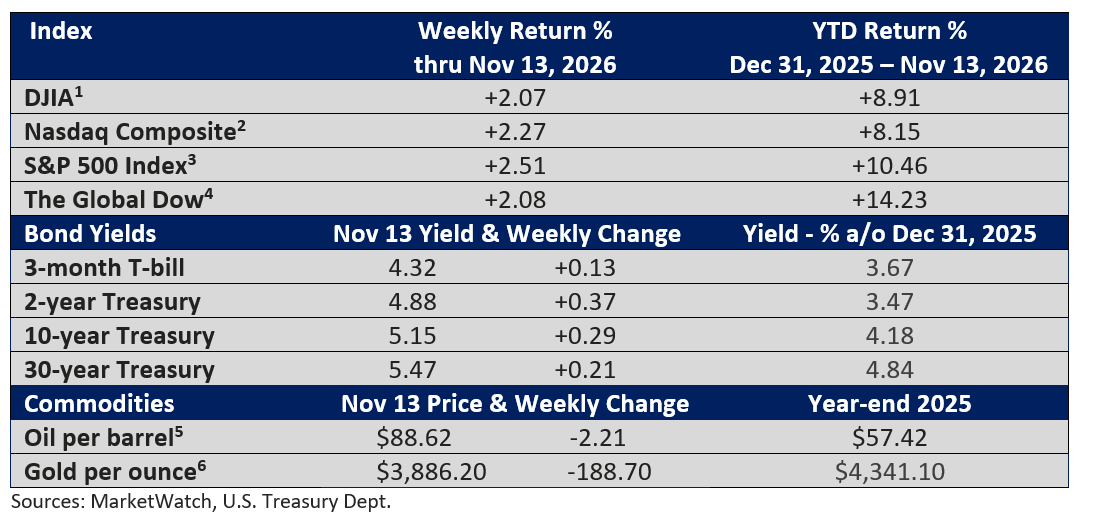
Market summary
TWO FOR THE ROAD
“The United States last year had the largest decline in homelessness since an annual count began nearly two decades ago, the Department of Housing and Urban Development announced late Friday.” – New York Times, November 12,2026
Chicago is on track to record even fewer homicides in 2026 than in 2025, when its homicide total was the lowest in 60 years. – WTTW News, November 13, 2026
I hope you have a great week!
Warmest Regards,
Bill Stordahl, CFP®
Managing Director
Stordahl Capital Management
A Weekly Perspective on Planning and Markets
Each week, we share The Week in Review — a short collection of articles on
financial planning and wealth management, along with a brief overview for context.
One email per week. No promotions, no sales – just clarity.
Stordahl Capital Management, Inc is a Registered Investment Adviser. This commentary is solely for informational purposes and reflects the personal opinions, viewpoints, and analyses of Stordahl Capital Management, Inc. and should not be regarded as a description of advisory services or performance returns of any SCM Clients. The views reflected in the commentary are subject to change at any time without notice. Nothing in this piece constitutes investment advice, performance data or any recommendation that any particular security, portfolio of securities, transaction or investment strategy is suitable for any specific person. Any mention of a particular security and related performance data is not a recommendation to buy or sell that security. Advisory services are only offered to clients or prospective clients where Stordahl Capital Management and its representatives are properly licensed or exempt from licensure. No advice may be rendered by Stordahl Capital Management unless a client service agreement is in place. Stordahl Capital Management, Inc provides links for your convenience to websites produced by other providers or industry-related material. Accessing websites through links directs you away from our website. Stordahl Capital Management is not responsible for errors or omissions in the material on third-party websites and does not necessarily approve of or endorse the information provided. Users who gain access to third-party websites may be subject to the copyright and other restrictions on use imposed by those providers and assume responsibility and risk from the use of those websites. Please note that trading instructions through email, fax, or voicemail will not be taken. Your identity and timely retrieval of instructions cannot be guaranteed. Stordahl Capital Management, Inc. manages its clients’ accounts using a variety of investment techniques and strategies, which are not necessarily discussed in the commentary. Investments in securities involve the risk of loss. Past performance is no guarantee of future results.
1. The Dow Jones Industrials Average is an unmanaged index of 30 major companies which cannot be invested into directly. Past performance does not guarantee future results.
2. The NASDAQ Composite is an unmanaged index of companies which cannot be invested into directly. Past performance does not guarantee future results.
3. The S&P 500 Index is an unmanaged index of 500 larger companies which cannot be invested into directly. Past performance does not guarantee future results.
4. The Global Dow is an unmanaged index composed of stocks of 150 top companies. It cannot be invested into directly. Past performance does not guarantee future results.
5. CME Group front-month contract; Prices can and do vary; past performance does not guarantee future results.
6. CME Group continuous contract; Prices can and do vary; past performance does not guarantee future results.