
The Week in Review: July 6, 2026
A Muddy Jobs Report
The recent pickup in job growth is welcome news for job seekers. But June's jobs report left more questions than answers. Here's why.
Nonfarm payrolls rose by a smaller-than-expected 57,000 in June, according to the U.S. Bureau of Labor Statistics.
In addition, April and May were revised lower by a combined 74,000.
Overall, it was not a particularly impressive month for payroll growth. However, employment data can be volatile from month to month. An uneven pattern is not unusual in the labor market.
As we’ve seen for some time, health care continues to be the engine of growth, generating 47,000 new jobs in June.
What really raised eyebrows, however, was the loss of 61,000 jobs in leisure and hospitality, the sector's largest decline since late 2020.
Even more surprising, the drop occurred during a month when foreign visitors were flocking to the U.S. for the FIFA Club World Cup.
You’d expect hiring as companies staff up restaurants, bars, and maybe even hotels. But, at least according to the government’s survey, that didn’t happen. All that said, something seems amiss. But if that’s the case, these anomalies tend to wash out over time.
Still, there was some good news. The unemployment rate fell to 4.2% in June from May’s 4.3%.
Notably, the jobless rate has remained within a fairly narrow range for two years, averaging 4.24% over that period.
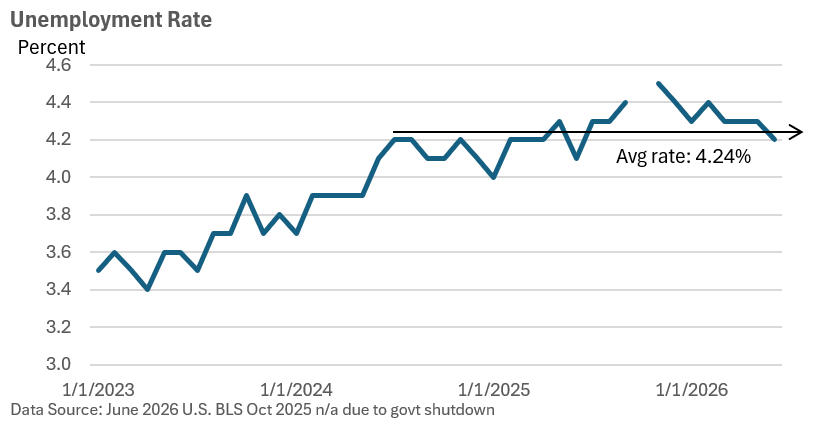
What does the unemployment rate tell us? At its core, it helps answer whether job growth is strong enough to keep the jobless rate from rising, or better yet, strong enough to push it lower.
During that two-year period, the average monthly increase in nonfarm payrolls was 54,000.
Historically, that’s soft, but slow labor force growth has prevented the jobless rate from rising. Slow job growth offers little comfort to those seeking new jobs, but the number of unemployed remains reasonably low, according to government data.
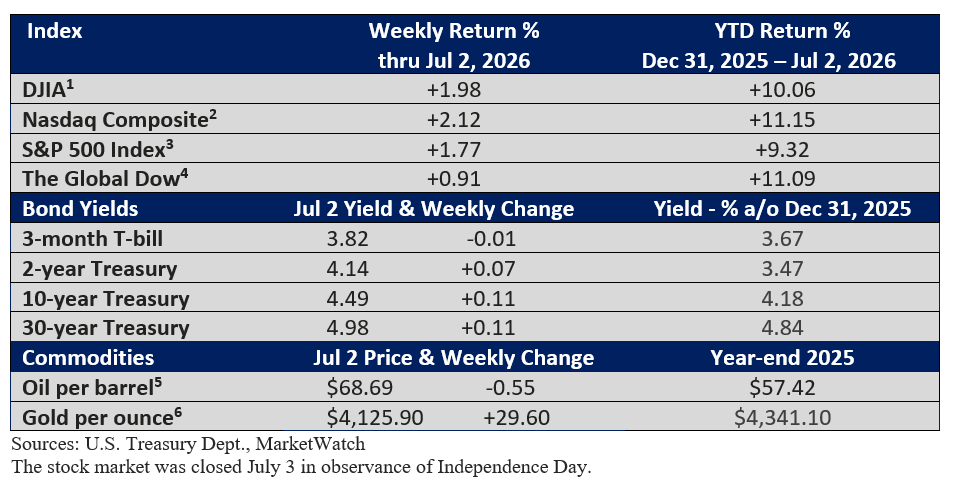
Market summary
Two FOR THE ROAD
A single fiber optic cable made from less than 150 pounds of silica can carry the same volume of information as multiple 1 ton copper cables. - “Markets and Dematerialization,” Jonathan H. Adler
The Federal Aviation Administration has proposed a new rule that would allow civilian aircraft to fly faster than Mach 1 over the United States if their sonic booms stay below a strict noise threshold at ground level. If finalized, the rule, along with another planned rule that would set landing and takeoff noise standards for supersonic aircraft, would end the 1970s ban on overland civilian supersonic flights. – Human Progress, Jul 3, 2026
I hope you have a great week!
Warmest Regards,
Bill Stordahl, CFP®
Managing Director
Stordahl Capital Management
A Weekly Perspective on Planning and Markets
Each week, we share The Week in Review — a short collection of articles on
financial planning and wealth management, along with a brief overview for context.
One email per week. No promotions, no sales – just clarity.
Stordahl Capital Management, Inc is a Registered Investment Adviser. This commentary is solely for informational purposes and reflects the personal opinions, viewpoints, and analyses of Stordahl Capital Management, Inc. and should not be regarded as a description of advisory services or performance returns of any SCM Clients. The views reflected in the commentary are subject to change at any time without notice. Nothing in this piece constitutes investment advice, performance data or any recommendation that any particular security, portfolio of securities, transaction or investment strategy is suitable for any specific person. Any mention of a particular security and related performance data is not a recommendation to buy or sell that security. Advisory services are only offered to clients or prospective clients where Stordahl Capital Management and its representatives are properly licensed or exempt from licensure. No advice may be rendered by Stordahl Capital Management unless a client service agreement is in place. Stordahl Capital Management, Inc provides links for your convenience to websites produced by other providers or industry-related material. Accessing websites through links directs you away from our website. Stordahl Capital Management is not responsible for errors or omissions in the material on third-party websites and does not necessarily approve of or endorse the information provided. Users who gain access to third-party websites may be subject to the copyright and other restrictions on use imposed by those providers and assume responsibility and risk from the use of those websites. Please note that trading instructions through email, fax, or voicemail will not be taken. Your identity and timely retrieval of instructions cannot be guaranteed. Stordahl Capital Management, Inc. manages its clients’ accounts using a variety of investment techniques and strategies, which are not necessarily discussed in the commentary. Investments in securities involve the risk of loss. Past performance is no guarantee of future results.
1. The Dow Jones Industrials Average is an unmanaged index of 30 major companies which cannot be invested into directly. Past performance does not guarantee future results.
2. The NASDAQ Composite is an unmanaged index of companies which cannot be invested into directly. Past performance does not guarantee future results.
3. The S&P 500 Index is an unmanaged index of 500 larger companies which cannot be invested into directly. Past performance does not guarantee future results.
4. The Global Dow is an unmanaged index composed of stocks of 150 top companies. It cannot be invested into directly. Past performance does not guarantee future results.
5. CME Group front-month contract; Prices can and do vary; past performance does not guarantee future results.
6. CME Group continuous contract; Prices can and do vary; past performance does not guarantee future results.