
The Week in Review: July 27, 2026
Social Security and You
The 2026 OASDI Trustees Report presents a sobering assessment of the financial outlook for Social Security.
The trust fund that supports Social Security retirement benefits is projected to be depleted in the fourth quarter of 2032.
At that point, ongoing revenue from Social Security payroll taxes is expected to cover approximately 78% of scheduled retirement benefits.
The Disability Insurance Trust Fund, by contrast, is projected to remain solvent through at least 2100.
Combining the retirement and disability trust funds would enable Social Security to pay full scheduled benefits until the third quarter of 2034.
After that, combined trust fund reserves would be exhausted, and program income would be sufficient to cover about 83% of scheduled benefits.
However, combining the two trust funds would require a change in federal law.
Teetering on the edge of bankruptcy? No.
Given its enduring popularity, reform proposals focus on improving the program’s financial stability rather than dismantling it.
Even without new legislation to shore up its finances (and contrary to popular opinion), revenues from current
Social Security taxes are available to pay most benefits. But that’s of little comfort to those who rely on or will depend on every "promised" dollar.
Twenty years ago, former Fed Chairman Alan Greenspan remarked that politicians could solve the problems facing
Social Security in about 15 minutes. “It would take them 15 minutes only because 10 minutes would be used for pleasantries,” he quipped.
Waiting this late in the game to shore up the program’s finances has increased the financial challenges, but a solution is not out of reach.
Greenspan was right. This solution isn’t difficult.
Raise payroll taxes,
boost the amount of income subject to payroll taxes,
tax compensation that is currently exempt,
reduce benefits to current or future retirees,
raise the retirement age,
reduce annual cost-of-living adjustments,
implement an asset/income test,
invest some payroll taxes in the stock market (or individual accounts),
or some combination of these measures.
But compromise is never easy. The proposed measures will face opposition to varying degrees. Consequently, it has been easy for legislators to kick the can down the road.
File now?
If you are nearing retirement, it might be tempting to file now or soon. You know, lock in your benefits so they can’t be reduced if Congress crafts new legislation.
If you don’t need the income, delaying benefits produces a higher monthly payout. You may choose that based on income needs, health, or marital status—not whether you can get in front of a possible future cut.
Although understandable, concerns about Social Security's finances shouldn't drive early filing to avoid a potential future benefit reduction.
Most reform proposals would likely shield current retirees and phase in changes gradually, while claiming benefits early results in a permanent reduction in monthly payments.
However, there’s no ironclad guarantee that an eventual plan to stave off a reduction in payments wouldn’t impact your benefits.
All that said, the real debate is not whether the program should exist but how to strengthen its finances.
The leading proposals include higher payroll taxes, increasing or eliminating the taxable wage cap, gradually
raising the retirement age, slowing benefit growth for higher-income retirees, or adopting a combination of these measures to restore long-term stability.
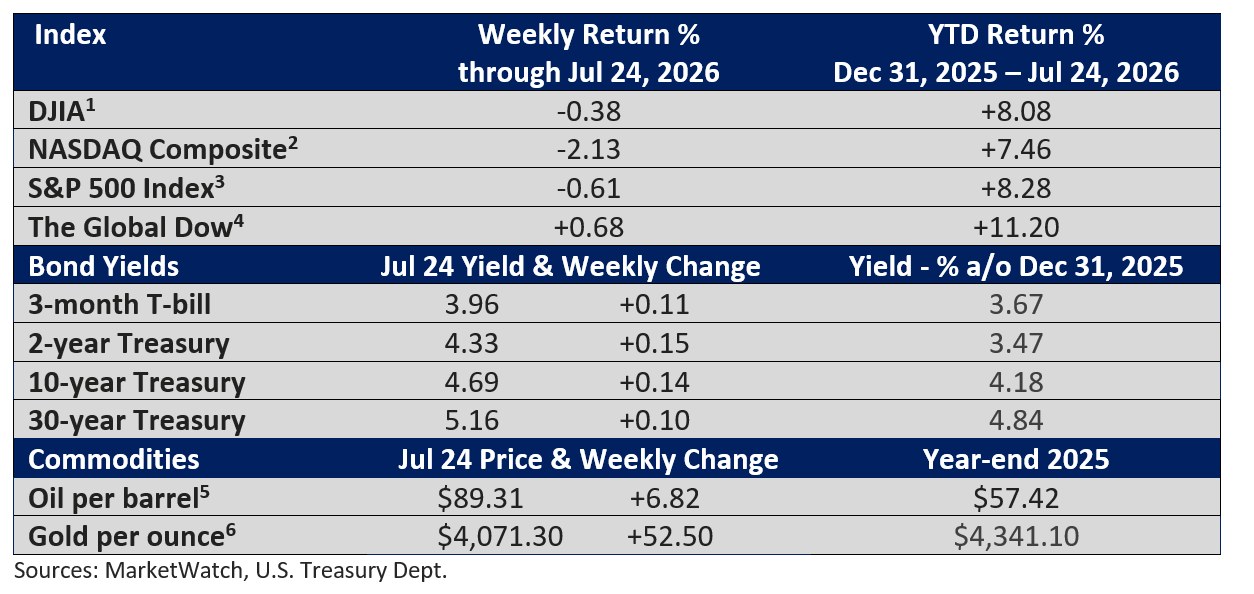
Market summary
TWO FOR THE ROAD
The number of economies with high levels of inequality, defined as having a Gini coefficient greater than 40, fell by 40 percent between 1995 and 2024. The Gini coefficient measures how unevenly incomes are distributed across a population, with zero representing perfect equality and 100 representing a situation in which one person receives everything. Word Bank, July 2, 2026
The co-founder of The Humpback Whale Project, a Brazilian research and conservation nonprofit, estimates that the western South Atlantic humpback population has grown from around 2,000 whales four decades ago to roughly 35,000 today, approaching or possibly matching its estimated pre-commercial whaling abundance. Associated Press, July, 17, 2026
I hope you have a great week!
Warmest Regards,
Bill Stordahl, CFP®
Managing Director
Stordahl Capital Management
A Weekly Perspective on Planning and Markets
Each week, we share The Week in Review — a short collection of articles on
financial planning and wealth management, along with a brief overview for context.
One email per week. No promotions, no sales – just clarity.
Stordahl Capital Management, Inc is a Registered Investment Adviser. This commentary is solely for informational purposes and reflects the personal opinions, viewpoints, and analyses of Stordahl Capital Management, Inc. and should not be regarded as a description of advisory services or performance returns of any SCM Clients. The views reflected in the commentary are subject to change at any time without notice. Nothing in this piece constitutes investment advice, performance data or any recommendation that any particular security, portfolio of securities, transaction or investment strategy is suitable for any specific person. Any mention of a particular security and related performance data is not a recommendation to buy or sell that security. Advisory services are only offered to clients or prospective clients where Stordahl Capital Management and its representatives are properly licensed or exempt from licensure. No advice may be rendered by Stordahl Capital Management unless a client service agreement is in place. Stordahl Capital Management, Inc provides links for your convenience to websites produced by other providers or industry-related material. Accessing websites through links directs you away from our website. Stordahl Capital Management is not responsible for errors or omissions in the material on third-party websites and does not necessarily approve of or endorse the information provided. Users who gain access to third-party websites may be subject to the copyright and other restrictions on use imposed by those providers and assume responsibility and risk from the use of those websites. Please note that trading instructions through email, fax, or voicemail will not be taken. Your identity and timely retrieval of instructions cannot be guaranteed. Stordahl Capital Management, Inc. manages its clients’ accounts using a variety of investment techniques and strategies, which are not necessarily discussed in the commentary. Investments in securities involve the risk of loss. Past performance is no guarantee of future results.
1. The Dow Jones Industrials Average is an unmanaged index of 30 major companies which cannot be invested into directly. Past performance does not guarantee future results.
2. The NASDAQ Composite is an unmanaged index of companies which cannot be invested into directly. Past performance does not guarantee future results.
3. The S&P 500 Index is an unmanaged index of 500 larger companies which cannot be invested into directly. Past performance does not guarantee future results.
4. The Global Dow is an unmanaged index composed of stocks of 150 top companies. It cannot be invested into directly. Past performance does not guarantee future results.
5. CME Group front-month contract; Prices can and do vary; past performance does not guarantee future results.
6. CME Group continuous contract; Prices can and do vary; past performance does not guarantee future results.