
The Week in Review: July 20, 2026
Chips in Flux
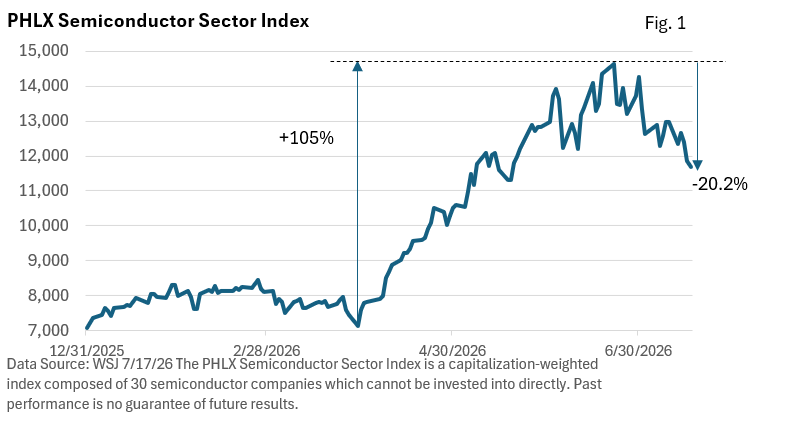
Since the most recent market low at the end of March, semiconductors (microchips, commonly called chip stocks) have been a very popular trade. In less than three months, the PHLX Semiconductor Index has more than doubled—see Figure 1.
Investors are expecting a staggering rise in second-quarter earnings for the semiconductor sector, with profits expected to rise by 131%, according to MarketWatch.
But why have chip stocks entered a bear market—a drop of at least 20% from peak to trough? The index is down 20.2% from its June 22 peak. It remains substantially higher than the late-March low and the end of last year.
For starters, chips became a crowded trade, i.e., a large number of investors holding the same position. With investors heavily concentrated on the same side of the market, liquidity risks build beneath the surface, creating the potential for a rapid and disorderly unwind if the trade begins to reverse.
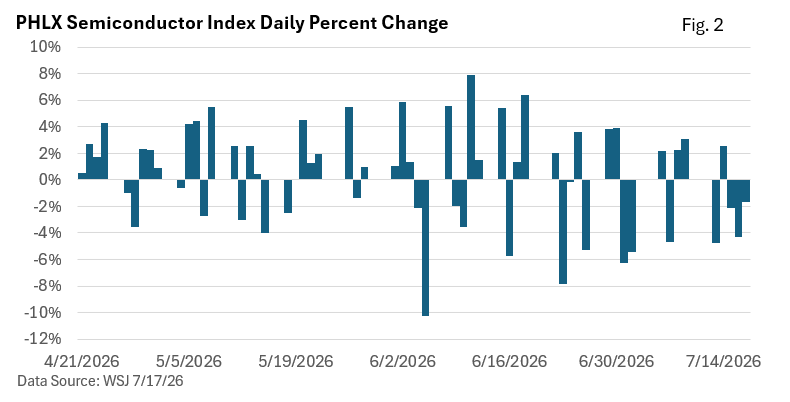
Figure 2 illustrates the high level of volatility since late April, both to the upside and downside.
What’s going on in recent months? Semiconductor stocks took off as massive demand from the buildout of AI data centers fueled huge purchases of memory chips. Infrastructure needs are enormous, including demand for memory chips from these chip makers.
But investors are constantly reassessing how sustainable the AI boom really is. Besides, the production cycle for chip makers has historically been feast-or-famine.
In addition, have valuations in this sector already risen to a level that prices in stellar growth? Of course, that’s a difficult question to answer, but it may be playing a role in recent volatility.
LPL Research recently opined, “The most dangerous investment mistakes often begin with an inability to imagine outcomes that differ from what the market expects.
LPL added, “That does not mean investors should reflexively bet against strong trends, because momentum is real and great businesses can stay great for a long time, but when an investment thesis depends on outcomes that are inherently unknowable, imagination becomes a risk-management tool.”
How strong has demand been? “The computing power of the total stock of AI chips has grown at 3.4 times per year, doubling every 7 months since 2022, based on revenue data, other financial disclosures, and analyst reports,” according to Epoch AI.
The recent pullback in semiconductor stocks may simply represent a healthy correction, helping to flush out excess optimism and speculative froth.
For now, AI remains in a powerful cycle as hyperscalers try to catch up and anticipate future demand for AI.
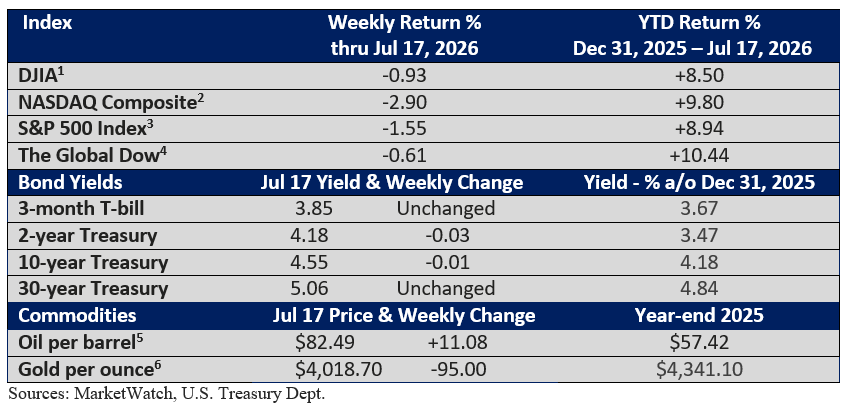
Market summary
I hope you have a great week!
Warmest Regards,
Bill Stordahl, CFP®
Managing Director
Stordahl Capital Management
A Weekly Perspective on Planning and Markets
Each week, we share The Week in Review — a short collection of articles on
financial planning and wealth management, along with a brief overview for context.
One email per week. No promotions, no sales – just clarity.
Stordahl Capital Management, Inc is a Registered Investment Adviser. This commentary is solely for informational purposes and reflects the personal opinions, viewpoints, and analyses of Stordahl Capital Management, Inc. and should not be regarded as a description of advisory services or performance returns of any SCM Clients. The views reflected in the commentary are subject to change at any time without notice. Nothing in this piece constitutes investment advice, performance data or any recommendation that any particular security, portfolio of securities, transaction or investment strategy is suitable for any specific person. Any mention of a particular security and related performance data is not a recommendation to buy or sell that security. Advisory services are only offered to clients or prospective clients where Stordahl Capital Management and its representatives are properly licensed or exempt from licensure. No advice may be rendered by Stordahl Capital Management unless a client service agreement is in place. Stordahl Capital Management, Inc provides links for your convenience to websites produced by other providers or industry-related material. Accessing websites through links directs you away from our website. Stordahl Capital Management is not responsible for errors or omissions in the material on third-party websites and does not necessarily approve of or endorse the information provided. Users who gain access to third-party websites may be subject to the copyright and other restrictions on use imposed by those providers and assume responsibility and risk from the use of those websites. Please note that trading instructions through email, fax, or voicemail will not be taken. Your identity and timely retrieval of instructions cannot be guaranteed. Stordahl Capital Management, Inc. manages its clients’ accounts using a variety of investment techniques and strategies, which are not necessarily discussed in the commentary. Investments in securities involve the risk of loss. Past performance is no guarantee of future results.
1. The Dow Jones Industrials Average is an unmanaged index of 30 major companies which cannot be invested into directly. Past performance does not guarantee future results.
2. The NASDAQ Composite is an unmanaged index of companies which cannot be invested into directly. Past performance does not guarantee future results.
3. The S&P 500 Index is an unmanaged index of 500 larger companies which cannot be invested into directly. Past performance does not guarantee future results.
4. The Global Dow is an unmanaged index composed of stocks of 150 top companies. It cannot be invested into directly. Past performance does not guarantee future results.
5. CME Group front-month contract; Prices can and do vary; past performance does not guarantee future results.
6. CME Group continuous contract; Prices can and do vary; past performance does not guarantee future results.