
The Week in Review: April 27, 2026
Retail Sales Surge on Higher Gasoline Prices
It is no surprise that retail sales surged last month—but not for the reason investors typically want to see.
The U.S. Census Bureau reported a 1.7% increase in March retail sales, driven largely by a 15.5% jump at gasoline stations. The overall strength reflects higher prices at the pump, not strong underlying consumer demand.
Retail sales are goods purchased online or at the store.
Put plainly, if you drive a gasoline-powered vehicle, higher gasoline prices translate into higher spending for gasoline, and that was reflected in the March data.
But there was good news in the data, too. The higher price of gasoline didn’t eat into other categories. In other words, the shock of higher gasoline prices didn’t force most folks to cut back in other areas.
You see, if spending at gas stations is excluded, spending rose a healthy 0.6% in March. And that’s not a big surprise either.
Retail sales spending is ‘lumpy’ and can be affected by everything from weather to statistical quirks in the data.
That said, a spike in gasoline prices wouldn’t be expected to immediately force a reallocation in the family budget.
Initially, most folks simply dip into their savings or add to their credit card balances, and spending holds up in other categories.
But as onerous as higher gas prices might be, if prices were to hold at today’s levels over an extended period of time, would they dampen economic growth as consumers are forced to choose between gasoline and other items or services?
As the graphic illustrates, family budgets have weathered worse. In part, autos are more efficient today, and more people are driving EVs.
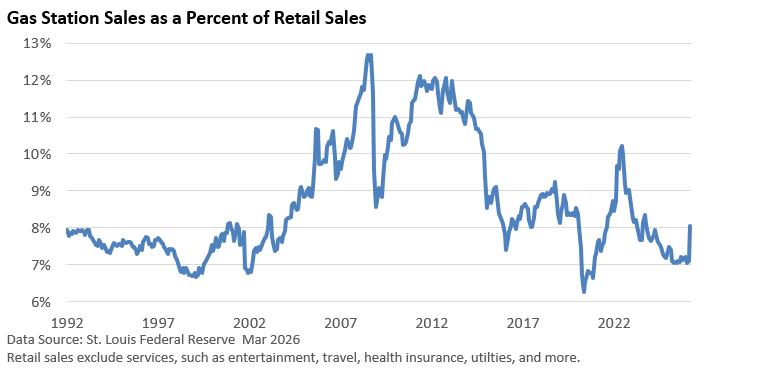
Paying high prices for gasoline is never welcome. Still, higher gas prices alone, viewed through the narrow lens that is laser-focused on the overall economic impact, don’t appear to be sufficient to destabilize the economy, particularly given the consumers’ ability to absorb higher gasoline costs in the past.
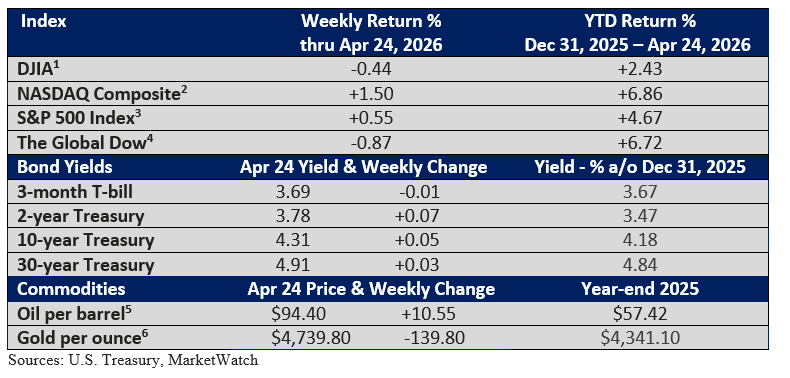
Market Summary
Two FOR THE ROAD
Americans will collectively burn nearly 6.93 billion hours filing their federal tax returns this season. That’s $477 billion all-in, once you add up lost productivity and out-of-pocket costs for software and tax pros, which is the equivalent of more than 3 million full-time workers doing nothing but taxes for an entire year. - National Taxpayers Union Foundation, April 13, 2026
The average federal tax refund this filing season climbed to $3,571, an 11% jump from last year. More than 53 million filers claimed at least one new deduction from the 2025 tax bill, including tip income, overtime, auto loan interest, or senior-specific, for an average cut of more than $800. - CNBC, April 17, 2026
I hope you have a wonderful week!
Warmest Regards,
Bill Stordahl, CFP®
Managing Director
Stordahl Capital Management
A Weekly Perspective on Planning and Markets
Each week, we share The Week in Review — a short collection of articles on
financial planning and wealth management, along with a brief overview for context.
One email per week. No promotions, no sales – just clarity.
Stordahl Capital Management, Inc is a Registered Investment Adviser. This commentary is solely for informational purposes and reflects the personal opinions, viewpoints, and analyses of Stordahl Capital Management, Inc. and should not be regarded as a description of advisory services or performance returns of any SCM Clients. The views reflected in the commentary are subject to change at any time without notice. Nothing in this piece constitutes investment advice, performance data or any recommendation that any particular security, portfolio of securities, transaction or investment strategy is suitable for any specific person. Any mention of a particular security and related performance data is not a recommendation to buy or sell that security. Advisory services are only offered to clients or prospective clients where Stordahl Capital Management and its representatives are properly licensed or exempt from licensure. No advice may be rendered by Stordahl Capital Management unless a client service agreement is in place. Stordahl Capital Management, Inc provides links for your convenience to websites produced by other providers or industry-related material. Accessing websites through links directs you away from our website. Stordahl Capital Management is not responsible for errors or omissions in the material on third-party websites and does not necessarily approve of or endorse the information provided. Users who gain access to third-party websites may be subject to the copyright and other restrictions on use imposed by those providers and assume responsibility and risk from the use of those websites. Please note that trading instructions through email, fax, or voicemail will not be taken. Your identity and timely retrieval of instructions cannot be guaranteed. Stordahl Capital Management, Inc. manages its clients’ accounts using a variety of investment techniques and strategies, which are not necessarily discussed in the commentary. Investments in securities involve the risk of loss. Past performance is no guarantee of future results.
1. The Dow Jones Industrials Average is an unmanaged index of 30 major companies which cannot be invested into directly. Past performance does not guarantee future results.
2. The NASDAQ Composite is an unmanaged index of companies which cannot be invested into directly. Past performance does not guarantee future results.
3. The S&P 500 Index is an unmanaged index of 500 larger companies which cannot be invested into directly. Past performance does not guarantee future results.
4. The Global Dow is an unmanaged index composed of stocks of 150 top companies. It cannot be invested into directly. Past performance does not guarantee future results.
5. CME Group front-month contract; Prices can and do vary; past performance does not guarantee future results.
6. CME Group continuous contract; Prices can and do vary; past performance does not guarantee future results.