The Week in Review: April 13, 2026
Inflation Heats Up as Gasoline Prices Surge
Led by a 10.9% rise in energy, including a 21% rise in gasoline, the US Bureau of Labor Statistics reported that the Consumer Price Index (CPI) rose 0.9% in March, the highest in almost four years. On an annual basis, prices rose 3.3%.
If food, which was unchanged, and energy were excluded, the core CPI rose 0.2%. It was up 2.6% from one year ago.
Economists closely watch this so-called core measure to better capture inflation’s underlying trend.
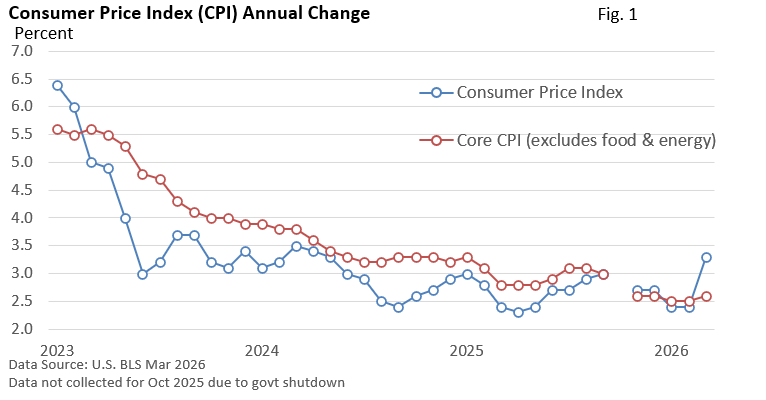
It comes as no surprise that the CPI surged last month amid the sharp rise in gasoline prices.
Otherwise, outside of energy, the CPI was less discouraging.
Let’s review Figure 2, which breaks the CPI into two key categories: services and consumer goods. As supply chains normalized in the wake of the pandemic, inflation in consumer goods slowed sharply and briefly slipped into deflationary territory. Services inflation proved to be more persistent, but it has since eased back toward pre-pandemic levels.
More recently, however, inflation in consumer goods has re‑accelerated.
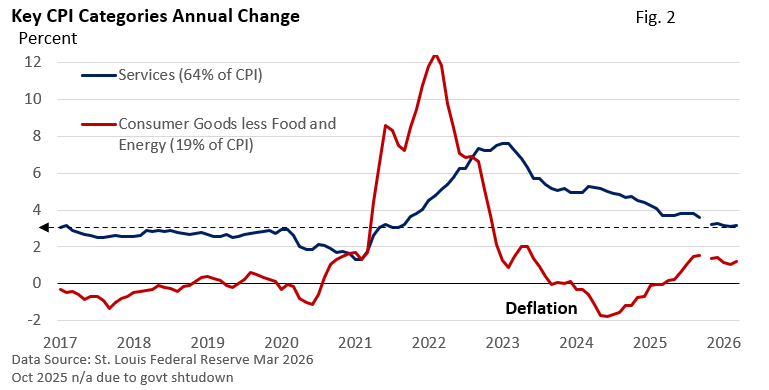
Trade‑related cost pressures that businesses initially absorbed appear increasingly to be passed on to consumers.
If the recent pickup in consumer goods prices is driven largely by tariffs, however, the Fed would likely judge it to be temporary and look through the increase.
Given the CPI’s methodology, inflation may be slightly lower right now due to the government shutdown. That should work its way out of the CPI by April or May. There have also been signs that wholesale and import prices have also ticked up recently.
That pickup may prove to be temporary, much like past trade-related cost pressures, while generally tame services inflation could allow the Fed to look past the oil-price shock.
If not, the Fed could find itself caught between two goals: supporting a softening labor market or responding to renewed inflationary pressures.
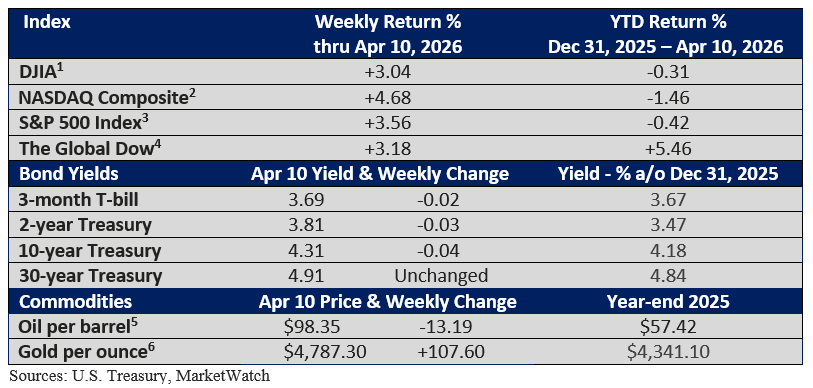
Market Summary
Two FOR THE ROAD
How about this for good news? The U.S. homicide rate fell to its lowest level since 1900, so that can’t be a bad thing! - Axios, January 22, 2026
Not all graduate degrees pay off. Some of the most popular programs actually produce negative financial returns net after tuition and lost income. Medical degrees led with a 173% lifetime earnings gain, followed by pharmacy (68%), law (41%), and public administration (26%). Meanwhile, social work, psychology, and education-related degrees delivered returns as low as -8%. So, graduate school can boost earnings… but only if you choose wisely. - Inside Higher Ed, March 31, 2026
I hope you have a wonderful week!
Warmest Regards,
Bill Stordahl, CFP®
Managing Director
Stordahl Capital Management
A Weekly Perspective on Planning and Markets
Each week, we share The Week in Review — a short collection of articles on
financial planning and wealth management, along with a brief overview for context.
One email per week. No promotions, no sales – just clarity.
Stordahl Capital Management, Inc is a Registered Investment Adviser. This commentary is solely for informational purposes and reflects the personal opinions, viewpoints, and analyses of Stordahl Capital Management, Inc. and should not be regarded as a description of advisory services or performance returns of any SCM Clients. The views reflected in the commentary are subject to change at any time without notice. Nothing in this piece constitutes investment advice, performance data or any recommendation that any particular security, portfolio of securities, transaction or investment strategy is suitable for any specific person. Any mention of a particular security and related performance data is not a recommendation to buy or sell that security. Advisory services are only offered to clients or prospective clients where Stordahl Capital Management and its representatives are properly licensed or exempt from licensure. No advice may be rendered by Stordahl Capital Management unless a client service agreement is in place. Stordahl Capital Management, Inc provides links for your convenience to websites produced by other providers or industry-related material. Accessing websites through links directs you away from our website. Stordahl Capital Management is not responsible for errors or omissions in the material on third-party websites and does not necessarily approve of or endorse the information provided. Users who gain access to third-party websites may be subject to the copyright and other restrictions on use imposed by those providers and assume responsibility and risk from the use of those websites. Please note that trading instructions through email, fax, or voicemail will not be taken. Your identity and timely retrieval of instructions cannot be guaranteed. Stordahl Capital Management, Inc. manages its clients’ accounts using a variety of investment techniques and strategies, which are not necessarily discussed in the commentary. Investments in securities involve the risk of loss. Past performance is no guarantee of future results.
1. The Dow Jones Industrials Average is an unmanaged index of 30 major companies which cannot be invested into directly. Past performance does not guarantee future results.
2. The NASDAQ Composite is an unmanaged index of companies which cannot be invested into directly. Past performance does not guarantee future results.
3. The S&P 500 Index is an unmanaged index of 500 larger companies which cannot be invested into directly. Past performance does not guarantee future results.
4. The Global Dow is an unmanaged index composed of stocks of 150 top companies. It cannot be invested into directly. Past performance does not guarantee future results.
5. CME Group front-month contract; Prices can and do vary; past performance does not guarantee future results.
6. CME Group continuous contract; Prices can and do vary; past performance does not guarantee future results.