The Week in Review: November 11, 2024
A Drama-Free Fed Meeting, Press Conference* and the Election
More about the asterisk in a moment, but first, let’s touch on the meat and potatoes of last week’s Federal Reserve meeting.
It came as no surprise that the Fed reduced its key rate, the fed funds rate, by 25 basis points (bp, 1 bp = 0.01%) to a range of 4.50—4.75%. That follows the Fed’s 50 bp rate cut in September.
At his press conference, Fed Chief Jay Powell did not commit to another reduction in interest rates at the December meeting, but he strongly signaled that the general path is lower.
But if economic growth is strong, why cut interest rates? “It's actually remarkable how well the U.S. economy has been performing,” Powell said.
Despite a generally positive economic outlook, the Fed believes interest rates are too high, discouraging consumer and business borrowing. In turn, this could slow economic activity too much and increase the unemployment rate.
Recalibration
Powell responded that the Fed is recalibrating policy. He used the words ‘recalibrate,’ ‘recalibration,’ or ‘recalibrating’ five times at his press conference.
In other words, he wants to gradually reduce the fed funds rate to a less restrictive level. However, does the Fed risk stoking economic embers? If so, the Fed could give back some of the hard-won gains on inflation. Notably, the price level hasn’t fallen, but the rate of increases has slowed.
How low might interest rates go? Let’s look at rate cuts over the last 30 years when a recession didn’t set in.
During the four rate-cut cycles when the economy avoided a recession, the Fed lowered the fed funds rate three times. Each non-recessionary cycle of rate cuts totaled 75 basis points.
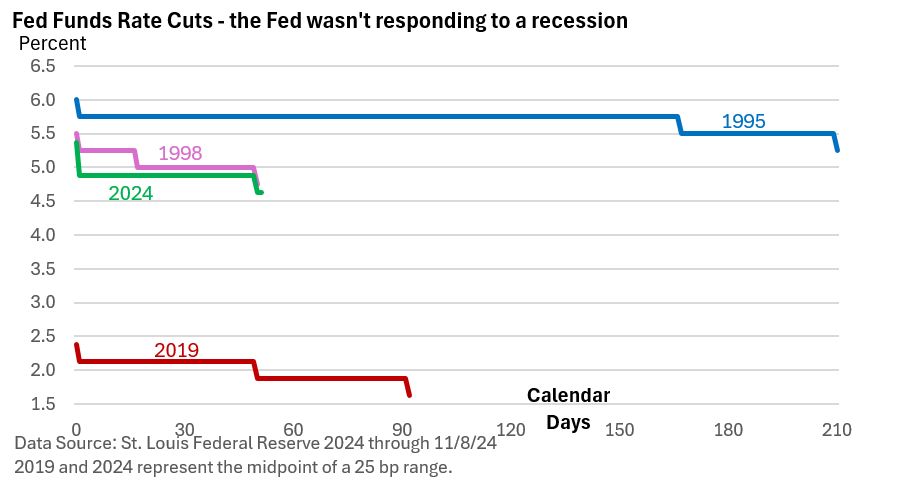
The Fed has already reduced rates by 75 basis points, indicating that additional cuts are likely. In order to find a sharper series of non-recessionary rate cuts, one must look back to the 1980s.
*Drama at a drama-free press conference
About that asterisk, a reporter asked Chair Powell, “Some of the president-elect’s advisors have suggested that you should resign. If he asked you to leave, would you go?
Powell didn’t flinch. He simply said, “No,” and took the next question.
The chairman of the Federal Reserve serves a four-year term. He was appointed by President Trump in 2018. President Biden re-appointed him in 2022. His four-year term ends in February 2026.
President elect-Trump has not threatened to fire Powell. A president can only fire a Fed chair “for cause.” Most legal scholars believe this doesn’t mean a president can fire a Fed chair simply because he/she disagrees with the Fed chair. There must be something more.
That leads us to last week’s election and subsequent stock market rally. As citizens and voters, our choices go well beyond the narrow lens of investors.
Let me explain.
Investors focus on the market through a very narrow lens. Investors don’t care if a president is Republican, Democrat, liberal, or conservative. Investors simply view the market through the very narrow lens of the economic fundamentals.
Historically, on average, stocks have performed well under both political parties (CNBC).
Investors expect that Trump will be business-friendly, pro-deregulation, and staff a justice department that will be more inclined to approve mergers rather than challenge them in court.
Investors believe the 21% corporate tax rate is safe. Moreover, markets are relieved that the outcome was quickly settled and didn’t drag out.
In 2017, stocks performed quite well in a pro-business, tax-cutting environment. In 2018, Trump turned his attention to trade and tariffs, which generated uncertainty among investors. How he may ultimately levy tariffs is unknown. Tariffs may support domestic manufacturing while also potentially lifting prices.
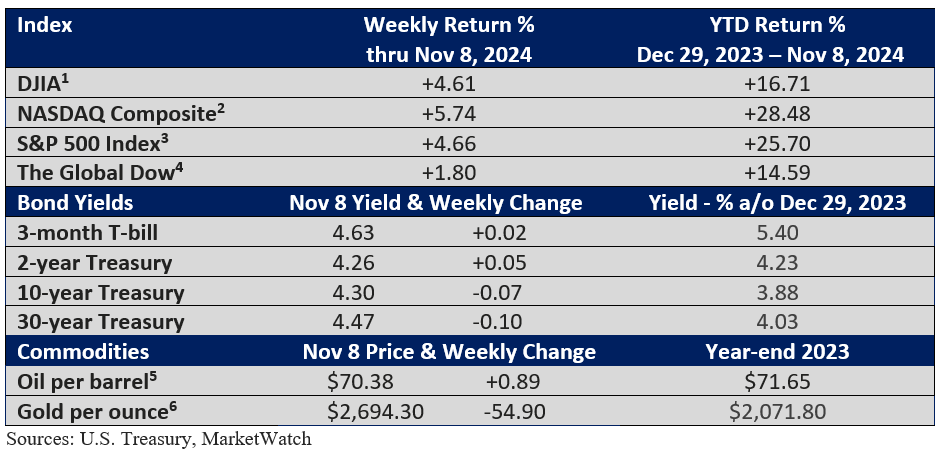
Last week, business-friendly, pro-deregulation sentiment fueled gains, lifting the Dow, S&P 500, and Nasdaq to new highs.
Market Summary
Two for the Road
“The first rule of compounding is to never interrupt it unnecessarily.” – Charles Munger
In an experiment where rats were given a choice between water sweetened with saccharin or cocaine, a staggering 94% of the rats preferred the saccharin. This preference for intense sweetness was also observed with sucrose, a natural sugar. - ConiferPark.com, March 21, 2024
Lastly, on Monday, we celebrate Veterans Day. We honor and salute all the brave men and women who have selflessly served and put themselves in harm's way to protect our freedom and nation.
Please do not hesitate to contact me with any questions or concerns. I hope you have a wonderful week!
Bill Stordahl, CFP®
Managing Director
Stordahl Capital Management
Stordahl Capital Management, Inc is a Registered Investment Adviser. This commentary is solely for informational purposes and reflects the personal opinions, viewpoints, and analyses of Stordahl Capital Management, Inc. and should not be regarded as a description of advisory services or performance returns of any SCM Clients. The views reflected in the commentary are subject to change at any time without notice. Nothing in this piece constitutes investment advice, performance data or any recommendation that any particular security, portfolio of securities, transaction or investment strategy is suitable for any specific person. Any mention of a particular security and related performance data is not a recommendation to buy or sell that security. Advisory services are only offered to clients or prospective clients where Stordahl Capital Management and its representatives are properly licensed or exempt from licensure. No advice may be rendered by Stordahl Capital Management unless a client service agreement is in place. Stordahl Capital Management, Inc provides links for your convenience to websites produced by other providers or industry-related material. Accessing websites through links directs you away from our website. Stordahl Capital Management is not responsible for errors or omissions in the material on third-party websites and does not necessarily approve of or endorse the information provided. Users who gain access to third-party websites may be subject to the copyright and other restrictions on use imposed by those providers and assume responsibility and risk from the use of those websites. Please note that trading instructions through email, fax, or voicemail will not be taken. Your identity and timely retrieval of instructions cannot be guaranteed. Stordahl Capital Management, Inc. manages its clients’ accounts using a variety of investment techniques and strategies, which are not necessarily discussed in the commentary. Investments in securities involve the risk of loss. Past performance is no guarantee of future results.
1. The Dow Jones Industrials Average is an unmanaged index of 30 major companies which cannot be invested into directly. Past performance does not guarantee future results.
2. The NASDAQ Composite is an unmanaged index of companies which cannot be invested into directly. Past performance does not guarantee future results.
3. The S&P 500 Index is an unmanaged index of 500 larger companies which cannot be invested into directly. Past performance does not guarantee future results.
4. The Global Dow is an unmanaged index composed of stocks of 150 top companies. It cannot be invested into directly. Past performance does not guarantee future results.
5. CME Group front-month contract; Prices can and do vary; past performance does not guarantee future results.
6. CME Group continuous contract; Prices can and do vary; past performance does not guarantee future results.