The Week in Review: December 2, 2024
Another Strong Earnings Season
Our discussions have included Fed policy, the economy, and the surge in inflation since the pandemic. Why? In large part, they are all a part of the stock market pricing equation.
Yet, so are corporate profits, and profits for the largest U.S.-based companies are heavily influenced by economic activity.
Undoubtedly, there are a few companies that execute well in most environments, while others reside in industries that are more resilient to economic downturns.
However, most companies in the S&P 500 rely on a stiff tailwind from economic growth. And when an economic downturn eventually occurs, profits in the S&P 500 turn south.
A recession has yet to happen, but when it occurs, profits fall, as we experienced in the 2008-09 and 2020 recessions.
A numerical review
With 95% of S&P 500 companies having reported in Q3, S&P 500 profits are projected to rise a solid 8.9% compared to one year ago, according to LSEG. That is up from a 5.3% forecast as of October 1.
Typically, projections rise through the quarter as firms, on average, typically top conservative forecasts.
More impressively, 76% of S&P 500 firms that have reported have beaten the consensus profit forecast, which compares favorably to the long-term average of 67%.
And there’s more. Companies that top profit estimates are beating by a wider-than-average margin in Q3: 7.6% versus the historical average of 4.2%.
A strong reason for Q3’s upbeat performance is technology, which is projected to rise by 19% in Q3.
Bottom line
Over the medium and longer term, the economy is a significant underlying support for corporate profits. Put another way, rising corporate profits have historically been a magnet for investor cash over the longer term.
When the economy is expanding, companies, individuals, and families buy more ‘stuff.’ And it is that stuff (goods and services) that drives profits. It’s not a one-to-one relationship, but it is a significant driver of earnings.
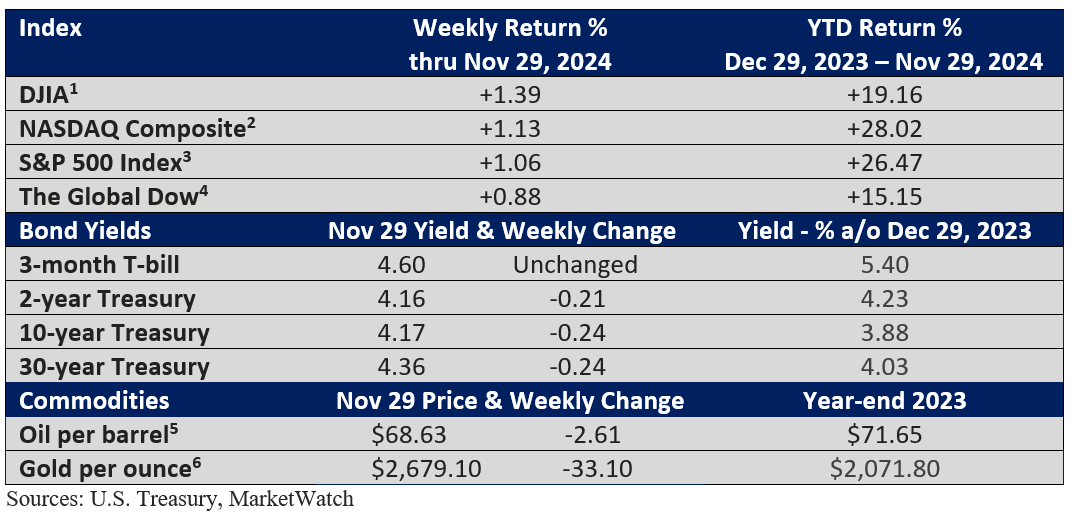
Market Summary
Two for the Road
Including dividends, the S&P 500 is currently up over 25% in 2024, well above the historical average of 9.8%. 25% sounds abnormally high, but it is actually more common than you might think. The S&P 500 has finished with a total return above 25% in 26 out of 96 years since 1928. That’s 27% of the time. But how many times did the S&P 500 end the year down 25% or more? Only 5. - The Week in Charts, November 21, 2024
Researchers at Johns Hopkins University just achieved a breakthrough in surgical robotics: They trained a robot to perform complex medical procedures solely by having it watch videos of human surgeons at work. - Johns Hopkins Univ, November 11, 2024
Please do not hesitate to contact me with any questions or concerns. I hope you have a wonderful week!
Bill Stordahl, CFP®
Managing Director
Stordahl Capital Management
Stordahl Capital Management, Inc is a Registered Investment Adviser. This commentary is solely for informational purposes and reflects the personal opinions, viewpoints, and analyses of Stordahl Capital Management, Inc. and should not be regarded as a description of advisory services or performance returns of any SCM Clients. The views reflected in the commentary are subject to change at any time without notice. Nothing in this piece constitutes investment advice, performance data or any recommendation that any particular security, portfolio of securities, transaction or investment strategy is suitable for any specific person. Any mention of a particular security and related performance data is not a recommendation to buy or sell that security. Advisory services are only offered to clients or prospective clients where Stordahl Capital Management and its representatives are properly licensed or exempt from licensure. No advice may be rendered by Stordahl Capital Management unless a client service agreement is in place. Stordahl Capital Management, Inc provides links for your convenience to websites produced by other providers or industry-related material. Accessing websites through links directs you away from our website. Stordahl Capital Management is not responsible for errors or omissions in the material on third-party websites and does not necessarily approve of or endorse the information provided. Users who gain access to third-party websites may be subject to the copyright and other restrictions on use imposed by those providers and assume responsibility and risk from the use of those websites. Please note that trading instructions through email, fax, or voicemail will not be taken. Your identity and timely retrieval of instructions cannot be guaranteed. Stordahl Capital Management, Inc. manages its clients’ accounts using a variety of investment techniques and strategies, which are not necessarily discussed in the commentary. Investments in securities involve the risk of loss. Past performance is no guarantee of future results.
1. The Dow Jones Industrials Average is an unmanaged index of 30 major companies which cannot be invested into directly. Past performance does not guarantee future results.
2. The NASDAQ Composite is an unmanaged index of companies which cannot be invested into directly. Past performance does not guarantee future results.
3. The S&P 500 Index is an unmanaged index of 500 larger companies which cannot be invested into directly. Past performance does not guarantee future results.
4. The Global Dow is an unmanaged index composed of stocks of 150 top companies. It cannot be invested into directly. Past performance does not guarantee future results.
5. CME Group front-month contract; Prices can and do vary; past performance does not guarantee future results.
6. CME Group continuous contract; Prices can and do vary; past performance does not guarantee future results.