Health Insurance Tax Credits and the Government Shutdown: What to Know
When the federal government shuts down, headlines focus on national parks closing and federal employees going without pay. But millions of Americans wonder about something far more personal: What happens to my health insurance during a government shutdown? And if you rely on Marketplace insurance tax credits under the Affordable Care Act (ACA), you might be asking: Will my subsidies stop if the government shuts down?
The short answer is no—Marketplace health insurance plans and tax credits continue during a government shutdown. But there are important details that every taxpayer should know, especially about premium payments, IRS tax reconciliation, and potential delays in government services tied to your coverage. Whether you support the ACA or think healthcare reform still needs major improvements, it’s essential to understand how a shutdown affects your insurance options and financial protection.
This article provides a clear explanation of what happens to Marketplace coverage, premium tax credits, Medicaid and CHIP enrollment, and IRS tax reporting during a shutdown—based on real data, real sources, and expert insights.
What Happens to Health Insurance During a Government Shutdown?
A federal shutdown happens when Congress fails to pass a spending bill or temporary funding resolution. During a shutdown, “non-essential” federal services either close or scale back staffing. However, not all programs are affected equally.
Marketplace health insurance stays active
If you purchase health insurance through HealthCare.gov or a state Marketplace, your plan will not be canceled during a shutdown. Marketplace insurance plans are offered by private companies, not the federal government. Your coverage continues as long as you continue to pay your monthly premium.
According to the nonprofit Kaiser Family Foundation (KFF), more than 15 million Americans were enrolled in Marketplace health insurance plans in 2023 (source). Many of these enrollees worry that a shutdown might interrupt their coverage, but that’s not how the system is designed.
“Marketplace coverage is not directly affected by a government shutdown. Plans remain in effect and tax credits continue,” — Cynthia Cox, Vice President at KFF (source).
Do Health Insurance Tax Credits Continue During a Shutdown?
Yes. If you qualify for Advance Premium Tax Credits (APTC) to lower your monthly insurance payment, those tax credits will not stop during a government shutdown.
These tax credits are considered mandatory federal spending, meaning they are authorized permanently by law and do not depend on annual approval by Congress. The Congressional Research Service confirms:
“Affordable Care Act premium tax credits and cost-sharing reduction payments are mandatory spending and are not affected by a lapse in appropriations.” — Congressional Research Service Report, 2023 (source).
So even during a shutdown, your tax credit is applied automatically each month to reduce your health insurance premium. The only thing that could interrupt your financial assistance is if your income changes and you don’t update your Marketplace account—which could lead to IRS payback later.
Can I Still Enroll or Change My Coverage?
Yes—HealthCare.gov stays open online even during a shutdown, and open enrollment still runs on schedule.
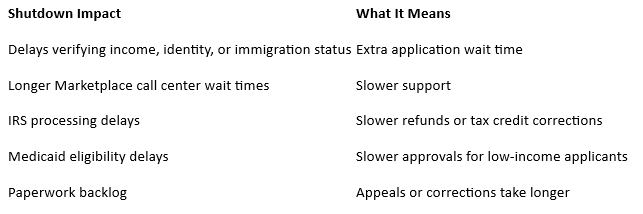
However, Marketplace call centers may experience longer wait times due to reduced staffing. Paper applications, appeals, and Medicaid/CHIP verifications may also be delayed.
Here’s what still works during a shutdown:
Applying for Marketplace coverage online
Renewing a Marketplace plan
Applying for premium tax credits and subsidies
Changing your application due to life events
Uploading documents online
Special Enrollment Period (SEP) applications
What may slow down:
Application processing that requires manual verification
Marketplace call center wait times
Paper applications by mail
Appeals decisions
Will My Health Insurance Be Cancelled If I Miss a Payment During a Shutdown?
No—but insurance companies can still cancel your plan if you miss payments. This has nothing to do with a shutdown; it’s simply how insurance works.
If your insurance company does not receive your portion of the premium (after your tax credits), they can terminate your coverage—even during a shutdown. The Centers for Medicare & Medicaid Services (CMS) explains:
“Consumers must continue to pay their share of premiums on time to maintain coverage.”
— CMS Marketplace Guidelines (source).
What About Medicaid and CHIP During a Shutdown?
Medicaid and CHIP benefits continue during a shutdown, but new applications may face delays depending on the state's processing capacity. Medicaid and CHIP are jointly funded by states and the federal government. Much of this funding is mandatory, so coverage continues even during shutdowns.
However, if you submit an application during a shutdown, states may take longer to approve eligibility, especially if extra documentation is requested.
Does a Shutdown Affect IRS Tax Forms and Reporting?
If you receive a Marketplace tax credit, you must file Form 8962 with your federal taxes to reconcile your subsidy. The IRS continues operating during shutdowns—at least partially.
According to the IRS contingency plan during shutdowns, tax return processing continues, but customer support is limited and refunds may be delayed (IRS source). So tax credit reconciliation continues, but it may take longer to resolve problems.
Should I Update My Marketplace Income During a Shutdown?
Absolutely, yes. This is one of the most important steps to protect your finances. If your income changes and you do not update it, you could owe money back to the IRS later.
Example: If your income goes up mid-year but your Marketplace account isn’t updated, you may receive more tax credits than you're eligible for—meaning you may have to repay the extra amount at tax time.
How Your Coverage Could Still Be Affected
Even though tax credits continue, a shutdown can still affect you in smaller ways:
Steps to Protect Your Coverage During a Government Shutdown
Here are five smart steps to stay covered and avoid problems:
Pay your monthly premium on time
Set up auto-pay if available.
Update income changes right away
Even small income changes can affect tax credit eligibility.
Use HealthCare.gov instead of the call center
Faster and avoids hold times.
Save your tax forms
Form 1095-A is required for taxes—don’t lose it.
Check messages from your insurer
Coverage issues come from insurers, not the Marketplace.
The Bottom Line
A government shutdown does not stop Marketplace insurance or tax credits. Coverage is stable as long as you pay your premium and provide updated income information. The biggest issues during a shutdown are delays—not loss of benefits.
The Affordable Care Act remains in effect, and whether Americans consider it essential or flawed, its Marketplace system is insulated from political disruption—at least in the short term. If you stay informed and proactive, you can protect your health and your wallet even during uncertain political times.
Frequently Asked Questions (FAQ)
Will my Marketplace health insurance stop during a government shutdown?
No. Marketplace plans continue normally.Will my Advance Premium Tax Credit stop during a shutdown?
No. Tax credits are mandatory spending and continue automatically.Can I enroll in Marketplace insurance during a shutdown?
Yes. HealthCare.gov stays open and functional online.Will the Marketplace call center still answer calls?
Yes, but expect longer wait times.Do I still have to file taxes to reconcile my tax credit?
Yes. You must file Form 8962 with your federal tax return.Will Medicaid still work during a shutdown?
Yes, Medicaid and CHIP coverage continue, but new applications may be delayed.Can my insurance be canceled during a shutdown?
Yes—but only if you miss your monthly premium payments.Will shutdowns affect my health insurance tax refund?
Possibly. IRS support and processing can be slower during shutdowns.
Questions? We offer a complimentary 15-minute call to discuss your concerns and explore how we can assist you.
This material was written in collaboration with artificial intelligence (ChatGPT) and derived from sources believed to be correct.
Stordahl Capital Management, Inc is a Registered Investment Adviser. This commentary is solely for informational purposes and reflects the personal opinions, viewpoints, and analyses of Stordahl Capital Management, Inc. and should not be regarded as a description of advisory services or performance returns of any SCM Clients. The views reflected in the commentary are subject to change at any time without notice. Nothing in this piece constitutes investment advice, performance data or any recommendation that any particular security, portfolio of securities, transaction or investment strategy is suitable for any specific person. Any mention of a particular security and related performance data is not a recommendation to buy or sell that security. Advisory services are only offered to clients or prospective clients where Stordahl Capital Management and its representatives are properly licensed or exempt from licensure. No advice may be rendered by Stordahl Capital Management unless a client service agreement is in place. Stordahl Capital Management, Inc provides links for your convenience to websites produced by other providers or industry-related material. Accessing websites through links directs you away from our website. Stordahl Capital Management is not responsible for errors or omissions in the material on third-party websites and does not necessarily approve of or endorse the information provided. Users who gain access to third-party websites may be subject to the copyright and other restrictions on use imposed by those providers and assume responsibility and risk from the use of those websites. Please note that trading instructions through email, fax, or voicemail will not be taken. Your identity and timely retrieval of instructions cannot be guaranteed. Stordahl Capital Management, Inc. manages its clients’ accounts using a variety of investment techniques and strategies, which are not necessarily discussed in the commentary. Investments in securities involve the risk of loss. Past performance is no guarantee of future results.