
AI, the Fed, and What Really Matters for Long-Term Investors
Artificial intelligence has quickly become one of the biggest stories in financial markets. Investors are trying to determine which companies will benefit, which jobs may be disrupted, how much businesses will spend building AI infrastructure, and whether today's enormous investments will ultimately pay off.
At the same time, the Federal Reserve is dealing with a much more immediate problem: inflation remains above its 2% target, while policymakers are trying to avoid unnecessarily slowing the economy.
These may seem like two separate stories. They aren't.
The connection is productivity.
If AI allows businesses and workers to produce more with the same resources, it could eventually lead to faster economic growth, rising wages, and less inflationary pressure than we would otherwise expect.
That's the long-term possibility. Getting there, however, is unlikely to happen in a straight line.
Why Productivity Matters So Much
Economic growth can come from adding more workers, building more factories, or buying more equipment. But the kind of growth that really changes living standards comes from figuring out how to produce more with what we already have.
Economists call that productivity.
Think about the technological changes of the past several decades. Personal computers, the internet, smartphones, cloud computing, and increasingly sophisticated software didn't simply give businesses new things to buy. They changed how people worked.
The important question surrounding AI isn't simply whether companies will spend hundreds of billions of dollars developing it. It's whether AI eventually allows millions of workers to become more productive.
That's a much bigger question.
AI could help a doctor analyze information more quickly, allow an engineer to test ideas faster, help a financial analyst work through enormous amounts of data, or automate routine tasks that consume hours of an employee's week.
In each case, the value isn't necessarily replacing the worker. It's increasing what that worker can accomplish.
The source commentary notes that current evidence does not yet establish the science-fiction version of AI replacing information workers wholesale. There are already examples of companies rehiring workers after earlier reductions tied to expectations about AI.
Technological Revolutions Take Time
This is where history provides some useful perspective.
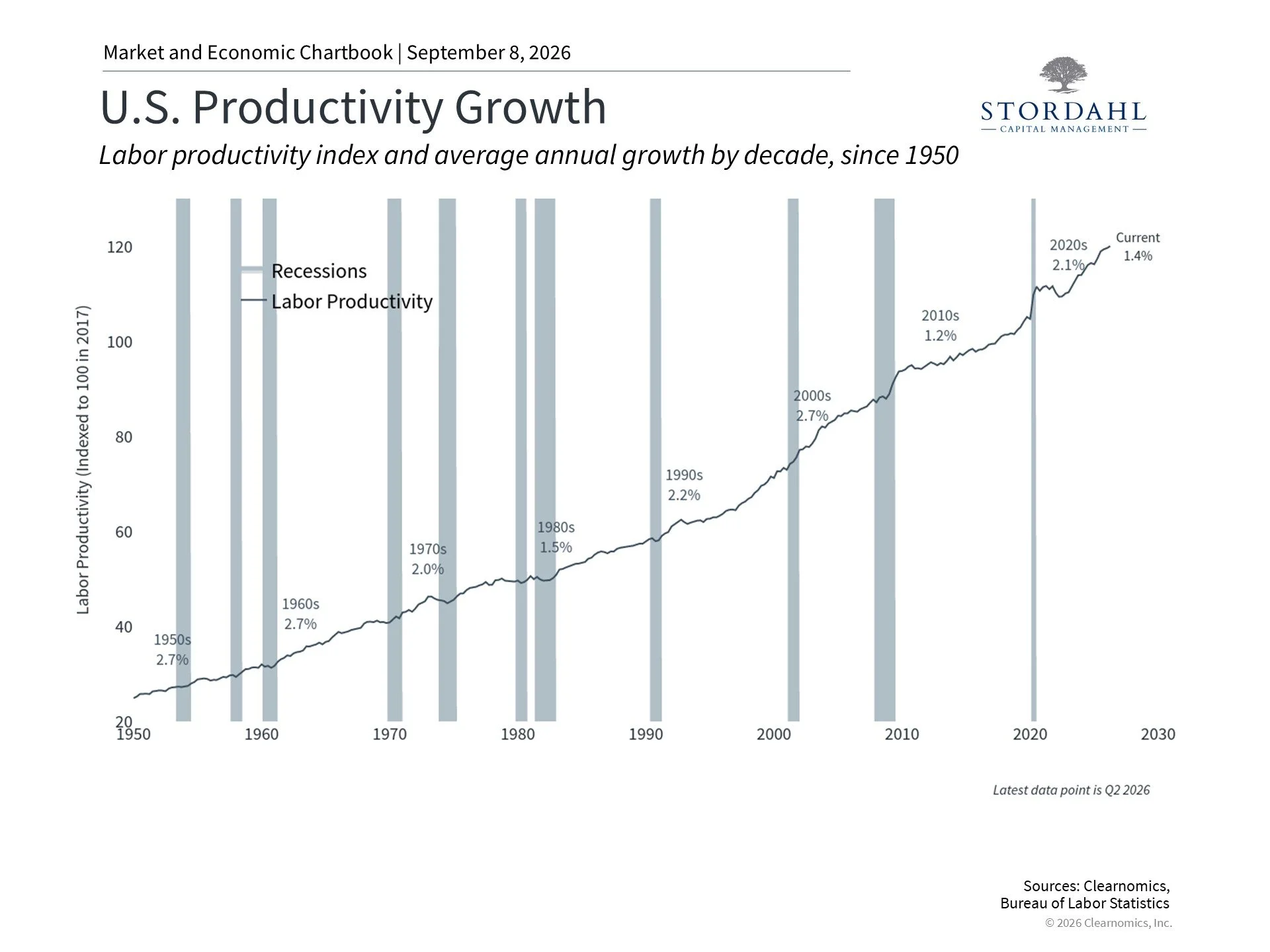
Take a close look at the chart above.
Productivity growth has varied significantly from decade to decade. Importantly, the economic benefits of major technological advances haven't always appeared immediately. The productivity acceleration associated with the technology boom of the 1990s took time to develop.
That should give investors some humility when thinking about AI.
We may be witnessing a technology that fundamentally changes the economy. We may also be overestimating how quickly those changes will occur, underestimating the costs required to implement them, or simply guessing incorrectly about which companies will ultimately capture the benefits.
All of those things can be true at the same time.
The internet changed the world. That didn't mean every internet company was a good investment.
AI may follow a similar pattern. The economic impact could ultimately be enormous while the investment results for individual companies vary dramatically.
Where the Fed Fits In
The Federal Reserve's immediate concern is much less futuristic.
Inflation remains above target. The source commentary reports year-over-year PCE inflation of 3.7% and core PCE of 3.3%, with higher energy prices among the factors complicating the inflation picture.
That creates a difficult balancing act for the Fed.
Keep interest rates too low and inflation could remain elevated. Raise them too aggressively and policymakers risk slowing economic growth more than necessary.
Markets naturally obsess over what comes next. Will the Fed raise rates? How many times? What will the next inflation report show?
Those questions can move markets significantly in the short run. Expectations can also change remarkably quickly as new economic data arrives.
But AI introduces an interesting longer-term possibility.
Technology is often deflationary. If a business can produce more with fewer resources, the cost of producing each unit can fall. If that occurs throughout the economy, stronger productivity could allow the economy to grow faster without generating the same amount of inflation.
In other words, AI could eventually make the Fed's job easier.
Eventually is the important word.
AI Doesn't Eliminate the Economic Cycle
There is a temptation whenever a transformative technology emerges to assume that the old economic rules no longer apply.
We've seen versions of this before.
New technology can increase productivity, create industries, eliminate others, and generate enormous wealth. But businesses still have to earn profits. Consumers still respond to prices. Interest rates still matter. Recessions still happen. And investors can still pay too much for a great company.
The current labor market illustrates some of that complexity.
Despite concerns about AI-related layoffs, unemployment remains historically low at 4.1%, according to the source data, while year-over-year wage growth remains positive. At the same time, the supply of available workers has been growing slowly as the population ages and labor-force participation has declined.
So when we hear that AI is going to "replace workers," the actual economic picture is considerably more complicated.
AI may eliminate certain tasks and some jobs. It may change the skills employers need. It may also make existing workers more valuable, create entirely new categories of employment, and help an aging economy produce more with a slower-growing workforce.
We don't know yet.
And investors shouldn't need to know exactly how it unfolds to have a successful investment strategy.
Investors Don't Need to Predict the AI Winners
This may be the most important point.
Whenever a new technology captures the public imagination, investors understandably want to find the winner.
Which AI company will dominate?
Which semiconductor company will benefit most?
Which software companies will be disrupted?
Which businesses will become dramatically more profitable because of AI?
There will eventually be answers to those questions. The problem is that today's stock prices already incorporate enormous expectations about what those answers might be.
Being right that AI will transform the economy isn't the same as being right about which investment will produce the best return.
That's one of the advantages of diversification.
A broadly diversified investor doesn't need to identify the one company that will win the AI race. As successful companies grow and become more valuable, investors can participate in that growth through the market.
There will be winners. There will be losers. There will probably be companies that don't exist today that become enormously important 10 or 20 years from now.
We don't have to identify all of them in advance.
The Long-Term Story Is Bigger Than the Next Fed Meeting
Financial markets will continue reacting to every inflation report, employment number, Fed speech, AI announcement, and earnings report.
That's what markets do.
But for someone investing for retirement over the next 10, 20, or 30 years, the more important question isn't whether the Fed raises rates at its next meeting.
It's whether the economy continues finding ways to become more productive.
That's ultimately what allows businesses to grow, wages to rise, living standards to improve, and the economy to create more value over time.
AI could become an important part of that story. It could also develop in ways none of us can predict today.
For investors, that doesn't require a dramatic change in strategy. It requires perspective.
Participate in economic growth through a diversified portfolio. Avoid making your financial future dependent on predicting which technology, company, or Fed decision comes next. And remember that some of the most important economic changes unfold over decades, not quarters.
The headlines will focus on what AI or the Fed might do next.
Your financial plan should remain focused on what you're trying to accomplish over the rest of your life.
If you'd like to talk about how your investment strategy fits into your broader financial plan, we'd be happy to help. Schedule a complimentary 15-minute call.
A Weekly Perspective on Planning and Markets
Each week, we share The Week in Review — a short collection of articles on
financial planning and wealth management, along with a brief overview for context.
One email per week. No promotions, no sales – just clarity.
This material was written in collaboration with artificial intelligence (ChatGPT) and derived from sources believed to be correct.
Stordahl Capital Management, Inc is a Registered Investment Adviser. This commentary is solely for informational purposes and reflects the personal opinions, viewpoints, and analyses of Stordahl Capital Management, Inc. and should not be regarded as a description of advisory services or performance returns of any SCM Clients. The views reflected in the commentary are subject to change at any time without notice. Nothing in this piece constitutes investment advice, performance data or any recommendation that any particular security, portfolio of securities, transaction or investment strategy is suitable for any specific person. Any mention of a particular security and related performance data is not a recommendation to buy or sell that security. Advisory services are only offered to clients or prospective clients where Stordahl Capital Management and its representatives are properly licensed or exempt from licensure. No advice may be rendered by Stordahl Capital Management unless a client service agreement is in place. Stordahl Capital Management, Inc provides links for your convenience to websites produced by other providers or industry-related material. Accessing websites through links directs you away from our website. Stordahl Capital Management is not responsible for errors or omissions in the material on third-party websites and does not necessarily approve of or endorse the information provided. Users who gain access to third-party websites may be subject to the copyright and other restrictions on use imposed by those providers and assume responsibility and risk from the use of those websites. Please note that trading instructions through email, fax, or voicemail will not be taken. Your identity and timely retrieval of instructions cannot be guaranteed. Stordahl Capital Management, Inc. manages its clients’ accounts using a variety of investment techniques and strategies, which are not necessarily discussed in the commentary. Investments in securities involve the risk of loss. Past performance is no guarantee of future results.
Copyright (c) 2024 Clearnomics, Inc. All rights reserved. The information contained herein has been obtained from sources believed to be reliable, but is not necessarily complete and its accuracy cannot be guaranteed. No representation or warranty, express or implied, is made as to the fairness, accuracy, completeness, or correctness of the information and opinions contained herein. The views and the other information provided are subject to change without notice. All reports posted on or via www.clearnomics.com or any affiliated websites, applications, or services are issued without regard to the specific investment objectives, financial situation, or particular needs of any specific recipient and are not to be construed as a solicitation or an offer to buy or sell any securities or related financial instruments. Past performance is not necessarily a guide to future results. Company fundamentals and earnings may be mentioned occasionally, but should not be construed as a recommendation to buy, sell, or hold the company's stock. Predictions, forecasts, and estimates for any and all markets should not be construed as recommendations to buy, sell, or hold any security--including mutual funds, futures contracts, and exchange traded funds, or any similar instruments. The text, images, and other materials contained or displayed in this report are proprietary to Clearnomics, Inc. and constitute valuable intellectual property. All unauthorized reproduction or other use of material from Clearnomics, Inc. shall be deemed willful infringement(s) of this copyright and other proprietary and intellectual property rights, including but not limited to, rights of privacy. Clearnomics, Inc. expressly reserves all rights in connection with its intellectual property, including without limitation the right to block the transfer of its products and services and/or to track usage thereof, through electronic tracking technology, and all other lawful means, now known or hereafter devised. Clearnomics, Inc. reserves the right, without further notice, to pursue to the fullest extent allowed by the law any and all criminal and civil remedies for the violation of its rights.